
• Skip to main content
  • Skip to secondary menu
  • Skip to primary sidebar
  • Skip to footer
Geographical

Geographical

Official magazine of the Royal Geographical Society (with IBG)

  • Geographical Home
  • News
  • Features
  • Opinion
    • Climatewatch
    • Front Lines
  • Podcast
  • Travel
    • Discovering Britain
    • Passport
  • Culture
    • Book reviews
  • Quizzes
    • Crosswords
  • Choose Geography
    • University directory
    • Masters courses
    • Course guides
      • Climate change
      • Environmental science
      • Human geography
      • Physical geography
    • University pages
      • Aberystwyth University
      • Brunel University
      • Cardiff University
      • University of Chester
      • Edge Hill University
      • The University of Edinburgh
      • Newcastle University
      • Nottingham Trent University
      • Oxford Brookes University
      • The University of Plymouth
      • Queen Mary University of London
    • Geography careers
      • Charity/non-profit
      • Education & research
      • Environment
      • Finance & consulting
      • Government and Local Government
    • Applications and advice
  • Magazine
    • Issue previews
    • Subscribe
    • Manage My Subscription
    • Special Editions
    • Geographical Archive
    • Advertise with us
  • Subscribe
    • Direct Debit Changes

Ocean acidification is ruining social life of reef fish, study finds

22 May 2026
3 minutes

Koheru (Decapterus koheru) schooling fish underwater
A shoal of koheru (Decapterus koheru). Image: Shutterstock

Fish are becoming part of smaller shoals, which offer less protection to individuals, as ocean pH becomes more acidic


By Victoria Heath

Ocean acidification is making reef habitats less complex and causing fish to gather in smaller shoals that offer less social protection, a study from Adelaide University has revealed.

Fish often move and feed in groups, as well as react to danger collectively. ‘For small reef fish, a shoal is a survival strategy – more eyes spot predators sooner, more bodies mean any one fish is less likely to be the unlucky one,’ said lead author Dr Angus Mitchell from Adelaide University.


Enjoying this article? Check out our related reads…

  • The world’s biggest coral reefs – and why they’re so important
  • Geo explainer: The threats to coral reefs
  • Listening to shrimp is an effective tool to monitor coral reef health, study finds
  • The business of conservation: Wakatobi Dive Resort
  • Climate extremes triggered rare coral disease and mass mortality on the Great Barrier Reef

‘Fish in bigger groups tend to be bolder, as they forage more efficiently, stay out in the open more, and spend less time hiding,’ said Dr Mitchell, whose study was published in the Journal of Animal Ecology.

Mitchell’s study found that the size of a fish shoal affects both their collective and individual behaviour. Crucially, the study found that these changes in behaviour were not attributable to the direct impacts of higher temperatures and lower pH.

‘Across all reef types, even during a heatwave, the fish behaved in much the same way. They kept feeding. They did not suddenly become more active,’ said Mitchell.
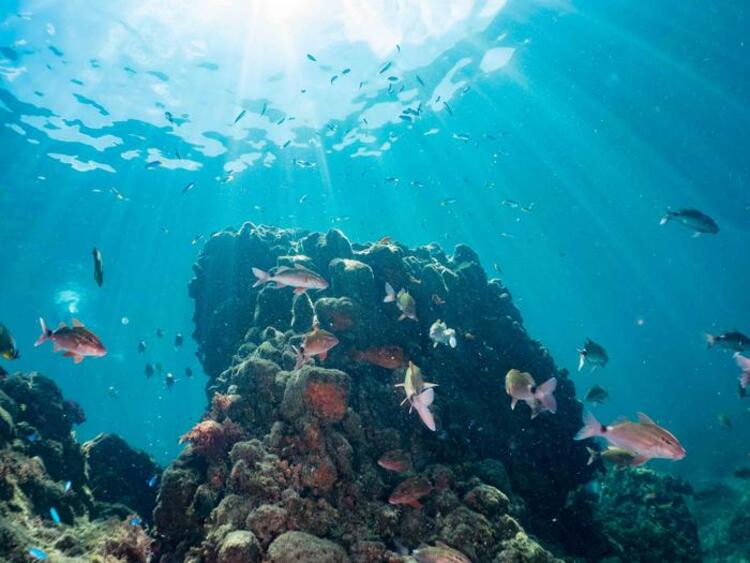
The size of a fish shoal affects their collective and individual behaviour
The size of a fish shoal affects both collective and individual behaviour of fish. Image: Getty/d3–plus d. Naruse

The authors of the study said that while studies looking into direct impacts of climate change on the environment are important, the broader context should also be considered when assessing climate change impacts.

‘In the real world, fish do not experience climate change in isolation; they experience it as members of communities, shaped by the habitat around them and the other individuals they live alongside,’ he said.

‘Our results suggest that even when individual fish seem to be coping fine behaviourally under climate stress, the social structures supporting their behavioural expression can quietly fall apart.’

How bad is ocean acidification?

Ocean acidification is often coined as climate change’s ‘evil twin’ due to the harm it can cause. The process arises because of excess carbon dioxide in the atmosphere dissolving into the world’s seas, making water more acidic. Ocean carbon dioxide concentrations are now higher than at any time during the past 800,000 years, with the current rate of increase likely unprecedented.

Every day, the world’s oceans absorb around 22 million tons of carbon dioxide from the atmosphere, with significant consequences for marine life and ecosystems alike. Some marine species may be able to adapt to more extreme changes, but many will likely suffer, and some will go entirely extinct.

Ocean acidification causes problems particularly for species including oysters, clams, lobsters, shrimps and coral reefs, as acidic conditions eat away at the minerals they use to build shells and skeletons. In the waters off Scotland and Norway, as well as the Caribbean and Great Barrier Reef, more acidic waters are weakening coral structures and reducing habitat for fish and the resilience of the entire reef system. Weaker coral structures also lessen the support that they can provide for storm protection.

In addition, ocean acidification also affects society. Many jobs and economies around the world rely on the fish and shellfish that live in the ocean. Decreasing harvests could hurt the least developed nations, leading to social disruption and even conflict.
Themes News Marine wildlife Oceans

Protected by Copyscape

Primary Sidebar

SUMMER SALE

GEOGRAPHICAL WEEKLY LOGO FREE - Sign up to get context, clarity and perspective in a noisy world, every Friday

Popular Now

Floating island in Canada

The newly-discovered Canadian island that appeared to vanish

QUIZ: Country Shapes – Hard

QUIZ: Country Shapes – Hard

Mosquito close up

Invasive tropical mosquito species detected in London

Industrial waste flowing into a waterway

The whistleblower who says England’s pollution watchdog buried the evidence

QUIZ: Geography Extremes

QUIZ: Geography Extremes

Footer

  • Facebook
  • Instagram
  • LinkedIn
  • Reddit
  • TikTok
  • Twitter
  • YouTube

Geographical print magazine cover

Published in the UK since 1935, Geographical is the official magazine of the Royal Geographical Society (with IBG).

Informative, authoritative and educational, this site’s content covers a wide range of subject areas, including geography, culture, wildlife and exploration, illustrated with superb photography.

Click Here for SUBSCRIPTION details

Want to access Geographical on your tablet or smartphone? Press the Apple, Android or PC/Mac image below to download the app for your device

Footer Apple Footer Android Footer Mac-PC

More from Geographical

  • Subscriptions
  • Get our Newsletter
  • About Us
  • Contact Us
  • Advertise with us
  • Privacy policy
  • Terms & Conditions

Copyright © 2026 · Site by Syon Media