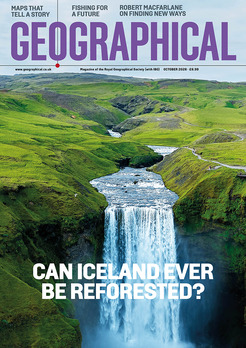
In this month’s issue, venture to Iceland, South Sudan, Alaska and more…
In our October cover story, Stuart Butler investigates whether Iceland’s terrain can be returned to its pre-Viking forested glory. Jonathan Lorie speaks to author Robert Macfarlane on how our relationship with the natural world can be one of hope, while Kate Plummer heads to South Sudan to report from the Gorom Refugee Settlement, where LGBTQ+ refugees describe the violence and discrimination they face after fleeing persecution elsewhere in East Africa.
Tom Parfitt follows the fight to save Alaska’s salmon, while in Namibia, Tommy Trenchard considers how to protect Cape fur seals and a valuable hake fishery. Elsewhere, Peter Keating looks at the power of maps and how they shape our understanding of the world.
Our columnists bring an array of topics to the forefront to help you stay on top of the world: Tim Marshall discusses how names of nations are imbued with history, identity and politics; Andrew Brooks looks at the complex geography behind some of our most familiar lagers, while Marco Magrini considers how the race to build data centres in space is gathering pace, even as mounting doubts appear over their cost, feasibility and environmental impact.
Our digital edition is out now, too, giving you access to all the stories in our latest issue, plus our full archive dating back to 1935, with hundreds of magazines to explore. Digital access is available through the Geographical app, and you can now enable notifications to be alerted the moment the latest issue is live. And if you want to enjoy our beautifully designed and produced print magazine, we can post the next edition to you anywhere in the world. Join us and stay on top of the world.
A geography of hope

Robert Macfarlane has spent more than two decades putting himself ‘in the way of places, people and ideas’. From climbing mountains and kayaking wild rivers to venturing into nuclear-waste bunkers, the award-winning writer has built a career exploring our relationship with the natural world – and asking what we risk losing.
His journey began with Mountains of the Mind, the 2003 bestseller that explored our fascination with high places and helped establish Macfarlane as a leading voice in what became known as ‘new nature writing’. Since then, books including The Wild Places, The Old Ways and Underland have taken him across landscapes both familiar and remote, combining adventure, history, literature and environmental thought.
His work has increasingly turned towards collaboration and environmental action. The Lost Words, created with illustrator Jackie Morris, sought to reconnect children with disappearing words for nature, while his recent Is a River Alive? follows campaigners fighting to protect threatened rivers in Ecuador, India and Canada.
Amid accelerating environmental loss, Macfarlane remains determined to find what he calls ‘a geography of hope’ – and new ways of imagining our place within the living world.
Fishing for answers
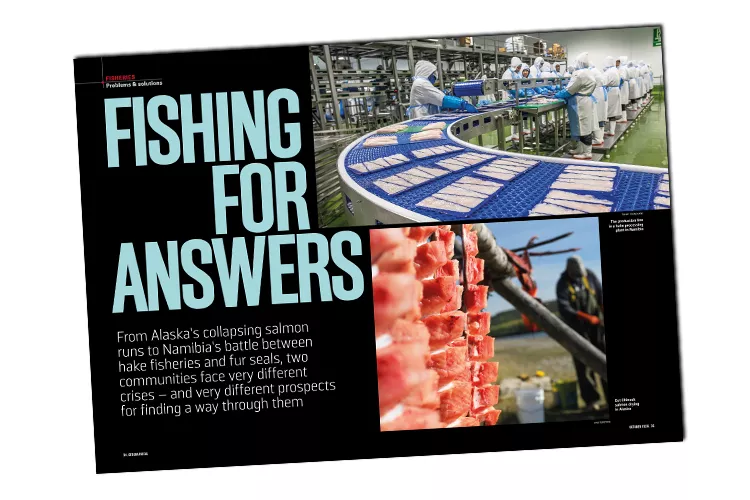
Deep in Alaska’s interior, the disappearance of salmon from the Yukon River and its tributaries is threatening far more than a source of food. For generations, Native Koyukon communities have gathered at riverside fish camps, where families caught and processed salmon, passed down skills and stories, and prepared for the long winter.
But salmon numbers have collapsed, particularly Chinook, prompting Alaska and Canada to introduce a seven-year fishing moratorium in 2024. For communities such as Huslia, the restrictions have accelerated the loss of a way of life stretching back thousands of years.
Scientists point to warming waters, industrial fishing, parasites, competition from hatchery fish and mining among the pressures facing salmon. Meanwhile, plans for the 340-kilometre Ambler Road have raised fresh concerns about river habitats.
Amid uncertainty over whether salmon populations can recover, Koyukon residents are fighting to protect a fish inseparable from their culture, identity and survival.
Can Iceland’s stark terrain be returned to its pre-Viking forested glory?
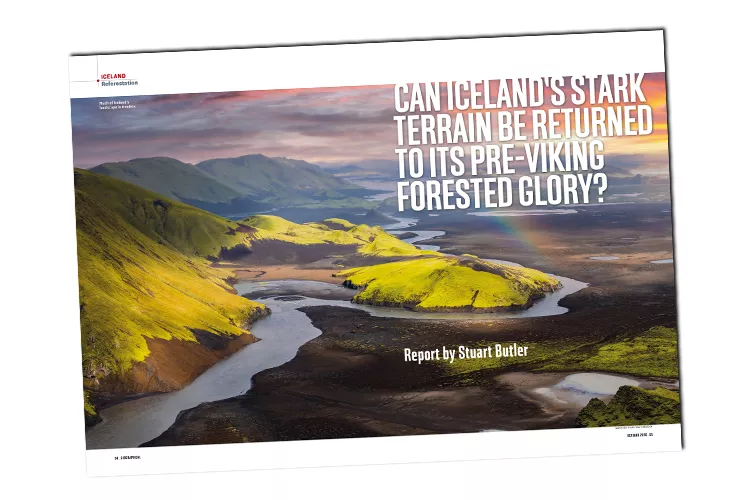
When the Vikings arrived in Iceland more than 1,000 years ago, forests may have covered up to 40 per cent of the island. Within centuries, settlers had felled much of the woodland for fuel, building and grazing, leaving exposed soils vulnerable to Iceland’s fierce winds and rain. Today, forests cover just one per cent of the country.
Now, Iceland is trying to turn the clock back. From individuals planting thousands of trees by hand to the vast Hekluskógar Reforestation Project, efforts are under way to restore forests, tackle soil erosion and create new habitats for wildlife. The challenge is formidable. Poor soils, free-ranging sheep and a harsh climate make it difficult for saplings to survive, while climate change is increasing tree mortality. Even the invasive Nootka lupin has become part of the debate over how best to restore damaged land.
Stuart Butler investigates in this in-depth feature whether Iceland could become a land of forests once again.
Maps that shaped the world
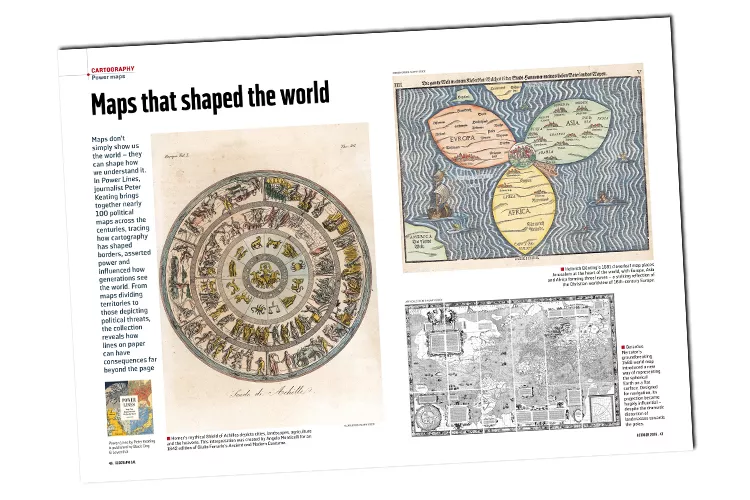
Maps don’t simply show us the world – they can shape how we understand it. In Power Lines, journalist Peter Keating brings together nearly 100 political maps from across the centuries to explore how cartography has been used to define borders, project power and influence public opinion.
From maps dividing disputed territories to those portraying enemies and political threats, the collection demonstrates that seemingly simple lines, colours and symbols are rarely neutral. Instead, they can reflect the ambitions, fears and prejudices of the societies that created them. Keating reveals how maps have helped shape political realities and continue to influence how we see the world today.
What’s in a name?
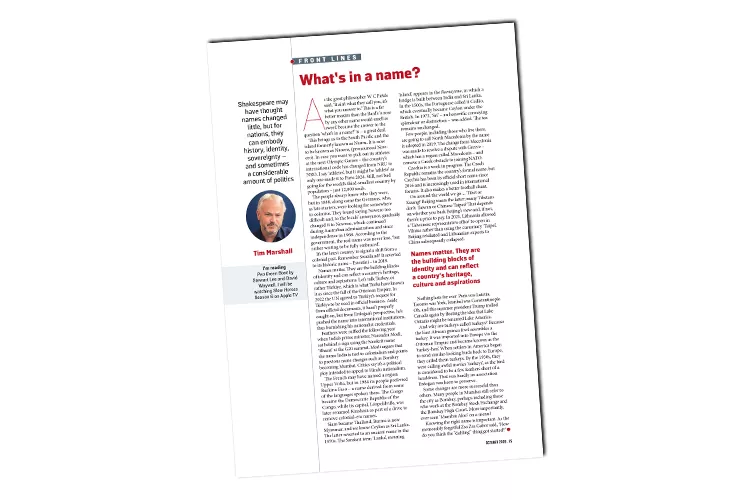
Tim Marshall explores what’s really in a name, and why the names we give countries and places can reveal far more than their location on a map.
From Nauru reclaiming its Indigenous name, Naoero, to Swaziland becoming Eswatini and Ceylon becoming Sri Lanka, countries have long renamed themselves to reflect their history, identity and political ambitions. Türkiye, meanwhile, has pushed for international recognition of the name its people have long used. Elsewhere, the question is more contentious. Narendra Modi’s use of ‘Bharat’ has fuelled debate over India’s colonial past and Hindu nationalism, while Beijing’s preference for Xizang over Tibet and disputes surrounding the name Taiwan show how language can become entangled with sovereignty and power.
From North Macedonia to Czechia, Tim Marshall reveals why names are far more than labels. They can reclaim heritage, reinforce national identity, settle diplomatic disputes – and sometimes create entirely new ones.
No safe haven
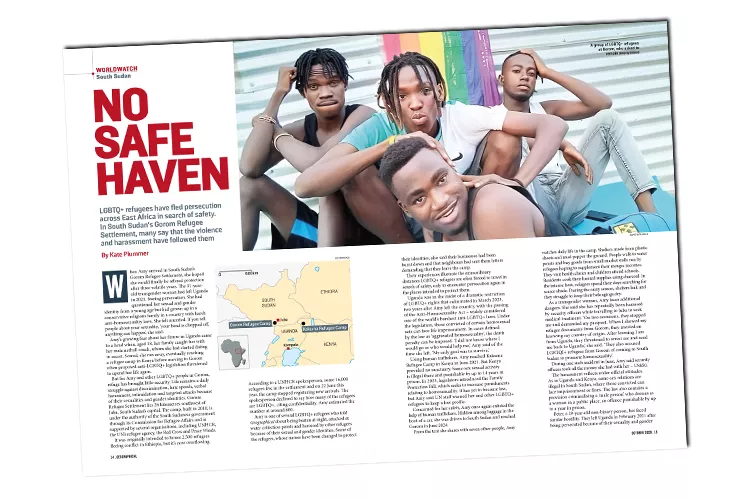
Kate Plummer investigates the plight of LGBTQ+ refugees in South Sudan’s Gorom Refugee Settlement, where people who have travelled thousands of kilometres in search of safety are finding themselves facing persecution once again.
Among them is Amy, a 31-year-old transgender woman who fled Uganda in 2021, fearing violence because of her sexuality and gender identity. After travelling to Kenya, she eventually reached Gorom, but life in the overcrowded settlement has brought new dangers, including harassment, discrimination and physical attacks. Other LGBTQ+ refugees describe being assaulted, threatened and driven from their shelters, highlighting the extraordinary difficulties facing those who escape countries where same-sex relationships are criminalised, only to seek refuge in places with similar laws.
Gorom now houses around 16,000 refugees, despite being built for 2,500. While UNHCR says it works to protect vulnerable residents, refugees describe difficulties accessing help. With resettlement overseas available to only a fortunate few, Plummer examines what happens when a supposed place of sanctuary offers little escape from fear.