
Discover more about how clouds display an array of vivid colours under a certain set of conditions
By
Clouds are usually white or grey, but under the right conditions, they can display patches of pink, green, blue and violet. These colours sometimes follow the edges of a cloud, or spread across it in irregular bands, giving it an appearance similar to mother-of-pearl.
The colours form when sunlight encounters tiny water droplets or ice crystals in the cloud and spreads around them through a process called diffraction. Different wavelengths of light spread by different amounts. As the light waves overlap, they reinforce or cancel one another, separating the sunlight into bands of colour.
For a clear display to form, the droplets or crystals within each part of the cloud need to be small and similar in size. If their sizes vary too much, the colour patterns overlap and become washed out. The cloud must also be thin enough for light to pass through without being scattered repeatedly.
This is why iridescence is often most visible along cloud edges.
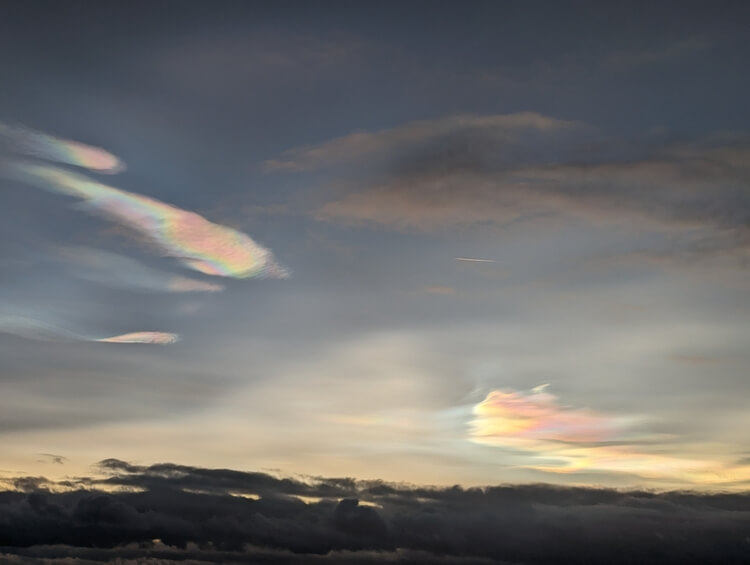
Newly forming clouds can produce particularly vivid colours. Their droplets have formed under similar conditions and have had little time to grow to different sizes. As the cloud develops, the colours can change or disappear.
When particles are similar in size across a larger area, they can produce coloured rings around the Sun or Moon, known as a corona.
Although cloud iridescence is fairly common, it can be difficult to see because it often appears close to the Sun, where the glare overwhelms the colours. Keeping the Sun hidden behind a building can make them easier to distinguish. The effect can also occur in moonlight, although the colours are generally much fainter.
In December 1884, brightly coloured clouds seen over Britain prompted a series of letters to the journal Nature. Observers disagreed over whether the displays were unusual or simply examples of a familiar effect.
C Michie Smith, writing from India in January 1885, said that he had seen similar clouds several times before. There, he reported, they usually appeared before the monsoon and were taken as a sign that it was approaching. Other observers argued that the British displays were different from ordinary iridescence.
Enjoying this article? Check out our related reads…
Without photographs, written descriptions left considerable room for disagreement.
Today, scientists can use the colours to estimate particle sizes within a cloud and study how they change as it develops. Scientists have also used this approach on Mars, where NASA’s Curiosity rover photographed a feather-shaped iridescent cloud in January 2023.
Most Martian clouds are made of water ice, but this one appeared to be higher in the atmosphere, where temperatures are lower. This suggested that it was made of frozen carbon dioxide. By studying the changing colours across such clouds, researchers can learn more about how ice particles form and grow in the Martian atmosphere.