A poorly monitored market for stingray leather is raising fresh concerns for threatened marine species
By Bryony Cottam
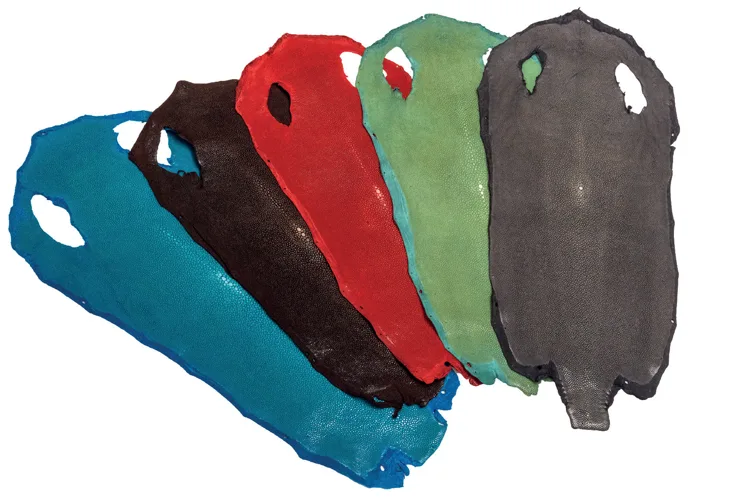
Rima Jabado was at a marine conservation workshop in Malaysia when she first realised that a growing threat to marine life was unfolding entirely under the radar. The conversation kept turning to galuchat, a luxury leather crafted from the skin of sharks and rays – most commonly, stingrays. Several attendees pulled out their wallets to show her examples.
Soon after, at another conference in New Zealand, delegates approached to tell her about the stingray skin products they’d seen for sale, and the stingray skin chandeliers hanging in a restaurant where they’d just eaten.
Jabado, who chairs the IUCN Species Survival Commission Shark Specialist Group, began to understand that this was more than just a niche market – ‘and it was something we hadn’t been talking about at all.’
In conservation, ‘sharks’ is often used as a catchall term for elasmobranchs – a group that includes both sharks and rays. ‘I think that has done a major disservice to rays,’ says Jabado, adding that for decades, international funding, monitoring, and protective measures focused almost exclusively on sharks – and on the lucrative trade in shark fins.
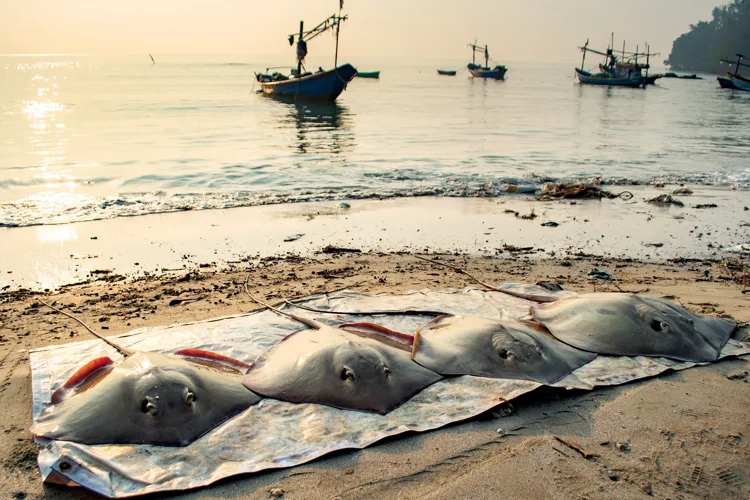
But the reality is that rays account for the majority of at-risk elasmobranchs, with more than a third of all ray species now threatened with extinction. Their recovery is hampered by their biology; some rays take up to 15 years to mature and produce only a single pup per litter.
Jabado began reaching out to other marine scientists and conducting her own research to determine which species were entering the galuchat supply chain and where. With virtually no published data to rely on, and processed skins nearly impossible to identify without DNA testing, the work became an investigative effort to piece together a hidden trade.
So far, she has established that at least 29 ray species are being sourced for galuchat. Two of the most popular are the whitespotted whipray (Maculabatis gerrardi) and Jenkins’ whipray (Pateobatis jenkinsii), both classified as Endangered on the IUCN Red List. ‘Seventy per cent of the species on that list are threatened with extinction,’ says Jabado.
‘None of them are listed by CITES.’
Even though galuchat is only now emerging as a threat to ray conservation, its use is centuries old – Japanese swordmakers prized ray skin as a tough, hard-wearing material for covering sword hilts and dagger grips. This durability comes from dermal denticles – tiny, tooth-like structures made of dentine and enameloid that cover the skin of certain species of rays and sharks like a flexible coat of armour.
The material eventually travelled along trade routes to Europe, where craftsmen found its abrasive, calcified surface notoriously difficult to work. That changed in the 18th century when French leatherworker Jean- Claude Galluchat discovered a tanning technique for softening the skins, in which he would sand down the hard denticles with pumice stone and dye the material in vibrant shades.
His bespoke creations quickly caught the attention of King Louis XV and his influential mistress Madame de Pompadour, making galuchat the height of French court fashion – and giving the leather its name.

Today, galuchat – also known as shagreen and, more simply, stingray leather – has been used by fashion houses such as Chanel and Alexander McQueen to make shoes and bags. But it has also entered the mainstream market.
‘If you go onto Etsy or eBay, or you search for stingray skin leather, you’ll find millions of products to buy that are made from galuchat,’ says Jabado. ‘I don’t think anybody has realised the scale at which it’s being traded around the world.’
International oversight should come from the Convention on International Trade in Endangered Species of Wild Fauna and Flora (CITES), which aims to ensure global wildlife trade doesn’t threaten species survival. Without CITES listings, international trade in these rays is not subject to the convention’s permit and reporting requirements.
As a result, Jabado explains, ray skins are currently exported and imported under broad, vague classifications such as ‘fish leather’ or ‘fish skin’, rather than by individual species names.
Most rays are benthic, living on or near the ocean floor, which makes them vulnerable to bottom trawling and bottom-set nets. Most are caught as incidental bycatch; historically there hasn’t been much of a market for their meat. Nevertheless, they are caught in vast numbers across shallow, tropical waters, particularly in the Indo-Pacific and western Indian Ocean, where ray populations and fishing pressure are most concentrated.
A 2024 report led by WWF Indonesia notes that Indonesia is the world’s largest shark- and ray-fishing nation, with rays accounting for about 60 per cent of the country’s total elasmobranch landings. However, gauging the true number of rays being caught is nearly impossible; fisheries data for elasmobranchs are rarely broken down by species groups – let alone by individual ray species.
While galuchat may once have been a way to use up bycatch that would otherwise go to waste, Jabado fears its growing popularity is now incentivising fishers to target rays directly.
‘I know that there are some fisheries, specifically in the Western Indian Ocean, India, and Bangladesh, that are now targeting the rays specifically for the skin because they can make so much money.’
That financial incentive is illustrated by a 2020 study by Indonesian researchers Latif Sahubawa and Ambar Pertiwiningrum, which found that while fishers made a tiny profit on stingray meat – roughly 4,000–5,000 Indonesian rupiah (16–21 pence) per kilogram – a single small whitespotted whipray skin could be sold for 60,000–75,000 rupiah (£2.46–£3.08), with larger hides fetching up to 125,000 rupiah (£5.13).
Ahead of the next biannual CITES meeting in Panama in 2028, Jabado is building scientific consensus among international delegates to secure listing for the ray species on her list. As it stands, she believes that everything known about ray biology points to a clear conclusion: the galuchat trade is unsustainable.