
• Skip to main content
  • Skip to secondary menu
  • Skip to primary sidebar
  • Skip to footer
Geographical

Geographical

Official magazine of the Royal Geographical Society (with IBG)

  • Home
  • Briefing
  • Science & Environment
  • Climate
    • Climatewatch
  • Wildlife
  • Culture
  • Geopolitics
    • Geopolitical hotspots
  • Study Geography
    • University directory
    • Masters courses
    • Course guides
      • Climate change
      • Environmental science
      • Human geography
      • Physical geography
    • University pages
      • Aberystwyth University
      • Brunel University
      • Cardiff University
      • University of Chester
      • Edge Hill University
      • The University of Edinburgh
      • Newcastle University
      • Nottingham Trent University
      • Oxford Brookes University
      • The University of Plymouth
      • Queen Mary University of London
    • Geography careers
      • Charity/non-profit
      • Education & research
      • Environment
      • Finance & consulting
      • Government and Local Government
    • Applications and advice
  • Quizzes
  • Magazine
    • Issue previews
    • Subscribe
    • Manage My Subscription
    • Special Editions
    • Podcasts
    • Geographical Archive
    • Book reviews
    • Crosswords
    • Advertise with us
  • Subscribe
    • Direct Debit Changes

Climate extremes triggered rare coral disease and mass mortality on the Great Barrier Reef

12 December 2025
3 minutes

Black band disease
Black band disease in coral. Image: Shutterstock

New study suggests climate change is happening too quickly for corals to adjust


By Victoria Heath

Scientists at the University of Sydney have identified a devastating combination of coral bleaching and a rare necrotic wasting disease that wiped out large, long-lived corals on the Great Barrier Reef during the record 2024 marine heatwave.

The study, published in Proceedings of the Royal Society B, found that bleaching triggered by high ocean temperatures was followed by an unprecedented outbreak of black band disease, which killed vast swathes ofGoniopora corals, also known as flowerpot or daisy coral, at One Tree Reef on the southern Great Barrier Reef.


Enjoying this article? Check out our related reads…

  • ‘Catastrophic’ mass bleaching event hit Great Barrier Reef in 2024, study finds
  • Geo explainer: The threats to coral reefs
  • Great Barrier Reef’s coral cover has sharply declined, new study finds
  • The world’s biggest coral reefs – and why they’re so important
  • Listening to shrimp is an effective tool to monitor coral reef health, study finds

‘This research shows that the compounding impact of disease – which appeared after the onset of bleaching – is what killed the Goniopora. These are very long-lived corals that would normally survive bleaching,’ said Professor Byrne, a professor of marine biology in the School of Life and Environmental Sciences.

The team tracked 112 Goniopora colonies across a year, finding that three-quarters had died by October 2024, while only one quarter showed partial recovery. Surveys of more than 700 colonies showed the same pattern – widespread bleaching, the presence of black band disease and high incidences of mortality.

Black band disease is a bacterial infection able to infect living coral, forming a black band that crosses the infected coral, usually killing the colony. While common in Caribbean reefs, it is rare to see in Australian waters. Its sudden appearance in One Tree Reef’s marked the first recorded epidemic event of this kind on the Great Barrier Reef.
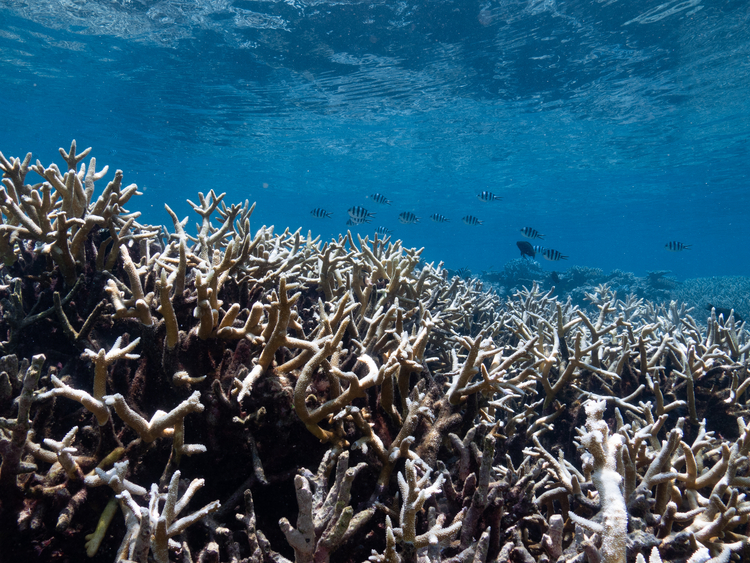
coral bleaching in Australia
Coral bleaching in the Great Barrier Reef. Image: Shutterstock

The 2024 El Niño weather event brought the highest sea temperatures on record to the Great Barrier Reef, with marine heatwave conditions lingering for months. During this time, 75 per cent of Goniopora colonies at One Tree Reef bleached. Initially, just four per cent showed signs of black band disease – by April, however, the disease had spread to more than half the bleached colonies.

‘Normally these massive corals withstand environmental stress, but the combination of record heat and infection was catastrophic,’ said Dr Shawna Foo, an ARC DECRA Fellow in the School of Life and Environmental Sciences. ‘It’s a stark example of how multiple stressors can act together to undermine reef resilience.’

Such findings highlight the importance of long-term in-water monitoring made possible by the University’s One Tree Island Research Station, which provides vital infrastructure for studying coral ecosystems under natural conditions.

The researchers conducting the study have also sent a stark warning out: ‘The current trajectory of climate change is progressing too quickly for corals to adjust,’ the authors write. ‘Coral reefs are in danger, with recurrent anomalous heatwaves and mass coral bleaching being the greatest threat to their survival.’

According to Professor Byrne, the loss of these large corals will have lingering impacts on reef biodiversity, coastal protection and food security.

‘Coral reefs support more than a billion people worldwide. What we’re witnessing is a collapse in the natural resilience of these ecosystems. Ambitious global action to reduce emissions is now the only path to their survival.’
Themes Briefing Marine wildlife

Protected by Copyscape

Primary Sidebar

OUR UK DIRECT DEBITS ARE CHANGING
THE PRESENT THAT LASTS ALL YEAR

Geographical subscriptions

GEOGRAPHICAL WEEKLY LOGOFREE - Sign up to get global stories, told well, straight to your inbox every Friday

Popular Now

Climate change graphic with tree

Climate change – how does it affect our mental health?

Lindsay Nikole

Travel tips with zoologist Lindsay Nikole

The Julian Assange documentary that plays like a spy thriller but tells…

The Julian Assange documentary that plays like a spy thriller but tells…

Earth with green forest in background

How have countries improved – or made worse – the environment in 2025?

Woman protesting

The courage to defend

Footer

  • Facebook
  • Instagram
  • LinkedIn
  • Reddit
  • TikTok
  • Twitter
  • YouTube

Geographical print magazine cover

Published in the UK since 1935, Geographical is the official magazine of the Royal Geographical Society (with IBG).

Informative, authoritative and educational, this site’s content covers a wide range of subject areas, including geography, culture, wildlife and exploration, illustrated with superb photography.

Click Here for SUBSCRIPTION details

Want to access Geographical on your tablet or smartphone? Press the Apple, Android or PC/Mac image below to download the app for your device

Footer Apple Footer Android Footer Mac-PC

More from Geographical

  • Subscriptions
  • Get our Newsletter
  • About Us
  • Contact Us
  • Advertise with us
  • Privacy policy
  • Terms & Conditions

Copyright © 2025 · Site by Syon Media