From huge global sea level rises to disruption of regional climates, discover the impacts if Greenland’s ice sheet completely thawed…
By
Greenland: the world’s largest island, stretching across more than two million square kilometres of land. It is larger than France, Germany, Spain, the United Kingdom, Italy, Greece, Switzerland, and Belgium combined.
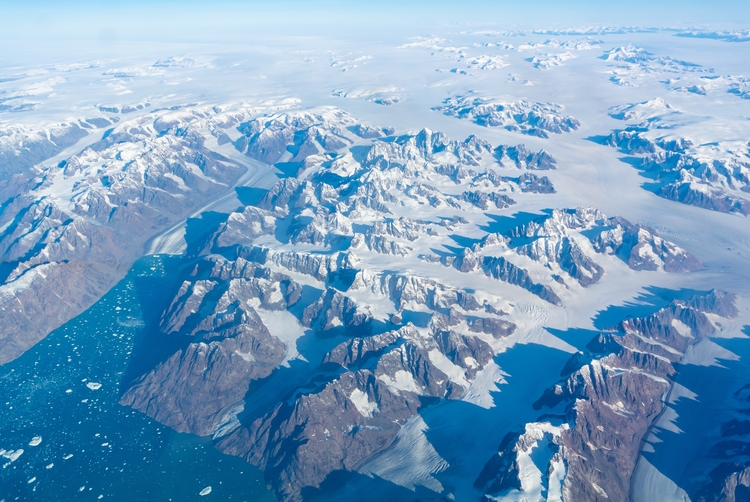
On top of 80 per cent of this land, however, lies a massive, permanent ice sheet. This forms one of the world’s largest glaciers, and some parts of it are so heavy that it has pushed part of the mainland below sea level. At its thickest point, the Greenland Ice Sheet is 3,500 metres deep, and collectively holds around seven per cent of the world’s total freshwater reserves.
Enjoying this article? Check out our related reads…
Unfortunately, this massive glacier is no stranger to the impacts of climate change. According to a recent study, an estimated 28,000 square kilometres of its ice has melted across the last three decades, an area equivalent in size to Albania and representing 1.6 per cent of Greenland’s total ice and glacier cover.
Areas once covered with ice and snow are being replaced by rocks, shrub and even vegetation, changing the familiar icy landscape. Scientists reiterate that such a drastic loss of ice has impacts on global sea level rise, and will continue to do so as long as the ice sheet melts.
As Geographical reported in 2025, the Greenland Ice Sheet is also cracking more amid climate change, with crevasses increasing in both size and depth at the fast-flowing edges of the ice sheet.
But what would happen in a scenario where the entire Greenland Ice Sheet collapsed? How would these impacts be felt across the world?
Massive global sea level rise
One of the starkest impacts of the Greenland Ice Sheet melting would be global sea level rise. In the event of a complete thaw, sea levels would rise worldwide by around seven metres – around 23 feet.
In practice, this would lead to entire coastal cities and regions – including Miami, Shanghai and Lagos – being entirely inundated with flooding. Low-lying island nations could also become uninhabitable.
Coastal infrastructure worldwide, from homes to ports and roads, would be threatened, leading to mass relocations and huge adaptation costs.
Flooding caused by high sea level rises also creates health risks, for example, by contaminating water supplies and encouraging the spread of waterborne diseases.
Disruption of ocean circulation
Already, research has indicated that the melting of Greenland’s ice sheet, and the subsequent influx of freshwater into the ocean, may be contributing to the slowing of important ocean currents that distribute heat around the planet. Fresh water is lighter than salty seawater, and large inflows can interfere with such currents.
Changes to the AMOC – the Atlantic Meridional Overturning Circulation – could spell colder climates for Europe, drier conditions in the tropics and wetter, warmer weather patterns in the Southern Hemisphere. Disruptions in these currents can also impact marine ecosystems, such as fisheries.
If a full collapse of the ice sheet were to occur, it could be said that such disruptions to ocean circulation would be more likely and more severe.
Altered regional climates
Currently, Greenland’s extensive ice sheet acts like a giant mirror. Its bright surface reflects solar energy back into space. When ice melts, however, darker surfaces are exposed like rock, tundra or meltwater pools. Darker surfaces absorb more heat, creating a feedback loop causing temperatures to rise and further ice to melt.
The Arctic is already warming around three to four times faster than the global average, in a phenomenon known as Arctic amplification. If a full ice sheet collapse were to occur, such an imbalance would be further intensified.
As a knock-on effect from this, changes may occur in the jet stream. There’s increasing evidence to suggest that a weaker temperature gradient between the Arctic and mid latitudes affects the jet stream, leading to less stable, slower patterns.
Such altered jet stream dynamics are associated with prolonged heatwaves, cold spells and persistent weather extremes.
Impacts to ecosystems
A total collapse of the Greenland Ice Sheet would also see significant impacts to ecosystems within oceans and on land. Already, with current melting rates of the ice sheet, changes in salinity and density are influencing nutrient cycling and biological productivity.
In the event of a total collapse of the Greenland Ice Sheet, detailed modelling has shown that glacier meltwater could boost phytoplankton by 15 to 40 per cent in specific fjords, potentially increasing food for fish and marine mammals.
Terrestrial ecosystems would also shift dramatically. As glaciers and ice retreat, new land would be exposed, allowing plants to colonise and ecosystems to develop where none existed before.