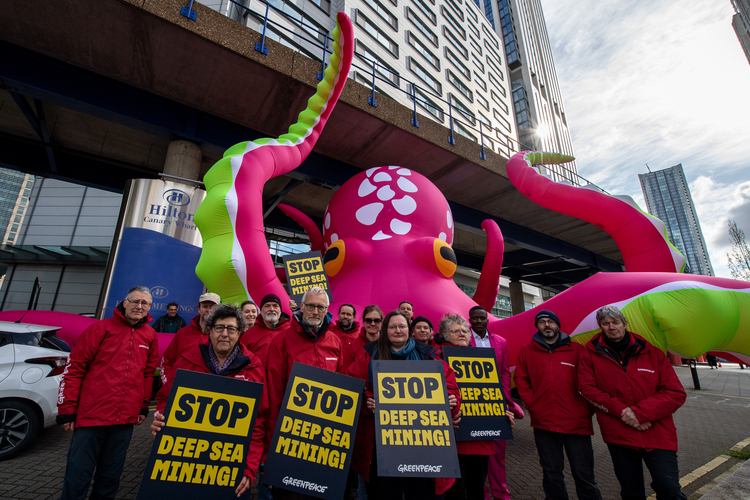

Doug Specht looks at a US$345 million ruling that could redefine the risks of environmental protest worldwide
When HBO’s Succession gave us Ewan Roy cutting Cousin Greg out of his inheritance and leaving a vast fortune to Greenpeace, viewers revelled in the idea of ‘spite philanthropy’: using wealth to punish corporate malpractice and bankroll environmental resistance. The joke went further when Greg blurted out that he might ‘sue Greenpeace’, turning a storied NGO into a punchline for elite anxiety about protest. The storyline did not stay on screen. It helped trigger a real-world spike in interest in leaving legacies to Greenpeace in wills and became a reference point for donors, including Succession creator Jesse Armstrong, who later gave £25,000 to support Greenpeace’s legal fight with Shell over a North Sea protest.
This fiction has, though, become a reality, with fossil fuel companies now suing Greenpeace for eye-watering sums. In February 2026, a North Dakota judge finalised a US$345 million judgment against three Greenpeace entities in a case brought by oil pipeline company Energy Transfer over the Dakota Access Pipeline protests. Greenpeace calls it a classic SLAPP (a strategic lawsuit against public participation) with implications that reach far beyond its own balance sheet. At stake is whether environmental movements can confront fossil capital without facing existential legal retaliation.
What happened in North Dakota?
To understand why this case matters, we have to go back to Standing Rock in 2016–17. The Dakota Access Pipeline (DAPL) had become a global flashpoint as the Standing Rock Sioux Tribe and allies protested a project they said threatened sacred sites and water sources. Greenpeace was one of several international NGOs that backed the Indigenous-led movement, providing communications support, campaigning, and training in non-violent direct action at the invitation of frontline leaders.
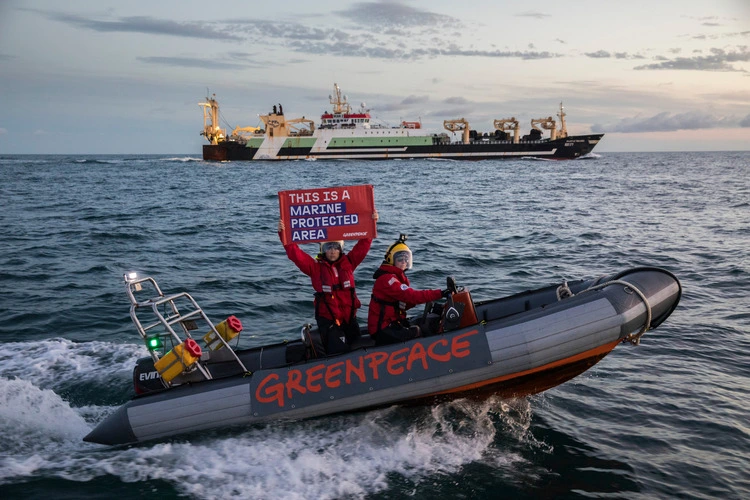
Energy Transfer, the company behind DAPL, responded with a sweeping civil suit. It accused Greenpeace and related entities of orchestrating a campaign to halt or delay construction, defaming the company by spreading false claims about the pipeline’s safety and environmental impact, and helping to organise protests that led to trespass, nuisance, and economic losses. In effect, the company has argued that Greenpeace went beyond advocacy and into a coordinated operation that caused concrete financial harm.
In March 2025, a North Dakota jury agreed. It found Greenpeace USA liable on all counts, including defamation, civil conspiracy, trespass, nuisance and interference with business relations, and held Greenpeace International and Greenpeace Fund Inc liable on some of the claims. The jury initially awarded around US$660–670 million in damages. Later that year, Judge James Gion ruled that parts of the award were double-counted and cut the total roughly in half, but he upheld the core findings of liability. In February 2026, he finalised a judgment of about US$345 million against the three Greenpeace entities. Greenpeace says it cannot pay such a sum and is seeking a new trial and appeal.
What is a SLAPP, and why does Greenpeace say this is one?
Strategic lawsuits against public participation (SLAPPs) are not defined by their legal label but by their function. They are cases brought by powerful actors not primarily to win on the merits, but to intimidate critics, drain their resources, and chill speech. They often wrap political disputes in the language of defamation, conspiracy, or economic harm, using the threat of crippling liability to deter advocacy.
A wide range of free-expression and human rights groups, including Amnesty International and civil society coalitions focusing on SLAPPs, have described Energy Transfer’s action as fitting this pattern. In their view, Greenpeace is being treated not as a participant in democratic debate but as an enemy whose punishment will deter others. The NGO’s role as a ‘public watchdog’ on environmental harms is precisely what makes it a target.
In the US, protection against SLAPPs varies dramatically by state. Some states have robust laws allowing early dismissal of abusive suits and shifting costs to the plaintiff. Others effectively have none. North Dakota is in the latter camp. That legal vacuum made it easier for such a sweeping claim to reach a full jury trial and produce a massive verdict. By contrast, the European Union has recently adopted an anti-SLAPP Directive intended to protect public watchdogs from abusive litigation, including certain cross-border cases. Greenpeace International is also testing European protections by challenging an Energy Transfer-related lawsuit in the Netherlands, which could become an important precedent for activists facing transnational legal pressure.
Why this verdict matters for future environmental activism
The most obvious implication is financial. Greenpeace USA’s assets are a fraction of the judgment now hanging over it. A single verdict can wipe out decades of accumulated organisational capacity: staff, infrastructure, campaigns, research. The headline number is not just punitive; it is existential. If such damages stand, they send a blunt message to other NGOs: large-scale, confrontational campaigns against critical fossil fuel infrastructure can carry annihilating financial risk.
Beyond the money, there is worry about the precedent the DAPL case sets for allocating responsibility in protest movements. The verdict risks collapsing important distinctions between those who commit unlawful acts, those who organise peaceful protest, and those who simply provide communications support or express solidarity.
Greenpeace and allied groups warn that, if this logic stands, corporations could try to hold any organisation associated with a protest responsible for the most escalatory actions of any participant. An NGO that trains activists in non-violent tactics or hosts a petition might, in theory, be swept into litigation over property damage it neither intended nor endorsed. Large NGOs may decide it is safer to retreat to narrow, policy-focused advocacy, leaving frontline communities without outside support when they choose to resist projects on their lands.
The implications extend beyond big NGOs. SLAPP-style liability threatens local grassroots groups, Indigenous organisations, independent journalists, researchers, and even academics who publish critical analyses. If defamation and economic torts are stretched to cover robust advocacy on matters of clear public interest, the safest course becomes silence.
From spite philanthropy to solidarity defence
What, then, can be done? One part of the answer may lie in revisiting the philanthropic energy that Succession momentarily channelled. Viewers loved watching a fictional patriarch divert his fortune to Greenpeace as a rebuke to ‘crapulous shills’, and that storyline measurably increased public interest in leaving legacy gifts to the organisation.
In the age of SLAPPs, and without further protections of the kind the EU is attempting to build, NGOs must treat legal retaliation not as an unexpected anomaly but as a predictable cost of serious confrontation with fossil capital. At the same time, movements will need to invest in legal infrastructure: rapid-response teams, cross-border alliances of public interest lawyers, and careful risk-sharing arrangements between local groups and large NGOs.
Coordinated public education about SLAPPs can help reframe such cases as attacks on democracy rather than obscure commercial disputes. And sustained campaigning for robust anti-SLAPP legislation, in the US and elsewhere, is essential if courtrooms are not to become the preferred arena for settling climate politics.
The question now is whether the Energy Transfer–Greenpeace case becomes a template for punishing environmental advocacy or a catalyst for stronger protections. The outcome of appeals, the willingness of legislators to act, and the readiness of donors and the wider public to stand with targeted groups will all play a role. Succession turned the idea of suing Greenpeace into a joke. Fossil fuel companies have turned it into a strategy. How societies respond will help determine the future shape, and safety, of climate activism.