
As the BJP takes power in West Bengal for the first time, Muslims in one of India’s most politically important border states fear that the language of law and order is becoming a tool of exclusion

By Ritwika Mitra
On 4 May, India’s eastern state of West Bengal saw the Bharatiya Janata Party (BJP) – the Hindu nationalist party of Prime Minister Narendra Modi – come to power for the first time in its history. By evening, the streets of Kolkata – the state capital, long proud of its multiculturalism and its public celebration of festivals across religions – were filled with rallies where supporters chanted ‘Jai Shri Ram’ (‘Hail Lord Ram’). In recent years, the slogan has become a marker of Hindu nationalist mobilisation, as well as a flashpoint in a country where religious identity is increasingly shaping politics.
Enjoying this article? Check out our related reads…
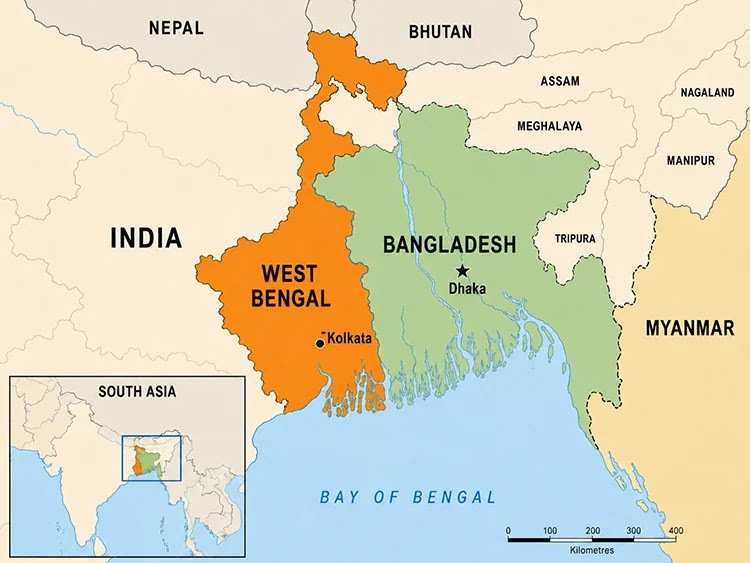
West Bengal is home to around 100 million people – more than the population of Germany – and shares a long, porous border with Bangladesh. It also has one of India’s largest Muslim populations: the 2011 census counted 24.6 million Muslims in the state, around 27 per cent of its population. That demographic reality was central to the BJP’s campaign.
The BJP’s victory marked a historic political shift. For 34 years, from 1977 to 2011, West Bengal was governed by the Left Front, led by the Communist Party of India (Marxist). It was then ruled for 15 years by the All India Trinamool Congress (TMC), led by Mamata Banerjee, whose party presented itself as a defender of secularism, welfare and Bengali identity. Its critics, however, accused it of corruption, minority appeasement and presiding over economic stagnation and deindustrialisation.
The BJP’s campaign and a controversial voter-roll revision
During the campaign, the BJP repeatedly invoked anti-Bangladesh rhetoric, promising to free West Bengal from ‘infiltrators’ and Rohingya – a mostly Muslim, stateless minority from Myanmar, more than a million of whom live in refugee camps in neighbouring Bangladesh. The party, which also leads India’s central government, has long accused the TMC of sheltering undocumented migrants in order to manipulate electoral rolls.
The election was preceded by a controversial Special Intensive Revision (SIR) of the voter rolls by the Election Commission of India. In principle, such exercises are meant to ensure that no eligible voter is left out and no ineligible voter remains on the list. In practice, the West Bengal revision generated fear and confusion across the state.
According to official data reported after the process, around 9.1 million names were deleted from the electoral rolls. Some were recorded as deceased, duplicate or absentee voters, but around 2.7 million people remained excluded after adjudication under a disputed ‘logical discrepancy’ category. This category, used in West Bengal, flagged voters for issues such as apparently implausible age gaps with parents or grandparents, unusually large numbers of children, or inconsistencies in names. Critics argued that such checks failed to account for the realities of documentation in poorer, rural and marginalised communities.
The Supreme Court of India also questioned aspects of the process, while opposition parties have accused the Election Commission of acting in ways that favour the BJP – an allegation the Commission rejects.
The burden fell heavily on people least equipped to navigate India’s documentation system. In districts such as Malda, Murshidabad and North 24 Parganas – all with significant Muslim populations – many voters spoke of the exhaustion of gathering documents, the humiliation of being treated as suspect citizens and the fear that exclusion from the voter roll might later affect access to welfare benefits.
Travelling through these districts before and after the election, I found palpable anxiety among Muslims, especially in families where names had been removed. Some people said they had produced documents but were still struck off. Others worried that losing voting rights could mark them out for further exclusion.
Polarised politics or law and order?
Within weeks of taking office, the new BJP government began implementing a series of directives that critics say disproportionately affect Muslims. The government argues that these measures are about law, order and administrative enforcement. For many minorities, however, they have intensified a sense of vulnerability.
One of the first flashpoints was the stricter enforcement of the West Bengal Animal Slaughter Control Act, 1950. The state has moved to ban the public slaughter of cattle and buffalo and to require official certification before slaughter. Those involved in the beef trade say the change has disrupted supply chains and threatened livelihoods.
The politics of cattle is now deeply charged in India. The cow is revered by many Hindus, and over the past decade the rise of Hindu nationalism has been accompanied by incidents of cow vigilantism and violence linked to accusations of beef consumption or cattle transport. In Kolkata, several restaurants that served beef have reportedly halted sales because of disruption to supply.
The government has also moved against Muslims offering Friday prayers on roads near mosques, saying prayers must be restricted to mosques and designated spaces to avoid public-order problems. In many parts of West Bengal, Friday congregations have historically spilt into nearby streets when mosques are full.
At the same time, illegal buildings and structures have been demolished in Kolkata as part of an anti-encroachment drive. Many of the demolitions have taken place in Muslim-majority areas. Supporters of the new government have celebrated the drives on social media as evidence that ‘law and order’ is being restored. But for minorities, the question is more troubling: will this be neutral governance, or will law and order become the language of polarisation?
For decades, West Bengal was seen as a state where left politics, Bengali culture and a strong secular self-image held Hindu nationalism at bay. The BJP’s arrival in power has upended that assumption. What happens next will test not only the state’s minorities, but also the meaning of citizenship in one of India’s most politically important borderlands.