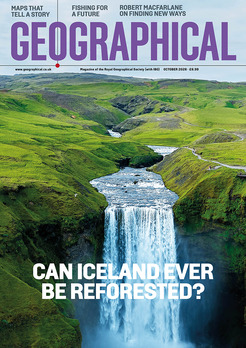
In the June issue of Geographical, head to Mongolia, the Sahara, Greece and the Caribbean
In our June 2026 cover story, Claire Thomas heads to Mongolia’s Altai, where Kazakh hunters still ride with golden eagles across a landscape in which survival, skill and tradition remain intimately bound.
Bryony Cottam reports from the Caribbean on the frontlines of climate adaptation in places reeling from a warming planet, while Boštjan Videmšek visits Corfu to see how Greece’s desire to become an energy power is playing out. Plus, Anthony Ham ventures to the Algerian Sahara to be immersed in ancient rock art, Tuareg hospitality and vast, wind-carved landscapes, and Rory Walsh traces the lost defence of Kenilworth Castle in Britain.
Check out our other issues…
- Out now: May 2026’s Geographical issue
- Out now: April 2026’s Geographical issue
- Out now: March 2026’s Geographical issue
- Out now: February 2026’s Geographical issue
- Out now: January 2026’s Geographical issue
- Out now: December 2025’s issue of Geographical
Tristan Kennedy explores the joys of multi-pitch climbing in an interview with Russian alpinist Alexander Odintsov, and Victoria Heath speaks to Jon McCormack, the fine-art photographer and senior Apple engineer, whose stunning images of natural patterns reveal the beauty hidden in plain sight. In our latest Phenomena, Grace Gourlay looks at coffin cubicles – Hong Kong’s response to its vast housing crisis.
Our columnists bring an array of topics to the forefront to help you stay on top of the world: Tim Marshall examines the ripple effects that cascade from the disruption of the Strait of Hormuz, from Gulf shipping lanes to supermarket shelves. Andrew Brooks reflects on how racialised slurs have helped cast enemies as less than human throughout history, while Marco Magrini explores how the heat of human-induced climate change stored in our planet’s oceans may be returning with compound interest.
Our digital edition is out now, too, giving you access to all the stories in our latest issue, plus our full archive dating back to 1935, with hundreds of magazines to explore. Digital access is available through the Geographical app, and you can now enable notifications to be alerted the moment the latest issue is live. And if you want to enjoy our beautifully designed and produced print magazine, we can post the next edition to you anywhere in the world. Join us and stay on top of the world.
Horses and eagles

Across Mongolia’s Altai Mountains, eagle hunting remains woven into the lives of Kazakh semi-nomadic herders. In the frozen valleys of Bayan-Ölgii, children such as 12-year-old Aykerim ride bareback across rocky plains while hunters carry golden eagles into the mountains in search of foxes and hares. Known as berkutchi, these hunters form close, carefully maintained bonds with their birds, relationships built through years of patience, trust and daily care. The eagle depends on the hunter for food and survival, while the hunter relies on the bird’s strength, vision and precision in the harsh winter landscape.
Yet this tradition is changing. Once passed almost exclusively from fathers to sons, eagle hunting is increasingly being learned by girls as well. At the same time, modern life is reshaping the remote region. Motorbikes are replacing horses, electricity and phones are becoming common, and more families are sending children to boarding schools in nearby towns, hoping that education will offer opportunities beyond the mountains.
Tourism has also transformed the practice. Annual eagle festivals now attract international visitors, turning a tradition rooted in survival into a cultural spectacle and income. Still, many families continue the rituals of eagle hunting with quiet pride, balancing adaptation with the preservation of a centuries-old way of life.
Greece’s offshore gamble

From the cliffs above Corfu’s western coast, the Ionian Sea appears untouched: dark winter water, empty horizons and small surf towns built around tourism and fishing. Yet beneath that calm surface lies Block 2, an offshore concession where ExxonMobil and its partners are preparing Greece’s first exploratory deep-water drilling campaign in more than 40 years. For the Greek government, the project represents energy security and a chance to strengthen the country’s strategic role in Europe as the continent moves away from Russian gas. For many locals and environmental groups, it represents something else entirely: a dangerous return to fossil fuels at a moment defined by the climate crisis.
Campaigners argue that offshore drilling threatens fragile marine ecosystems in the Hellenic Trench, an important habitat for sperm whales, dolphins, monk seals and sea turtles. They accuse the government of downplaying environmental risks while prioritising geopolitical ambitions and corporate interests. On Corfu, concerns extend beyond ecology. Tourism businesses fear industrialisation could damage the island’s identity and economy, even without a spill or accident.
The debate exposes a wider contradiction at the heart of Europe’s energy transition. Greece continues expanding renewable energy while simultaneously investing in new gas infrastructure and exploration. Whether significant gas reserves are ever found may matter less than what the project already symbolises: a continent still struggling to reconcile climate commitments with energy insecurity and geopolitical pressure.
The resilience test

Dominica’s new geothermal power plant rises from a landscape shaped by rain, jungle and volcanic heat. Beneath the island’s misty highlands lies a powerful reservoir of energy, now being tapped in an attempt to reduce dependence on imported diesel and build a more resilient future. The project is expensive and technically demanding, because everything must withstand the realities of the Caribbean: landslides, floods and category-five hurricanes. After Hurricane Maria devastated Dominica in 2017, destroying homes, roads and power infrastructure, resilience became less an ambition than a survival strategy.
Geothermal energy offers a rare form of promise. Dominica sits on the Lesser Antilles Volcanic Arc, where underground fluids reach temperatures ideal for power generation. If successful, the plant could meet half the island’s peak electricity demand, with future expansion allowing surplus power to support local industry or neighbouring islands.
Across the Caribbean, other islands are also searching for new ways to adapt. Montserrat is exploring whether its destructive volcano could provide geothermal power and valuable minerals. Antigua and Barbuda, meanwhile, faces deepening water stress and dependence on tourism. Together, these stories reveal a region trying to move beyond disaster recovery towards resilience.
The future already exists

Something is breaking in the story modern civilisation tells about itself. For decades, economic growth and technological progress were treated as guarantees of stability, proof that the future would always improve on the past. Now, the cracks are harder to ignore. Democracies are weakening, inequality is widening, and the ecological systems that sustain human life are under mounting strain.
In response, a new political language of ‘abundance’ has emerged, promising that faster growth, deregulation and innovation will solve these crises without the need for bigger structural change. But Jeremy Lent argues that this approach mistakes acceleration for transformation. The system driving ecological collapse and social fragmentation cannot simply be optimised into sustainability.
Instead, Lent points towards a different model already taking shape in fragments across the world: citizens’ assemblies that deepen democratic participation, worker cooperatives that redistribute power, technologies built around shared ownership rather than surveillance, and legal systems that recognise rivers and ecosystems as rights-bearing entities.
These ideas remain marginal, but they suggest another possibility: that civilisation could be organised not around extraction and profit, but around the long-term flourishing of both people and the living world.
The art of looking
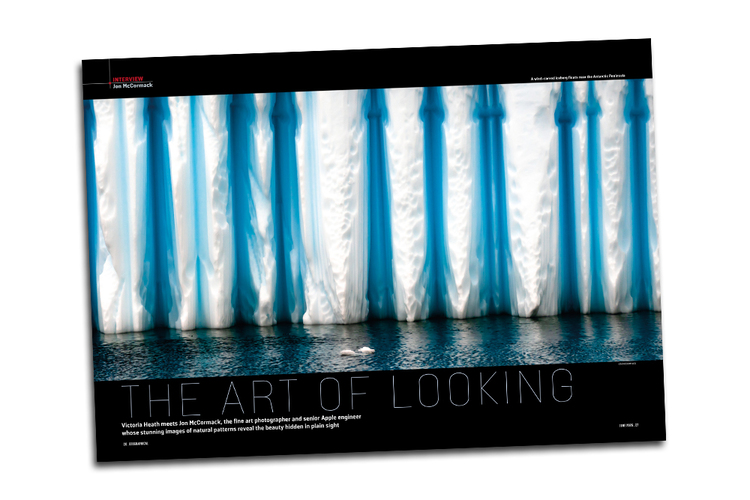
Humans are drawn to patterns. Familiar structures help us navigate the world, but in nature, those patterns are never exact. No wave breaks in quite the same way twice; no branch, ripple or grain of sand fully repeats itself. That subtle variation is part of what makes the natural world so calming – and so captivating to look at.
Photographer Jon McCormack has spent years searching for these fleeting moments. By day, he oversees the software behind the iPhone camera as Apple’s vice president of camera and photos software engineering. Away from Silicon Valley, however, his focus shifts towards stillness, patience and the overlooked details of the natural world.
His images reveal what he calls ‘tiny landscapes’ – cracked desert mud, glowing algae, crystalline minerals and microscopic organisms transformed into abstract worlds of colour and texture.
For McCormack, patterns are more than visual curiosities. As someone who is colourblind, they are a way of understanding the world itself. In his conversation with Victoria Heath, he reflects on photography, perception and why slowing down can reveal extraordinary beauty hidden in plain sight.