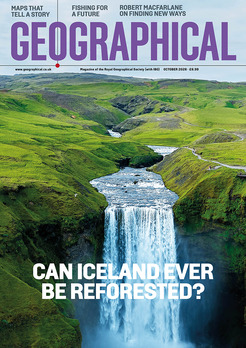
In our May edition, head to Ethiopia, Russia, North Korea and more in our array of stories from across the world
In our May 2026 cover story, we look at the science of tree rings with Valerie Trouet – who has spent her life studying tree patterns – and what they can tell us about our past.
Also in this issue, Rory Walsh explores the origins of a Dartmoor literary landmark. Bryony Cottam heads to Glasgow where she discovers hidden histories and fiercely held local identity, while Tristan Kennedy discovers how France’s waymarked walking routes open up mountains, coast and countryside to all.
Check out our recent editions..
- Out now: April 2026’s Geographical issue
- Out now: March 2026’s Geographical issue
- Out now: February 2026’s Geographical issue
- Out now: January 2026’s Geographical issue
- Out now: December 2025’s issue of Geographical
- Out now: November 2025’s Geographical issue
In Ethiopia, Stuart Butler takes us into a nation whose story stretches from the myths of the Queen of Sheba to the bitter realities of civil conflict, displacement and a fragile federal state, while in Komodo National Park, the world’s largest lizard is no longer quite the fearsome creatures early visitors describe.
Our columnists bring an array of topics to the forefront to help you stay on top of the world: Tim Marshall dissects the geography of AI and how place influences which regions become tech superpowers. Andrew Brooks reflects on the housing crisis in the UK, while Marco Magrini explores how the Gulf’s desalination plants are vulnerable in war and increasingly hard to sustain.
Our digital edition is out now, too, giving you access to all the stories in our latest issue, plus our full archive dating back to 1935, with hundreds of magazines to explore. Digital access is available through the Geographical app, and you can now enable notifications to be alerted the moment the latest issue is live. And if you want to enjoy our beautifully designed and produced print magazine, we can post the next edition to you anywhere in the world. Join us and stay on top of the world.
A dragon tamed
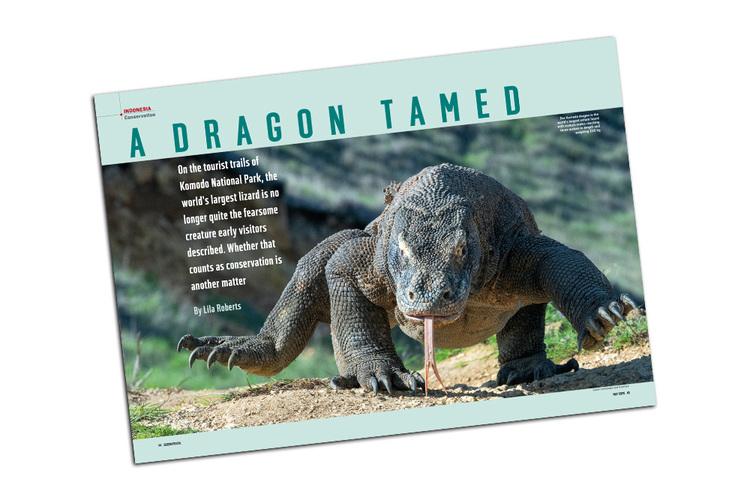
On Komodo Island, the dragons barely move. Beneath the sparse shade of low trees, their heavy bodies lie folded into the dust, eyes half-closed, as tourists edge closer with phones raised. It’s hard to reconcile these sluggish forms with the creatures that once inspired fear – apex predators that ruled these islands for more than a million years.
They have survived volcanic upheaval, shifting seas and the disappearance of entire species. What they now face is something far more recent: tourism.
Indonesia’s decision to cap visitor numbers at 1,000 a day is an attempt to restore balance in Komodo National Park, where crowds have surged in the wake of the pandemic. But the pressure is already visible. In the most visited areas, the dragons appear altered – less wary, more sedentary, drawn into predictable patterns shaped by human presence.
Beyond these carefully managed encounters, the wider landscape still holds something wilder. Yet even here, the forces reshaping the park are difficult to ignore. Conservation, economics and local livelihoods are increasingly entangled, raising an uncomfortable question: as we seek to protect these ancient animals, are we also changing them?
North Korea’s staged normality

From across the Korean Demilitarized Zone, Kijŏng-dong looks like a place that should be lived in. Apartment blocks rise in neat rows, a school stands ready, and a vast flagpole towers above it all – a carefully composed image of prosperity visible from the South. But the closer you look, the more the illusion begins to fray. Windows are painted on. Lights flicker to life on timers. The village is not built for living, but for watching.
It is an unsettling idea – a landscape designed not around its inhabitants, but around its audience.
Kijŏng-dong offers a glimpse into a broader geography that extends far beyond the border. In Pyongyang, wide boulevards stretch out with little traffic, monumental buildings stand in ordered symmetry, and visitors are guided through a tightly curated sequence of spaces. What is visible is deliberate; what lies beyond remains obscured.
Even light follows this pattern. By night, the capital glows brightly while much of the countryside fades into darkness.
In North Korea, the landscape does more than function. It communicates. And in places like Kijŏng-dong, that message is as much about power as it is about place.
An ageing power
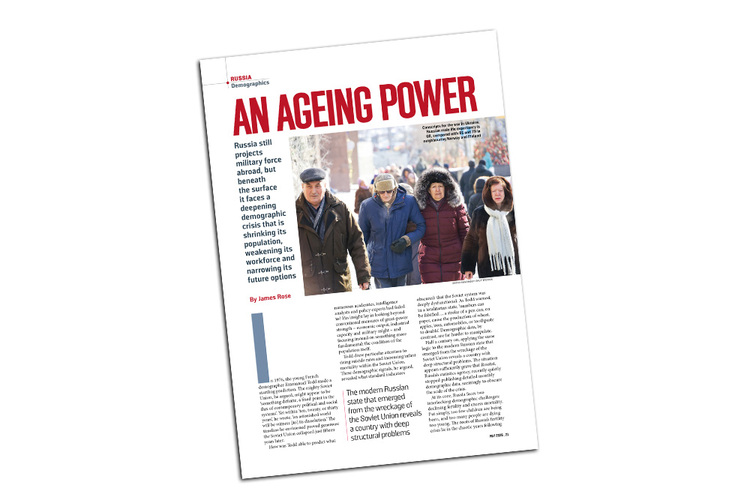
In 1976, a young demographer looked beyond the Soviet Union’s military might and saw something more fragile. Emmanuel Todd focused not on industry or weapons, but on people – rising infant mortality, increasing suicide rates, quiet signals of a system under strain. Fifteen years later, the Soviet Union collapsed.
Today, similar patterns are emerging in Russia. Birth rates remain low, mortality is high and the population is shrinking. Since peaking around 2020, decline has set in, with fewer children born and too many people dying young – particularly men.
The imbalance is spreading across the landscape. Major cities continue to draw people in, while vast regions, especially in the east, grow emptier. These territories remain rich in resources, but increasingly thin in population.
The consequences are not just domestic. As numbers fall, so too does relative power. Demography does not dictate outcomes, but it shapes them. In Russia, the limits are becoming harder to ignore.
Power lines

Across the British countryside, change is arriving in steel and cables. From Highland forests to lowland farmland, new pylons, substations and underground lines are being built to carry renewable energy from where it is generated to where it is needed.
The logic is clear. As the UK shifts away from fossil fuels, the grid must expand. Offshore wind, solar and rising electricity demand all require new infrastructure, and quickly. Without it, the transition stalls. With it, the landscape changes.
That is where the tension lies. In places like Contin in the Scottish Highlands, communities are facing years of disruption – tree felling, road widening and towering pylons cutting across familiar views. Support for climate action remains strong, but frustration is growing over how decisions are made and imposed.
The pattern is repeating across the country. Rural areas are being reshaped to deliver national goals, often without a clear overarching plan.
What emerges is not outright opposition, but unease. The transition is necessary. But how it is delivered – and who bears the cost – remains deeply contested.
On The Ground
In the second episode of On the Ground, Geographical’s new podcast, Laura Cole travels to the site of the oldest forest ever discovered – an extraordinary landscape dating back 390 million years. Found unexpectedly on the edge of a Butlin’s holiday park, these fossilised remains offer a rare glimpse into a world long before humans, or even dinosaurs.
As Laura explores the site, she uncovers how these ancient trees helped shape the very foundations of life on Earth – from stabilising soils to transforming the atmosphere itself. It’s a story that stretches deep into geological time, revealing how forests didn’t just grow in the world, but helped create it.