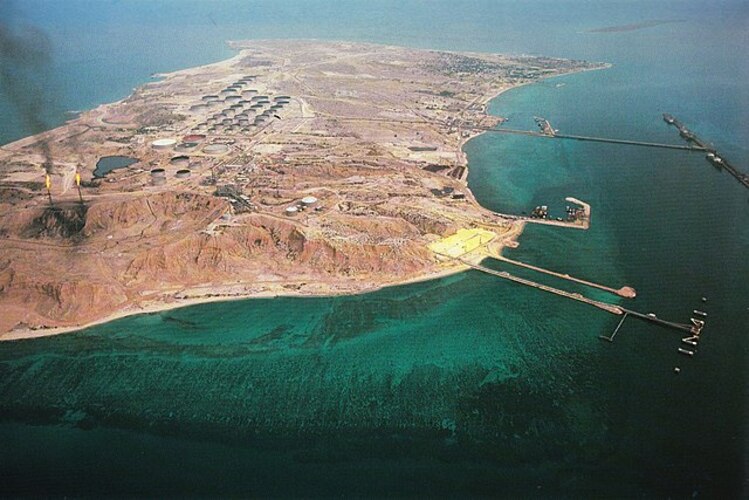
A tiny five-mile-long strip of land has up to 90 per cent of Iran’s oil pumping through it
By
Nestled within the waters of the northern Persian Gulf is a tiny, five-mile-long stretch of land known as Kharg Island. It is twice the size of London’s Heathrow Airport. Despite its modest size, this piece of land serves as a pivotal terminal for nearly all of Iran’s oil exports, with a loading capacity of about seven million barrels per day.
At times, around 90 per cent of the nation’s oil exports have passed through Kharg. Pipelines connect the island to offshore oilfields in the Persian Gulf and to major oilfields on the Iranian mainland.
The result is a dense concentration of energy infrastructure, making the island one of the most strategically sensitive points in the global oil network.
But what is Kharg’s history, and how did it become such a major oil site?
Enjoying this article? Check out our related reads…
Iran’s oil export lifeline
Kharg first became strategically important back in the 1960s oil boom.
After offshore oilfields were discovered in the Persian Gulf and southern Iran, the island was developed into a major crude-export terminal linked by pipelines to both offshore platforms and mainland oilfields in Khuzestan. Most of Iran’s coastline is silty and too shallow for large tankers used in the oil industry, but Kharg’s location is sufficiently close to deep waters.
By the early 1970s, this infrastructure had transformed Kharg into Iran’s largest oil-loading terminal.
Before the latest US-Israel offensive, most of Iran’s crude oil from Kharg was exported to China.
Energy analysts often describe the island as a single-point vulnerability: disrupting Kharg would immediately constrain Iran’s ability to sell crude to global markets and could also hike oil prices.
Kharg’s role in geopolitics
During conflicts in the Gulf, Kharg’s importance became especially clear. Throughout the Iran-Iraq War, Iraq repeatedly bombed Kharg’s oil infrastructure. Iraqi aircraft targeted the island throughout the 1980s, aiming to cripple Iran’s economy by ceasing its oil exports.
By 1986, much of the terminal infrastructure had been severely damaged or temporarily disabled. However, despite repeated air strikes, Iran was able to keep exporting oil from Kharg throughout the war.
After the war, Iran spent years repairing and expanding the facilities.
A long history
Prior to the arrival of oil on the island, Kharg had an important role in trade and maritime culture in the Persian Gulf.
According to medieval sources, the island was known to be a centre for pearl fishing and Gulf trade by the late 10th century. In the 17th century, travellers described the island as a trading stop connected to Basra, Bandar Rig and the Iranian interior.
Its prime location along shipping routes also made it a place where ships could hire experienced Gulf pilots to navigate the shallow waters near Basra.
Keeping an eye out
It may be thousands of kilometres away from the US, but that fact wouldn’t necessarily deter President Trump from sizing up Kharg. Media reports have hinted at White House interest, including a brief reference in an Axios report last month that officials had considered ‘seizing Kharg’.
In recent weeks, Trump has become more explicit in his desire for the island. ‘Maybe we take Kharg Island, maybe we don’t. We have a lot of options. It would also mean we had to be there [in Kharg Island] for a while,’ he said.
‘I don’t think they have any defence. We could take it very easily.’
According to a senior Pentagon adviser on Iran and Iraq in the George W. Bush administration, Michael Rubin, seizing Kharg Island would deprive the Iranian regime of a key funding source for controlling the population, in a way that would intensify pressure on Iran outside of missile strikes and bombings.
‘If they can’t sell their own oil, they can’t make payroll,’ said Rubin.
Bombing or capturing the site with US forces would also likely cause a sustained increase in already surging oil prices. As of 30 March, a barrel of Brent crude – the benchmark for oil prices – was close to a four-year high, costing $115.54. This represents a near 60 per cent price increase since before the war broke out.
If the US did invade Kharg, it would – according to the BBC – most likely be a temporary measure intended to put pressure on Iran until it relinquished its chokehold on the Strait of Hormuz. Such a move would put American troops well within range of Iran’s arsenal of drones and missiles, making it an extremely risky move.
For some, taking over Kharg could give the US ‘enormous leverage’ in negotiations. Others are concerned that taking the island would be an ‘absolutely disastrous decision that would ensure the conflict lasted many months’.
However, it’s unlikely that American or Israeli forces would intentionally damage Kharg, said senior fellow at the Atlantic Council Global Energy Center Ellen Wald. Although the US has struck 5,000 targets in and around Iran, it has so far refrained from bombing the country’s oil infrastructure. Wald argues that, ultimately, it could trigger a wave of Iranian retaliation against energy infrastructure.
An effort to seize the island could also be seen as self-defeating.
‘If the US were to seize it, then you would be separating the Iranian oil industry. Iran would have production but couldn’t export, while the US wouldn’t be able to produce. That would set markets in a tailspin; that’s a real standoff,’ said Neil Quilliam with the Chatham House thinktank.