
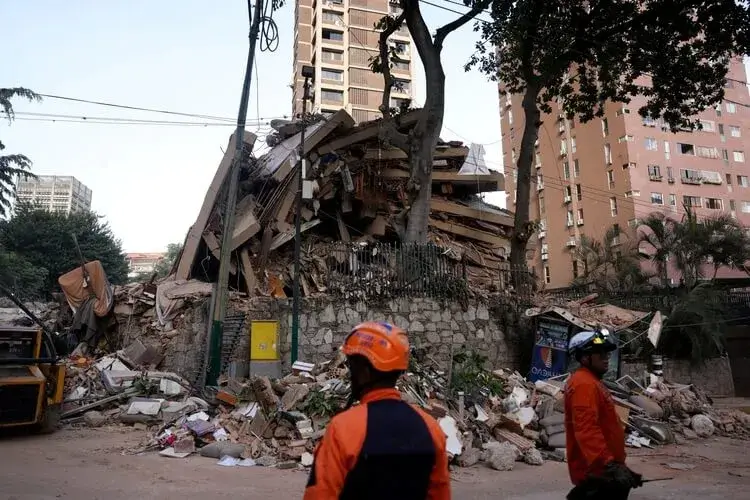

Two earthquakes struck neighbouring countries, but geology alone doesn’t explain the vastly different death tolls

By
In Manizales in Colombia, one of the side towers of the neo-Gothic cathedral sheared away and fell into the nave. In Cali, rescuers lowered patients on ropes from the windows of the Hospital Universitario del Valle after its upper floors gave way, and more than six hundred people were treated in the open air.
At Pereira’s Matecaña airport, part of the terminal collapsed, trapping three people inside. On the road to Buenaventura, fifteen vehicles sat in a tunnel behind a rockslide, waiting.
Related reads…
The magnitude 7.4 that struck beneath Chocó in Colombia at 7.34 a.m on Monday arrived three days into the presidency of Abelardo de la Espriella, the Trump-endorsed lawyer who won June’s run-off by less than a percentage point.
At the time of writing, at least 224 people are confirmed dead, and more than 2,700 are reported missing. Seven weeks earlier, the ground moved under the chavista remnant that has governed Venezuela since Nicolás Maduro was seized by American forces in January, and 6,301 people died, with something close to 29,500 still unaccounted for.
Similar magnitudes. Adjacent countries. The same tectonic neighbourhood.
The political conclusion was drawn within hours. ‘Colombia has a president,’ the opposition commentator Orlando Avendaño wrote. ‘Colombia has a state. The catastrophe is natural, but the size of the tragedy depends on the response. We Venezuelans paid dearly.’ Chavista accounts answered in kind, and a hemispheric argument about socialism and state capacity was underway before the aftershocks had finished.
Different earthquakes
Colombia’s rupture happened 107 kilometres down, inside the Nazca plate as it slides beneath the Pacific coast. Venezuela’s happened at around ten kilometres, on shallow strike-slip faults along the Caribbean plate boundary; and it happened twice, thirty-nine seconds apart, the second shock striking buildings the first had already cracked. Seismic energy attenuates with depth. Colombia’s shaking was dispersed across four regions; Venezuela’s was concentrated on a coastal strip and a city of five million.
The difference between the two death tolls is not a difference between two ideologies. It is a difference between ten kilometres and a hundred.
But nobody should be allowed to stop there, least of all a government now being congratulated for the depth of an epicentre. Governments do not control the first ninety seconds of a quake; they control the previous thirty years and the following thirty months.
Sanctions
Consider what actually killed six thousand Venezuelans. Not simply a shallow fault, and not simply the incompetence of a caretaker administration, though heavy machinery reportedly took a week to reach some zones and arrived without fuel. What killed them was a building stock that had spent a decade without maintenance, materials or enforcement, in an economy under sanctions — and sanctions cannot be unwound retroactively.
Washington suspended them for relief transactions two days after the quakes, under a general licence that ran through October, and eventually pledged $300 million, routed through NGOs rather than the state. Alex Main of the Center for Economic and Policy Research warned that the sanctions still standing ‘threaten to obstruct the global response to the earthquake, just as happened in Syria in 2023’.
Sanctions are themselves a slow seismic amplifier, and they were applied by the same government now being invoked as the guarantor of Colombia’s superior response.
Death tolls and politics
Venezuela’s National Assembly president gave a figure of 157 missing in June and never updated it, saying publication would invite speculation; a crowdsourced database run from Miami puts the figure above 41,000, and the United Nations spoke in July of tens of thousands possibly still beneath rubble. Colombia’s official reporting also faltered: after midday on Monday, the government released no figures at all, and journalists fell back on a tally kept by the association of capital cities. Within forty-eight hours, the reported toll ran 111, 132, 169, 224.
A death toll is not a measurement. It is a product of enumerative capacity operating under political pressure. To set 224 against 6,301 is to compare two statistical infrastructures as much as two catastrophes. In both countries, diasporas and civic associations are now counting the dead their governments cannot or will not.
None of which is to say the comparison is innocent or accidental. A president elected with 49.66 per cent of the vote, whose blank and spoiled ballots exceeded his winning margin, has acquired in his first week a national emergency to administer, decree powers to administer it with, and a ready-made contrast against the failed state next door. He caused none of that. He will not waste it either. Soldiers are back on the streets of Cali, and Venezuela’s policy has been further delegated to Washington.



