More than 75,000 people were killed in the first 16 months of the Gaza war – at least 25,000 more than the death toll announced at the time
By
A new peer-reviewed study published by Lancet Global Health has found that more than 75,000 people were killed in the first 16 months of the Gaza war, representing an increase of 25,000 more than the death toll announced by local authorities at the time.
The research is the first to use independent, population-based survey methods in Gaza, rather than relying on individual death records from Gaza’s Ministry of Health.
The death toll in Gaza has remained a disputed topic, with Israel claiming it was lower than the health ministry claimed it was.
‘Our research confirms that the Ministry of Health is not inflating the numbers – in fact, their figures were a substantial undercount, not an overcount,’ said the study’s lead author, Professor Michael Spagat.
The research also found reporting by the Gaza health ministry about the proportion of women, children and elderly people killed was accurate.
Related reads…
In total, 42,200 women, children and elderly people died between 7 October 2023 and 5 January 2025. These deaths made up 56 per cent of violent deaths in Gaza.
‘The combined evidence suggests that, as of 5 January 2025, 3-4 per cent of the population of the Gaza Strip had been killed violently and there have been a substantial number of non-violent deaths caused indirectly by the conflict,’ the authors of the study wrote.
The new research suggested 8,200 deaths in Gaza from October 2023 to January 2025 could be attributed to indirect effects, such as malnutrition or untreated disease.
Although these figures are a significant uptick compared to previous estimates, Professor Spagat stresses that the data only covers the first 15 months of the war, and so actual up-to-date figures may be higher still.
‘Our estimate of roughly 75,000 violent deaths covers the period up to early January 2025. It’s now more than a year out of date,’ he said.
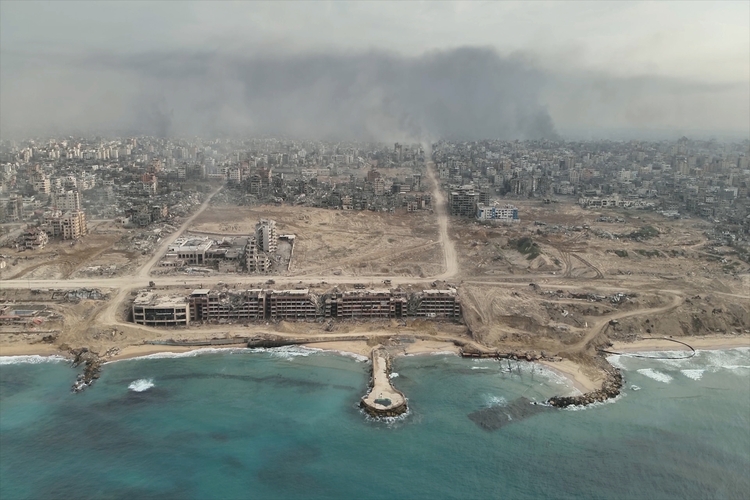
For the survey, researchers interviewed a ‘representative’ sample of 2,000 households in Gaza between December 20 2024 and January 5 2025, analysing changes since October 6 2023 and adjusting for displacement and areas that were difficult to reach. Three areas – North Gaza governorate, Gaza City and Rafah governorate – were inaccessible at the time of the survey, but researchers interviewed households that had fled these areas and were now living elsewhere. The survey found that the demographic profile of those killed closely matches Gaza’s Ministry of Health figures.
However, researchers say that reaching an exact and definitive figure of those killed in the conflict would take a significant amount of time and resources.
‘It is not a given that there will be a multimillion-pound research project to reconstruct what actually happened. It will be a long time before we get to a full accounting of all the people killed in Gaza, if we ever get there,’ Spagat said.
A spokesperson for the Israeli Embassy said the Lancet’s estimates are inaccurate and the outlet cannot be trusted to provide the correct death toll in Gaza.
‘A previous article published in the Lancet on 5 July 2024 made extreme estimates of the death toll which were widely debunked for being based on modelling rather than verifiable figures,’ said the spokesperson.