
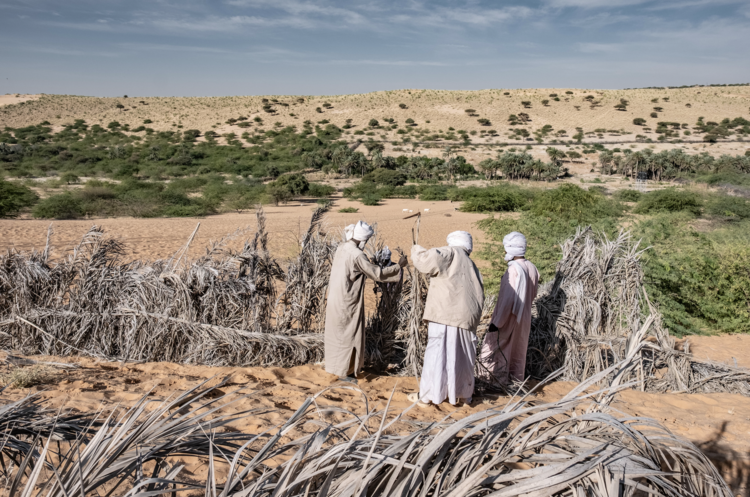
The Great Green Wall was meant to reshape the Sahel. But as drought, bureaucracy and fading funds take their toll, its legacy is uneven
Report by Julie Bourdin, Tommy Trenchard and Maya Misikir, photographs by Tommy Trenchard
A gust of hot wind sweeps up a swirl of dust from the parched field that was once Seydou Ka’s farm. Standing at the top of a derelict concrete tower that used to store hundreds of bags of seeds, the 70-year- old peers at the landscape of sand, shrubs and thorny trees that stretches as far as the eye can see.
Three cement wells stand empty on the plot – relics of a time when these five hectares near the village of Kadiar, in Senegal’s Ferlo desert, bustled with labourers working on green crops. Now, walking through the barren plot, Seydou Ka protects his face from the dust with a scarf. ‘There’s nothing left,’ he says with a sigh.
Enjoying this article? Check out our related reads:
When Ka was growing up, he says, this area was covered in trees – a forest so dense that young children were scared of venturing through it. Monkeys and parrots hid among the branches, and jackals roamed the land. But in the 1970s, devastating droughts transformed the landscape into an arid savannah.
‘From that moment on, everything started to dry up and many trees disappeared,’ he recalls.
So Ka was hopeful in 2011, when officials from Senegal’s environment ministry came to Kadiar and told villagers to start farming. He had long believed that, with just a little support, the land could return to its former glory. Now it seemed that help would finally come. The plot had been chosen to be part of one of the most ambitious environmental projects ever undertaken: the Great Green Wall.
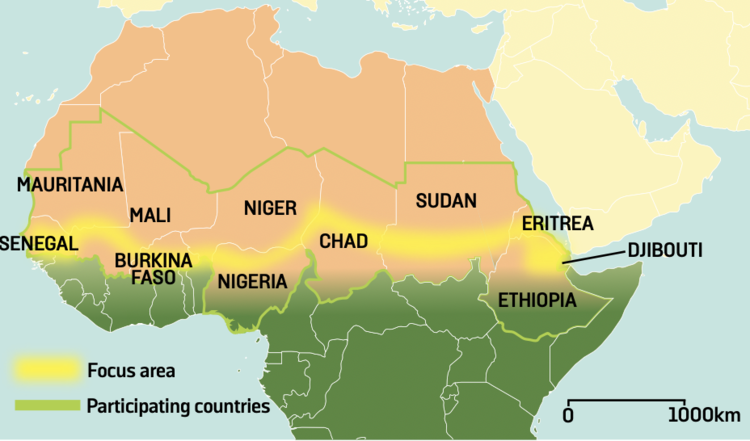
Launched to much fanfare by the African Union in 2007, the Great Green Wall’s concept was simple: planting a ‘wall’ of trees across the Sahel, the volatile region to the south of the Sahara, to stop desertification. Abdoulaye Wade, Senegal’s former president and one of the key figures involved in launching the project, described the desert as a ‘creeping cancer’. More than 135 million people in the Sahel rely on degraded land for their survival.
The Great Green Wall was meant to restore 100 million hectares of land by 2030, and create millions of ‘green jobs’. The initiative garnered billions of US dollars in international funding pledges, and was hailed as a panacea for the Sahel’s problems: hunger, conflict, migration.
‘It’s a mad project,’ admits Wade. ‘But a touch of madness can be useful when designing something that’s never been done before.’ The wall would stretch 8,000 kilometres across Africa, from Senegal in the west to Djibouti in the east. The UN said it would be a ‘new world wonder’. And Kadiar would be a part of it.

But five years from its deadline, the picture is much murkier. The Great Green Wall has fallen drastically short of its targets, bogged down in a morass of coordination issues, poorly designed projects and paque financing. While some initiatives have brought relief to vulnerable communities, across the Sahel, time and again, projects such as Ka’s farm have started up, only to wither away again.
At first, though, things had looked promising for the farm. Senegal’s Great Green Wall agency – tasked with overseeing the wall’s progress in the country – supplied seeds, fertilisers, tools and food. Villagers were trained in farming. Soon, 175 people were cultivating the land, planting citrus and mango trees, and producing more tomatoes than they could eat.
‘Harvests were abundant,’ Ka recalls. ‘We had even started to sell some produce.’ But the villagers earned little for their labour. Profits went not into people’s pockets, but into a bank account meant to support the farm. Some participants ended up leaving for another Great Green Wall initiative nearby. Others chose to focus on their own plots at home. Then, the money entrusted to the bank vanished – stolen, according to Ka. Eventually, the Great Green Wall officials stopped visiting.

‘All the trees that were planted died,’ laments Ka. ‘It brings me great sadness, after all the efforts that were put into this field.’
Kadiar’s story is repeated across the length of the Great Green Wall. A 2025 study published in Land Use Policy found that only two of 36 reforestation parcels assessed in Senegal showed significant re-greening. Of more than a dozen sites Geographical visited in Senegal, Chad and Djibouti, very few had survived beyond a couple of years – often undone by issues as simple as a broken fence or a faulty water pump. Sixty kilometres north of Kadiar, an acacia plantation was destroyed by cattle after funding to repair its chain-link fence was refused. In Djibouti, farming projects meant to provide a lifeline to nomadic communities had withered to nothing.

Originally envisioned as a vast tree-planting project, the wall was quickly reframed as a ‘mosaic’ of land restoration, re-greening and community development projects, after it became clear that countless trees were dying. But even these efforts have fared little better. By 2020, thirteen years after the initiative was launched, a UN report found that only four per cent of the wall’s target area had been ‘restored’. In 2021, international donors pledged another US$19billion (£14billion).
‘It’s quite incredible to think that, after 50 years of development projects that have failed because they weren’t adapted to local conditions, we keep doing the same thing,’ says Valerio Bini, a geographer and professor at the University of Milan who toured several sites in Senegal.
One of the main issues, according to researchers and officials in Great Green Wall countries, is that despite billions of dollars having been spent by international donors, very little has reached the national agencies originally tasked with overseeing the project.
The Wall ‘is surrounded by such “hype” that practical implementation falls to the background,’ write the authors of the 2025 study. ‘Africa’s GGW thus functions like a mirage: massive, inspirational and glistening in the distance, yet suddenly disappearing as one moves closer.’
Still, some experts point to successful initiatives – often the ones far away from the spotlight. In Niger, for instance, researchers found that farmers had been re-greening their own land since the 1980s – not by planting, but by protecting and managing the trees that grew naturally on their plots, a practice called farmer managed natural regeneration.
With no international funding or support, they had re-greened at least five million hectares in 20 years, research found – ‘the biggest positive environmental transformation in Africa’, according to sustainable land management specialist Chris Reij. Similar initiatives throughout the Sahel, in some cases supported by the Great Green Wall, have now re-greened more than 20 million hectares.
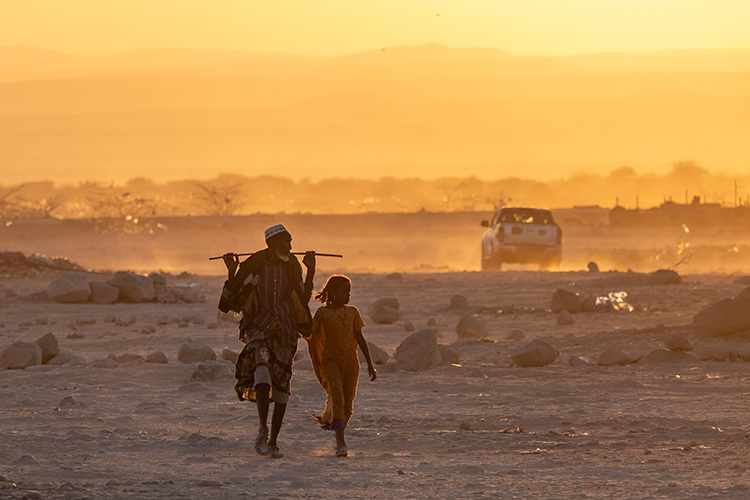
Of all the wall’s initiatives, experts say it’s those that provide tangible benefits to local communities that are most likely to succeed. Despite their vulnerability to precarious funding cycles and tedious red tape, some of the projects focusing on supporting community farms have undeniably had a positive impact.
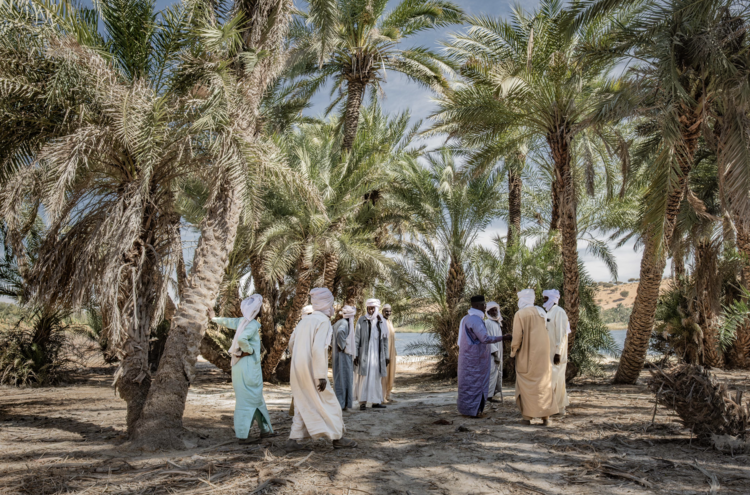
Deep in Chad’s Kanem province, 350 kilometres north of the capital, N’Djamena, the oasis of Barkadroussou appears like a mirage – a forest of palm and banana trees hugging a bright turquoise lake surrounded by golden sand dunes. In this hostile desert, such low-lying oases, known locally as wadis, are a lifeline for thousands of families. Yet they’re steadily disappearing. In 2014, international NGO SOS Sahel intervened to protect the area’s wadis in the Great Green Wall corridor.
‘When I was young, the dunes surrounding the wadi were much further away,’ says Issa Ousmane Tcharaba, the village chief, standing on the blinding white beach at the edge of the lake. ‘You couldn’t even see the end from here, but now they’ve moved much closer,’ he says with a sigh, gesturing at the dunes. Pushed by the wind and a hotter and drier climate, they now cast a menacing shadow only a few hundred metres away. ‘The wadi is almost completely buried under the sand.’
Fourteen small villages in the area depend on this oasis for their survival. For generations, locals have cultivated gardens in the trees’ shade, built striking white houses from the limestone-rich soil and collected spirulina – a blue-green alga – from the lake’s waters. ‘Without this wadi, people will leave for Libya or Saudi Arabia,’ Tcharaba says, joining the thousands who dig for gold and too often fall prey to human trafficking rings.
At the edge of the grove, a solar pump gushes a steady stream of shimmering water into a cement well. It was installed by SOS Sahel in 2014 and can irrigate up to 45 hectares. The organisation also supplied seeds, provided training and taught villagers to stabilise the dunes with hedges and palm-frond palisades.

More than a decade later, the results are striking. Today, more than 360 independent farmers cultivate bananas, maize, cassava, tomatoes, onions, sorghum and beetroot on flourishing plots under the dense canopy. Young men have returned from the gold fields. But in 2023, the project’s funding ran out. If the pump breaks, or the dune palisades fail, or the farmers’ seed stocks run out, it’ll be down to the farmers themselves to find a solution.
Just a few kilometres away, old palisades lie collapsed around the neighbouring oasis of Kaou. Around 50 villagers have gathered to fix them, wedging rows of palm fronds in the sand and weaving them tightly together in a bid to keep the encroaching dunes from swallowing their small vegetable gardens downhill.
‘Our lives depend on this wadi,’ explains 43-year-old Hereta Abakar Issa, who is raising her seven children in the village at the top of the dune. ‘It gives us water to drink and farm. We’re able to eat fresh okra and fresh tomatoes.’
The mood is upbeat, and women in bright dresses joke and chat as they work. But the challenge is colossal. Already, sand has started seeping through the small gaps in the palisades. ‘If the wadi disappears, I’m afraid I’ll have to leave,’ says Abakar Issa, sighing. Then she turns back around, picks up a thorny palm frond and plunges it into the ground.




