Greenpeace launches legal challenge against UK government’s decision to approve the transfer of two deep-sea exploration licences
By
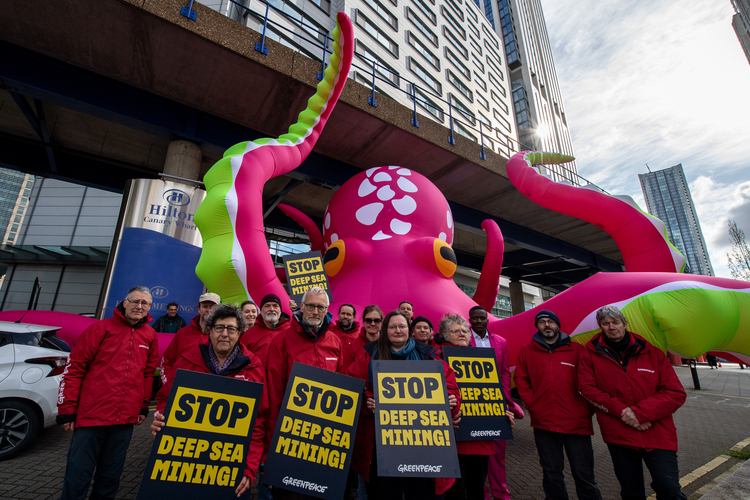
Greenpeace has launched a legal challenge against the UK government for their decision to approve the transfer of two exploration licenses in the Pacific Ocean to a ‘shady’ deep sea mining company called Glomar Minerals.
The environental group is concerned that licenses in the wrong hands could open the door to destructive deep-sea mining that could harm marine wildlife. It also said their transfer was inconsistent with the government’s calls for a moratorium on this harmful industry.
The Pre-Action Protocol letter sent by Greenpeace is the first step in a judicial review process. It states that the Business Secretary’s decision to transfer the licences could be in breach of international and domestic law.
The licenses concern two areas of the Clarion Clipperton Zone in the Pacific Ocean, spanning 133,000 square kilometres – an area larger than England. The zone is covered in polymetallic nodules containing metals that a handful of companies are desperate to mine in the future.
Enjoying this article? Check out our related reads…
But it is also home to precious marine life including whales, dolphins and extraordinary deep-sea creatures. A recent study by the Natural History Museum shows that even exploratory mining activity can reduce seafloor animal populations by almost 40 per cent.
Since 2012, these exploration licenses have been held by UK Seabed Resources Ltd (UKSRL), a company hat has been traded between a succession of foreign firms including the US defence giant Lockheed Martin. More recently, the licences were held by a small Norwegian company called Loke Marine Minerals AS, which went bust in April 2025.
The UK’s government’s continue sponsorship of exploration licenses contradicts its official public position in support of a moratorium ‘until sufficient scientific evidence is available to assess the impact on marine ecosystems, and strong, enforceable environmental regulations, standards and guidelines are adopted by the ISA [International Seabed Authority].’
Glomar Minerals is registered in the UK but is mostly owned and managed by companies and individuals based overseas. Raphael Isaac Meir Diamond is listed as its main controller. Mr Diamond is based in the US and is the founder and executive chairman of SAFE, a US lobby group which issued a statement of support for President Trump’s executive order on deep-sea mining, which is widely regarded to be a breach of international law.
More than 900 scientists and policy experts, 40 governments from Europe to the Pacific, and businesses including Google, BMW, Volvo and Renault are all calling for a pause on deep sea mining. Major UK bankshave ruled out financing the industry and other international investors are also pulling out. Indigenous Peoples in the Pacific have also raised strong objections, warning that deep sea mining threatens ocean ecosystems on which their lives and livelihoods depend.
What is deep-sea mining?
Deep-sea mining involves heavy machinery scooping up rare metals and minerals from the ocean floor from nodules located thousands of metres below sea-level. Metals like cobalt and nickel are of particular interest to companies who use them to create products such as electronics and computer chips. These minerals would then be pumped up to the surface, using machinery weighing more than a blue whale.
The industry is very new – apart from small tests, no commercial mining has yet to occur.
Like mining on land, deep-sea mining is extremely destructive. The nodules containing metal and mineral deposits are likely valuable ecosystems that cannot be replaced once removed. Mining these deposits would also destroy biodiversity and habitats that aren’t yet fully understood.
Undersea mining can also lead to an increase in underwater noise, causing extreme disruption to marine mammals like dolphins and whales who use echolocation as a primary means of communication and sensing.