NOAA ends support for Arctic climate and environment report after nearly two decades of monitoring the rapidly changing region
By
The Trump administration has announced it will pull federal support from an annual report on the Arctic and its environment, a statement released by the National Oceanic and Atmospheric Administration (NOAA) said on Tuesday.
Kim Doster, the communications director of NOAA, said: ‘Coordination of the 2026 Arctic Report Card will not be facilitated through NOAA … all data historically contributed by NOAA to the product will continue to be collected and will remain publicly available.’
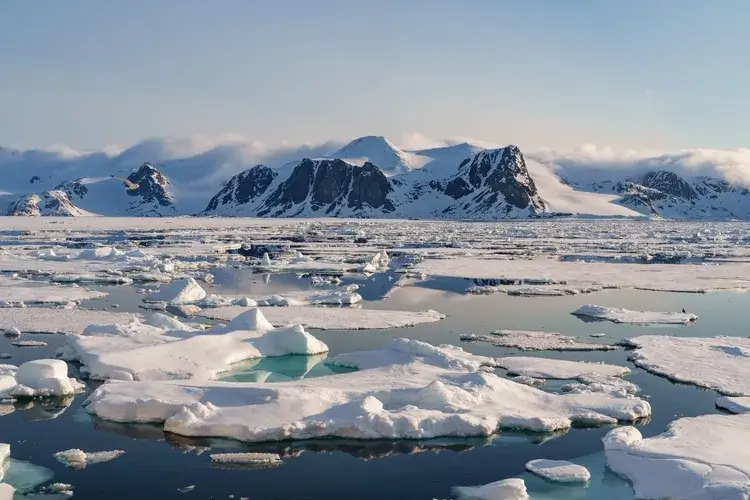
The report brings together peer-reviewed studies about Arctic conditions such as sea ice thickness, air temperature and the status of Arctic wildlife species. Recent editions of the report have included chapters on Indigenous knowledge and concerns.
Enjoying this article? Check out our related reads…
It has also been a critical tool for informing decisions and policies in the region, which is warming four times faster than anywhere else on the planet.
Among other findings, the 2025 Arctic Report Card discovered that surface temperatures across the Arctic from October 2024 through September 2025 were the warmest recorded since 1900. It also found that ongoing glacier loss has contributed to rising global sea levels.
‘What happens in the Arctic doesn’t stay in the Arctic. Its rapid warming has profound consequences for Arctic communities, ocean health, and our global climate,’ said vice president of the Arctic and northern waters for the environmental group Ocean Conservancy Wáahlaal Gíidaak.
‘We are already seeing the devastating impacts of extreme heat around the world, and those changes are even more pronounced in our ocean, which acts as a global heat sink. We cannot afford to look away from what is happening in the Arctic, or stop measuring it. We should continue to fund critical NOAA programmes, such as the report card, which are essential to protecting our ocean and keeping Americans safe.’
Although NOAA will no longer provide administrative support for the report – known as the Arctic Report Card – NOAA scientists and programs will continue to collect climate data.
The report has been published by the National Oceanic and Atmospheric Administration since 2006, and is typically released in mid-December.

One of the Arctic Report Cards’ editors and a scientist at the National Snow and Ice Data Center Twila Moon said: ‘Even if we’re able to move the Arctic Report Card forward in a way that brings information to people, there’s still a real loss in this not being a US federal effort. That’s a real stepping back of US leadership in the science arena, in the environmental intelligence arena, and that kind of has a whole other flavor of harm as well.’
The Trump administration’s decision to move away from the Arctic Report Card is just one example of the rollbacks taking effect since Trump took office in January 2025.
In January 2026, Trump decided to withdraw the US from the UN Framework Convention on Climate Change (UNFCCC), a bedrock treaty underpinning global efforts to prevent global warming.
Just one month later, the administration announced plans to revoke an Obama-era regulation that serves as the basis for combating greenhouse gas emissions in the US.
Earlier this year, the Trump administration also attempted to dismantle a $368million deep-sea observation system made up of 900 instruments, providing crucial data on oceans, climate change and marine biodiversity.