After decades of cultural suppression, a new generation is picking up the i‘e to reconnect with a history that was almost erased
When Hinatea Colombani set out to make her first tapa, there was no one left to show her how. All she had was the bark she’d cut from a mulberry tree and an i‘e – the tool to turn it into cloth. ‘It was like we had all the ingredients to make a cake, but no recipe to follow.’
She unrolls a length of cream-coloured material roughly the width and length of a table runner. It smells faintly of coconut oil and feels soft, like suede.
Today, clothing around the world is made from woven fabrics such as cotton, silk and synthetic polyester. But 150 years ago, barkcloth was still the textile of choice across the tropics, from Central Africa and the Amazon to Southeast Asia and the Pacific.
Enjoying this article? Check out our related reads…
Barkcloth – tapa, as it’s known in Tahiti – is crafted from the fibrous inner bark of select trees: the wild fig in Central and East Africa; the banyan tree in Vanuatu and the Solomon Islands; the breadfruit tree, which grows throughout the tropical belt; and the paper mulberry in the Polynesian islands. But while production has continued on islands such as Tonga, Fiji and Papua New Guinea, in Tahiti the practice of making tapa had all but died out.
Colombani, who teaches ‘ori Tahiti (traditional dance), grew up knowing that tapa – and the technique used to make it – were culturally important. She vividly remembers wearing her first barkcloth skirt as a young dancer, a moment made possible by her mother and grandmother. Their own lives had been shaped by the legacy of colonial efforts to erase Tahitian identity, from the suppression of the Reo Mā’ohi language to the shame (ha‘amā) they were made to feel about ‘ori Tahiti – a dance deemed too risqué for civilised society.
British missionaries arriving in the 19th century imported European cotton textiles, mandating their use as a mark of Christian modesty. While French Polynesia – a collection of five archipelagos and 118 islands, of which Tahiti is the largest – remains an overseas collectivity of France, new generations of Tahitians are increasingly reclaiming a cultural heritage that was nearly lost.
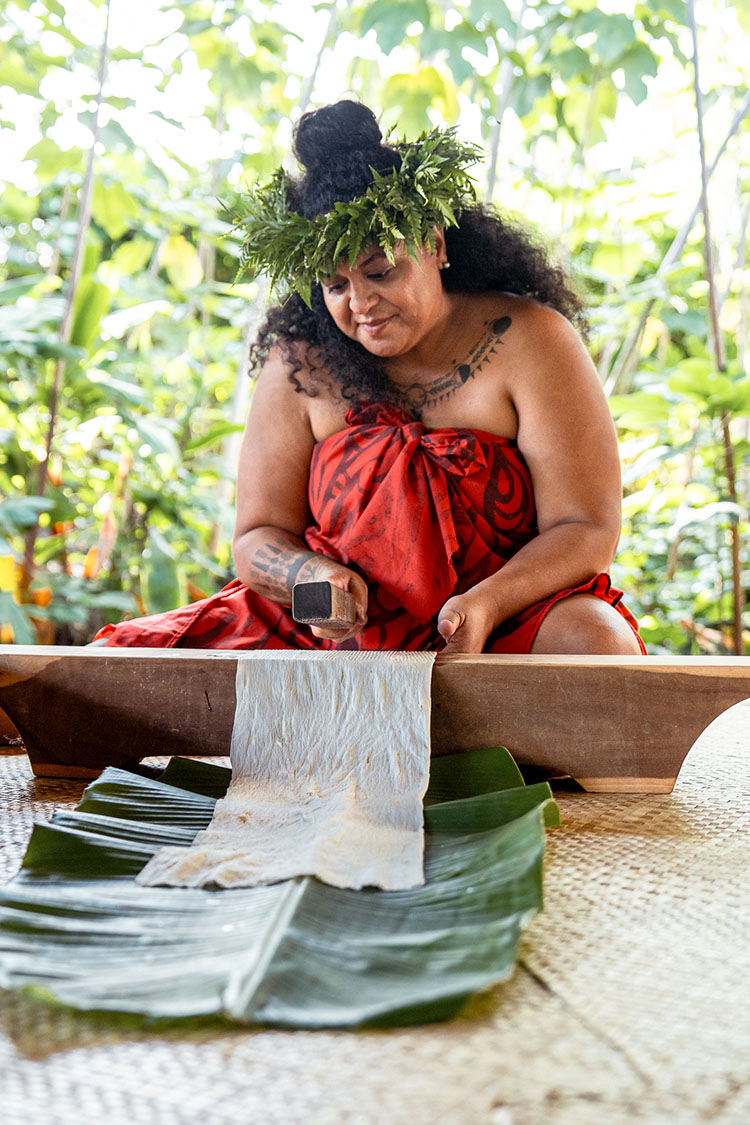
The tapa that Colombani now holds in her hands was not, she points out with a laugh, the first barkcloth that she attempted to make – ‘that one is best forgotten about.’ Through much trial and error, and with the help of her partner, Moe Meder, she spent hours mastering the technique. It’s a long and labour-intensive process of stripping, soaking, beating (with the wooden i‘e) and felting – all of which bonds the bark fibres together – before it is dried and painted.
‘Most people would say it takes a week to make a tapa like this, but I say it takes two years and one week, because I acknowledge the time it takes for the plant to grow.’
Introduced to Tahiti by early Polynesian settlers more than a millennium ago, the paper mulberry (Broussonetia papyrifera) almost disappeared from the island alongside the craft of barkcloth making. Today, Colombani and Meder tend a garden of 300 trees – a population they rebuilt from three coppiced plants. Each tree requires constant attention: the couple prunes them weekly to suppress new buds, ensuring the trunks remain smooth and branchless to avoid creating holes in the finished tapa.
Her mastery of the craft has gained widespread international recognition, leading to collaborations with major institutions across Oceania and Europe. Most recently, her work was featured at The Box in Plymouth as part of the Journeys with Mai exhibition, which ran from February to June this year.
In Tahiti, interest in wearing tapa is growing once more, especially for special occasions. ‘We get calls from people who are planning a wedding or baptism,’ says Colombani, highlighting a reconciliation between Christianity – still the island’s dominant religion – and traditional culture. In response, in 2021 she and Meder opened ‘ARIOI Cultural Centre, Tahiti’s first cultural centre, a project that Colombani has largely self-funded and which provides youth programmes and classes for islanders looking to rediscover their roots.
‘Nowadays, we teach people how to make tapa. It’s a way to reclaim their identity, their history, all while having a clear vision of what our future should look like.’