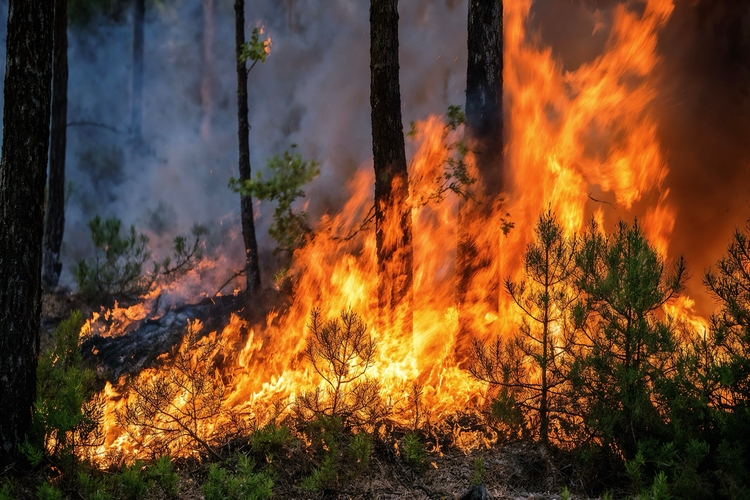
How firescapes are reshaping our landscapes, homes and the way we learn to survive as temperatures rise

By Alastair Bonnett, Professor of Social Geography at Newcastle University
This summer is posing pressing questions about fire, such as what burns and what doesn’t and where we can run for safety. When we look at a landscape with these questions in mind, we’re looking at a ‘firescape’. Firescapes are not just a terrain of terror; they contain rules, principles, and instructions about what and where to plant, build and flee to.
I first learnt about firescapes in the French city of Bordeaux a few years ago, when – although the danger was not nearly as close or as dangerous as today – the city was being threatened by forest fires. Bordeaux has plenty of expertise in managing fire. I was told that any town surrounded by pines, each packed with oily resins, might as well be circled by fuel trucks. I also discovered a disconcerting fact: one kilogram of dry vegetation has the energy to power a lightbulb for 24 hours, but all that energy is released, suddenly, explosively, by ten seconds of fire.
Enjoying this article? Check out our related reads…
Heat and fuel. You need both. There is no fire risk in the world’s hottest spots. There are few fires in the Sahara because there is nothing to burn. It’s in cooler places, lush with woods and gardens, where the danger lurks. It’s a painful paradox: trees are fire risks but vital to our existence. Forests have a key role in reducing pollution and chilling the climate at every scale. Trees cool the pavement and the planet. They are our friend, but they can be a serious foe. What are we to do?
An intense period of experimentation and trial and error has begun. The creation of firescapes that can ward off calamity has a long history. On the roads leading out of Bordeaux are traditional firebreaks, serried strips of cleared forest. The first recorded use of a firebreak in Britain was during the height of the Great Fire of London in 1666. Troops from the Tower of London used gunpowder and breaking equipment to remove buildings around the blaze and so got it under control. The same idea was seen again on Van Ness Avenue during the San Francisco earthquake of 1906. A mile of grand mansions was dynamited to stop the spread of fire. One of the world’s biggest fire breaks is, or rather was, the ‘Great Wall of California’, a 1,300-kilometre clearway through the Sierra Nevada built during the 1930s by unemployed, depression-era labour. It worked, protecting California’s forests for decades. But the hard part of firebreaks isn’t making them but keeping them going. The ‘Great Wall’ has gone to seed; trees tangle across it; an expensive, lifesaving asset wasted.
Fire defence can’t afford such missteps. The new model is to neglect nothing and try everything. Firebreaks are not enough. In Bordeaux, the plan was (and I guess still is) to plant hardwoods along roadsides. Oaks are slow to burn, but pines go up like a firework. In a warming world, surrounding cities – or your home – with pines and eucalyptus is not a smart move. Eric Rigolot, who works at France’s national forest research centre, says diversity of planting can ‘break the fire’, explaining that ‘certain hardwoods such as the cork oak burn less than maritime pines’. But he has a warning; don’t rely on them: hardwoods ‘can’t make miracles’, he says, ‘in today’s conditions, everything burns’.
Vineyards are all over this part of France and are another example of a resistant ‘greenbelt’: an irrigated, weeded, low-burn landscape. So too are golf courses, though there is a limit on the number any city would want. Vineyards, along with fruit trees, both citrus and apple, are a better bet – they are all slow burners – and they can help defend cities. There is no reason why firescapes have to be ugly. Roads lined with oaks and fruit trees would protect us and make the journey into town a happier one.
The planet is busy with people trying to figure out how to curb wildfires. Starving them of fuel by burning low-lying vegetation is an ancient solution. Over the last century it almost ceased, as fire began to be imagined as a freak event, to be dealt with by professional firefighters. The EU’s new fire chief, Domingos Viegas, head of FirEUrisk, has been pushing for a reappraisal and a fresh approach. ‘It is necessary to bring fire back’ he says, especially ‘in countries where vegetation grows very fast, like in southern Europe, where there aren’t the means to remove weeds mechanically or by hand’. Getting local people onside will be key. It isn’t practical to rely on paid firefighters anymore: the problem is just too big. All sorts of training and outreach programmes have sprung up, from the Greek islands to the Sydney suburbs, getting citizens prepared, active and informed. If you want a portrait of a 21st-century firefighter, then look in the mirror.
There is no shortage of advice. ‘The worst thing you can do is flee by car or on foot because you will have no defence’, Viegas instructs, adding ‘houses made of brick and stone, in principle provide good shelter’.
Did he say ‘in principle’? It’s not reassuring. My first encounter with wildfire was on the balcony of a stout brick-built house in the Sydney suburbs. I was enjoying a beer with Wendy Shaw, an Australian pal and fellow geographer, when she spied smoke clouds at two spots at what I took to be the far distance. The smoke was miles away; I smiled, I laughed. My wet British complacency did not last long. It evaporated under the hot sun and Wendy’s look of alarm. Like so many Australians, she has had direct and close experience of how quickly they can get out of control. On this occasion, we didn’t have to decide between bunkering down or fleeing. The wind was not blowing our way.
Firescapes can be big, public schemes, but most are closer to home. What can I do to keep my property safe? Greg Webb’s new house is a three-hour drive down the coast from Sydney and is just one of thousands of examples of an answer to that question. He has built it on a hillside overlooking Lake Conjola after his old home burnt down during what Australians call a Black Summer, a summer of wildfires. White-haired, tall, bony and worried-looking, Greg was traumatised, for he had already done everything that the authorities advised. ‘I cleared timbers away, I had no shrubs near the house’, he says, but adds, sadly, that ‘all of those features that made it a quaint holiday house were just wicks of ignition’. When the fire came roaring through the bush, he and his wife hid under their home, trying to ‘get away from the embers and the violence of it all’. It must have been terrifying. It’s no surprise that since that day he’s been on a mission to make the most resilient home he can. His new place goes above and beyond the old regulations and all the new ones that have now come in; including Australia’s Bushfire Attack Level ratings that, in fire-prone areas, come with mandated protections.
Greg explains that after his house burnt down, all that was left was ‘bricks, concrete and steel’, so he concluded ‘that’s what I’ve got to build my new house from’. It has wonderful sweeping views over the lake, but it’s also a bunker, with bushfire shutters and steel guttering.

Kate Cotter of Australia’s Bushfire Building Council worries that new builds like Greg’s are more the exception than the rule. ‘The way we’re building is like fast fashion’ she says, done on the cheap. Resilience against fire is, in the short term, an expensive option and it can be complex; there are so many things to get right. One of the key things that Australian fire researchers have discovered is that it’s not just about materials, or what surrounds your house that counts; it’s also the lie of the land. Perhaps Gregg shouldn’t have chosen a hillside, because fire accelerates exponentially when moving up or down a hill. The rate fire moves on flat ground is doubled for each additional 10 degrees of slope. This means that if your home is on a 20-degree slope, the fire will be moving at 20 km/hour. Too fast to outrun.
All sorts of policies and codes are rolling our way. In the USA, a new industry has developed around telling people how to manage their ‘Home Ignition Zones’, the name given to the concentric rings – 5 feet, 30 feet, 100 feet and 200 feet – designated by state authorities. Each zone comes with a to-do list, such as ‘keep your roof clear of leaves’ and, at 30 feet, ‘remove all scattered trees and keep grass mowed’. These are easy wins and barely have a price tag, but there are plenty of more costly impacts, and the biggest of all is insurance. The market for fire insurance has stopped functioning in large swaths of the USA. Millions of people now live in places too risky to cover.
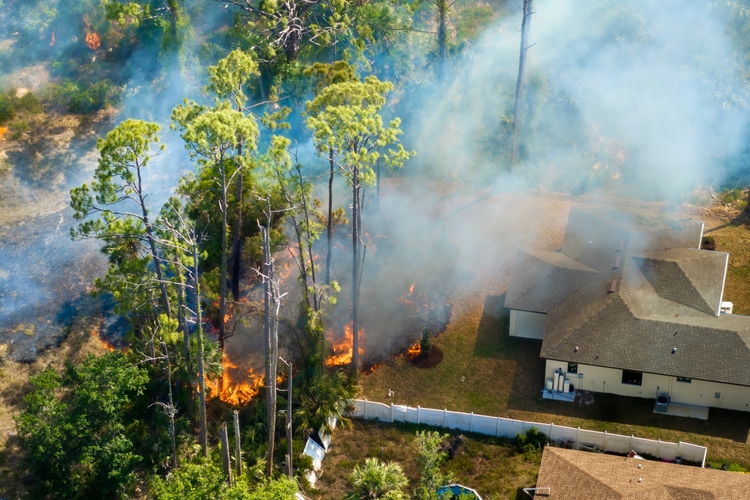
Public finances are being gouged. Cities, regions, and countries are having to dig deep, with many fire budgets rising severalfold across Europe, Asia and the Americas. In 2022 the UN issued a major new report, ‘Spreading like Wildfire: The Rising Threat of Extraordinary Landscape Fire’ which called for a radical shift from response to prevention. Response mode is still the default mode. In Australia, the most fire-risk aware country I know, 97 per cent of disaster funding is spent after the event.
Unfortunately, prevention continues to be politicised. The only serious form of prevention is tackling global warming and climate change but, in many countries the political appetite for action has evaporated. Firescapes point to a future where we will have to be a lot more careful about what we plant and where we live. But, as this summer is showing us, as temperatures rise, the risk cannot be magicked away by clever landscape management. The forests of South West France were already protected by firebreaks, but there comes a point when it is so hot and dry that fire will leap our defences.