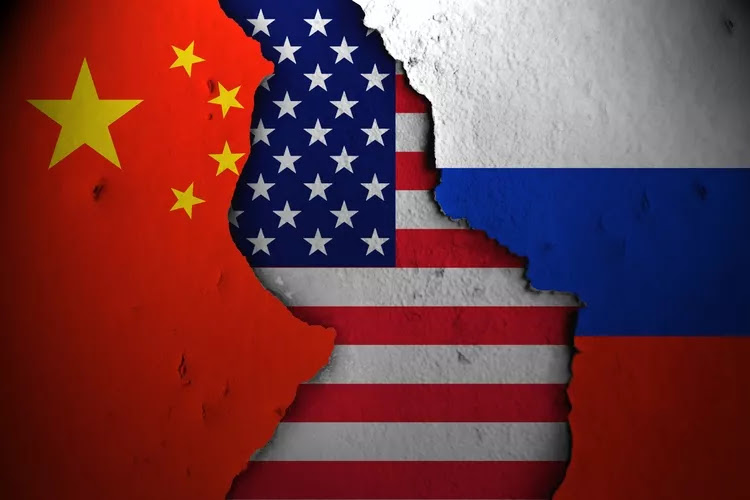

As Washington, Moscow and Beijing pursue competing spheres of influence, the international order faces a test of sovereignty and cooperation
By Nicholas Westcott
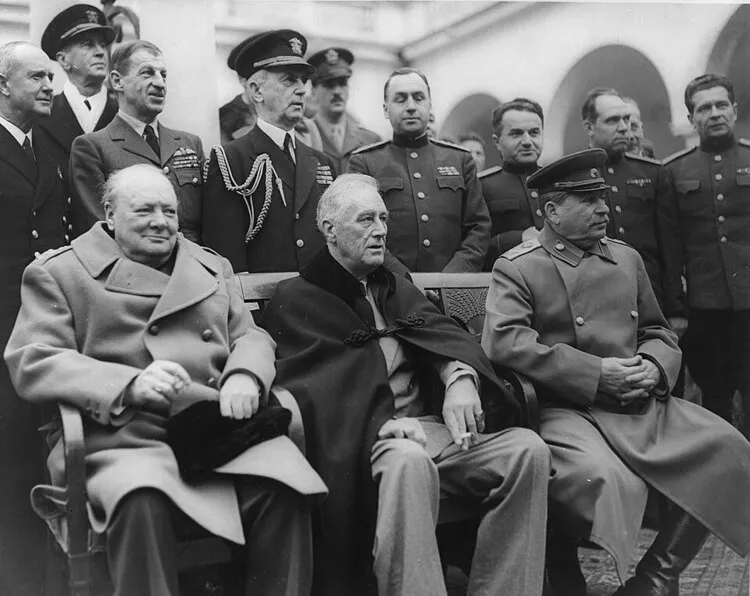
Discussions are underway for a potential meeting between Donald Trump, Xi Jinping and Vladimir Putin on the margins of the Asia-Pacific Economic Cooperation summit on November 18-19. The prospect has prompted comparisons with the ‘Big Three’ summit in Yalta in February 1945 at which the leaders of Britain, the US and the Soviet Union discussed a carve up of the world following the second world war.
It is clear that Trump, Xi and Putin, each in charge of a country that considers itself a ‘great power‘, rather like the idea of a new world order that will revolve around them. The US president appears to see himself as one of a modern triumvirate with presidents Putin and Xi who – like their 1945 predecessors – can propose and dispose of other nations as they please.
For these leaders alone, Trump appears to show respect and deference – compared to the disdain he demonstrates for most others presidents and prime ministers.
The 2025 US national security strategy was explicit that the western hemisphere should be considered a region of US predominance, and implied that Russia and China could have similar spheres of influence. The US-imposed change of leadership in Venezuela, and support for sympathetic populist regimes in Latin America suggest the US is serious about this.
Putin’s aim to restore Russian control over Ukraine by force of arms, meanwhile, and his use of bribery, threats and subversion to surround Russia with sympathetic regimes in the former Soviet sphere, is equally clear.
Xi has made no secret of his aim to recover control over Taiwan, and is evidently keen to exert Chinese influence in Myanmar and more broadly in south-east Asia and the South China Sea.
All three appear to regard Europe – and specifically the European Union – as an obstacle to the acceptance of their worldview.
The EU shows how countries can achieve stability and prosperity by agreeing to share sovereignty and abide by common rules, with human rights and the rule of law at the heart of the arrangement.
The US and Russia both appear bent on weakening Europe by stoking grievances against the established order and supporting anti-EU populist parties that they hope will undermine its unity.
Of course, imperialism involves more than just physical control over territory. Ultimately, it’s about who makes the important decisions about resource distribution, trade, security and government. Partly for that reason, in the years after the second world war, the so-called “liberal” international order appeared a lot less liberal to many states who had only recently won their independence.
Many felt that neo-colonial control continued long after the formal reins of power had been handed over through imposed economic and governance norms. For them, imperialism never really went away: it just took new forms.
But the world has changed out of all recognition since the heyday of imperialism in the 19th century. Empire was a common enough form of government for millennia because it was an effective way to bring people of different faiths, cultures, languages and locations under a single authority that imposed order. But it could not survive the rise of nationalism, based around a single culture, ethnicity, language and more centralised government.
This competitive nationalism proved chronically unstable. Though a precarious balance of power kept major conflicts at bay for a while, it led ultimately to the two most destructive world wars in human history between 1914 and 1945. By the end of the latter, mankind had developed the ability to destroy itself utterly – and world leaders decided there must be a better way of settling differences.
Towards a new world order
From 43 member states in 1946, the UN has grown to 193 members, many having struggled for an independence they are determined to keep. The post-war multilateral order helped end empires and sought to make the world safe for small countries so that people and land could no longer be traded like properties in a game of Monopoly.
The people themselves, as the Greenlanders recently demonstrated, refuse to be traded – and Iranians as much as Ukrainians have shown they are willing to fight to choose their own government, not have it imposed by others (and it remains to be seen how long Delcy Rodríguez lasts as the US-installed interim president of Venezuela).
Alongside this, trade and technology have transformed relations between people and states. Globalisation may be unfashionable, but it is still a reality. The volume of world trade has increased by about 4,500 per cent since 1950, and has underpinned substantial growth in both population and incomes. Leaders, democratic or not, need that prosperity to continue if they are to stay in power.
Technology has had an equally profound impact. The internet has connected people around the globe, even if it is dominated by a few US companies and rigorously controlled in a few countries by authoritarian states. And the development of new, effective military tech, such as drones, has transformed the way wars are fought.
We’re seeing that playing out in Iran and Ukraine. In these wars, and in Iraq, Afghanistan, Syria and Gaza, regardless of the imbalance in power, the ‘weak’ have been able to inflict unbearable pain on the ‘strong’. Force alone no longer works as a way to settle disputes. It leads instead only to ‘forever wars’ in which no one is willing to admit defeat.
Related reads…
These wars also show that having friends is as important for success as having manpower, money and military equipment. Trump’s dismissive treatment of the US’s traditional allies has done great damage to American power and influence in the world. It will be hard for whoever becomes president in 2028 to repair that.
Will the ‘middle powers’ rally to preserve a rules-based order, as Canadian prime minister Mark Carney hopes? In practice, they are too divergent a group, many of which (in the Middle East, for example) are as likely to seek individual advantage from the decaying order as they are to work to build a better system that constrains them.
But of the world’s 193 states, all but a few are small- and medium-sized countries whose interest is overwhelmingly in having a global order that continues to observe some rules, respects the rights of others, and allows global commerce to flourish peacefully. It is not the middle powers but the small who have the greatest interest in preserving a rules-based order.
The question is who can rally them to preserve – even enhance – the liberty they have achieved? That is what the leaders of the world’s remaining democracies should be focusing on.