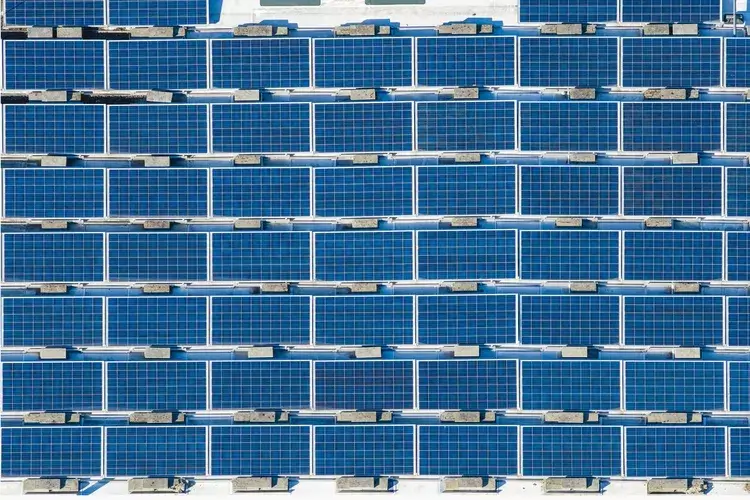

While AI threatens office jobs, the green transition needs people who can work with their hands. Are we doing enough to develop their skills?
By Fabian Stephany
The future of work currently looks rather gloomy. Open a newspaper, scroll through LinkedIn or listen to the pronouncements coming out of Silicon Valley and you could be forgiven for thinking that artificial intelligence is about to make large parts of the workforce redundant.
Yet we may be looking in the wrong place.
Much of the debate focuses on office work and asks which jobs AI will replace next, but if we look beyond the desk, a rather different picture emerges. Many forms of manual work aren’t disappearing. In fact, demand for them is growing rapidly. There’s an important distinction here. Repetitive manual tasks have been automated for decades. But non-routine manual work is much harder to replace. It requires dexterity, judgement and the ability to respond to an unpredictable physical environment. These skills are difficult for machines to replicate and, importantly, they are increasingly needed.
We tend to imagine the green economy as a technological story: better batteries, smarter electricity grids, carbon capture or more efficient renewable energy. But technology does remarkably little on its own. Someone has to put it into the physical world.
And this is true almost regardless of where you sit in the climate debate. Whether we concentrate on reducing emissions, adapting to a warmer planet or actively reversing environmental damage, all these approaches require an enormous amount of human work.
Changing how we heat our homes requires skilled workers. So does making buildings resilient to extreme temperatures, maintaining renewable-energy infrastructure and restoring landscapes. These are jobs that often require people to work skilfully with their hands.
Many of the ‘green skills’ now entering the labour market are manual skills. Workers from construction, utilities and even mining can be surprisingly well positioned to move into the green economy.
Related reads…
The numbers already point in this direction. Global renewable-energy employment reached 16.6 million in 2024, according to the International Renewable Energy Agency and the International Labour Organization. Although annual growth slowed to 2.3 per cent, the sector continues to provide millions of jobs. In the USA, wind turbine technicians and solar panel installers are among the occupations projected to grow fastest. A wind turbine may be an impressive piece of technology, but somebody still has to install and maintain it. A heat pump is only useful once somebody has fitted it properly. And retrofitting an old building requires someone who can deal with all the surprises that come with working in the real world.
This is why the green transition is not only a technological transition – it’s a skills transition. Unfortunately, our economies are not adapting particularly well to this change.
Across labour markets, there’s a persistent gap between the skills employers need and those available in the workforce. In April 2025, the European Labour Authority reported that 80 per cent of employers in the EU had difficulty recruiting people with the right skills and qualifications. Shortages remain pronounced in many skilled trades – precisely the occupations needed to install clean-energy technologies and improve our buildings.
In my book Skilled, I argue that closing this gap requires us to rethink how we value manual skills. One important step is to improve the reputation of vocational training. Practical skills have always been essential to our economies, but they’re gaining new importance as the environmental transition increases demand for electricians, technicians, builders and other skilled workers.

Countries such as Germany offer a useful model. Vocational training has traditionally been a much stronger institution there, with apprenticeships providing an established route into skilled employment and carrying less of the stigma that vocational education still faces elsewhere.
Workplaces need to become places of learning, too. Firms are often among the first to know which skills are becoming valuable, and they should have a much larger role in continuously developing them. Governments can help align these incentives.
One possibility is to reward companies that genuinely invest in building the skills of their workforce through the tax system, making investment in people more attractive rather than treating training as a cost that can easily be cut. A skilled workforce is a benefit for our society as a whole. We spend an enormous amount of time asking which jobs AI might take away. Perhaps we should devote more attention to a different question: where will millions of new workers be needed, and do they have the skills to do those jobs? The environmental transition gives us a remarkably clear answer to the first question.
The challenge now is getting the second one right.