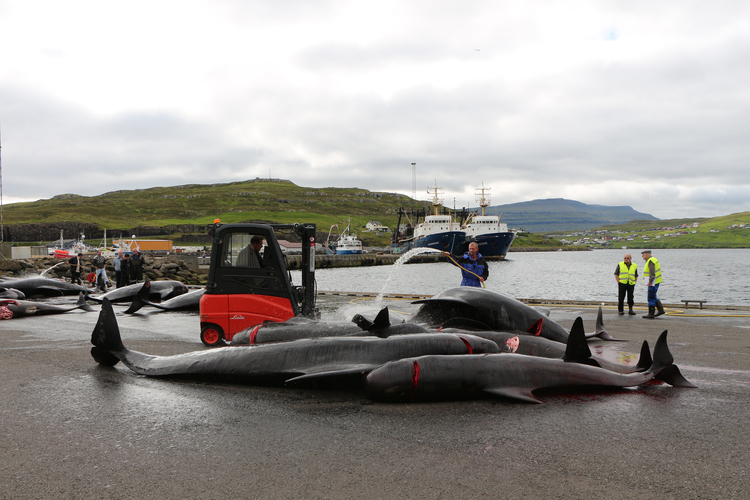

Sarah Champion MP discusses the harmful impacts that the grindadráp has upon pilot whales and dolphins across the Faroese islands

Although not known to many, the grindadráp is a traditional Faroese hunt in which more than 1,000 pilot whales and dolphins each year are driven into shallow bays and killed.
Despite picturesque rolling hills and breathtaking coastal landscapes, the killing of these marine mammals in the Faroese grindadráp – the Faroes word for the hunts –has become one of the most disturbing events in Europe – just 200 miles off the coast of Scotland.
Although often defended as a cultural ritual, it is increasingly clear that many Faroese citizens neither participate in nor support the practice. Far from being a united tradition, the grind exists against a backdrop of societal pressure that has prevented open debate in the Islands, and it must end. As Chair of the APPG for the Ocean, I have seen how intimately connected the North Atlantic’s marine systems are. All too often, our focus on net zero and wildlife protection is centred on land, but just because a particular event feels far detached from our everyday lives does not mean it is without serious consequences.
Enjoying this article? Check out our related reads:
When whales and dolphins are harmed in one part of the ocean, the ecological consequences do not stop at national borders. These species transport nutrients, influence the distribution of marine life, and help sustain entire ecosystems. Protecting them is not a niche concern but a core part of safeguarding the health of our shared waters.
Perhaps the most troubling element of the grindadráp is the killing of pregnant whales and young animals. No credible conservationist would argue that taking the most reproductively important individuals can ever be sustainable. It contradicts any attempt to justify the hunts as environmentally responsible. Britain has long contributed to international marine conservation, from supporting the commercial whaling moratorium to advocating the protection of vulnerable cetaceans. Building on this legacy, I have used the APPG to push for stronger UK leadership on marine welfare.
This includes supporting the Global Ocean Treaty, advocating for expanded Marine Protected Areas, and pressing for stricter controls on destructive practices like bottom trawling. By raising these issues in Parliament and fostering cross-party collaboration, the APPG highlights the urgent need to protect species whose survival is critical to the health of our oceans.
The grindadráp is a stark reminder that threats to marine life are not confined to national waters. Leadership in marine conservation requires vigilance, international cooperation, and a commitment to science-based policy. With ocean temperatures rising and pollution increasing, our duty to protect whales, dolphins, and the ecosystems they support has never been more urgent.
Labour’s approach to marine conservation has historically been rooted in science, sustainability and fairness. That has meant championing the High Seas, or BBNJ Treaty, enhancing marine protected areas and pushing for stronger measures to reduce bycatch in UK fisheries.
The Government also recognises that marine mammal welfare is inseparable from wider marine policy. Whether tackling plastic pollution, restoring coastal habitats or supporting clean, sustainable fishing, we see the protection of marine life as fundamental to a healthy world.
Yet, the UK’s trading relationship with the Faroes adds another layer of responsibility. If imported fish is tied to the hunting of whales and dolphins, consumers must be able to make ethical choices based on accurate information. Our trade partnerships should reflect shared environmental values, not undermine them. When dialogue is insufficient, responsible use of trade leverage can help amplify the voices of those in the Faroes who are already calling for change but do not feel able to speak publicly.
Years of working on marine issues have made one thing abundantly clear to me: the well-being of our oceans and our people cannot be separated, which is why ministers must build on their calls directly with the Faroese to end the hunts, not as a symbolic gesture but as a practical, moral and ecological necessity. Ending the grindadráp is not about imposing British values on another nation. It is about ensuring that decisions affecting shared marine species are made responsibly and transparently. It is also about supporting the many Faroese citizens who oppose the hunts but feel unable to speak out.
Britain can and should continue to be a principled voice for ocean conservation. Labour’s proud record over successive governments shows this. But we must do more.
Our stance must reflect a commitment to compassion and scientific integrity. Whales and dolphins are vital to the life of our oceans and protecting them is key for our collective future. Politics can feel hugely divisive at the moment, but this is one issue that unites us all in horror and equal determination to see the hunts end.
We need our Labour Government to lead once again, as it has done in the past, working across Whitehall departments to make clear to the Faroese that the grind must stop.