Once a sleepy, duty-free mountain village, Livigno is about to host the world’s best skiers and snowboarders – and four British medal hopefuls
By
The Italian village of Livigno is not, ordinarily, a place that feels like the centre of the universe. Located at 1,816 metres above sea level on a remote, high-altitude plateau near the Swiss border, it’s known to locals as ‘Little Tibet’: a place so remote that it was granted special duty-free status in medieval times, as rulers sought to ease the financial burden on its hardscrabble residents – and the travel burden on their own tax collectors.
Yet for two weeks at the beginning of February, the focus of the world will fall on this tiny town (population 7,000) as it hosts some of the most eye-catching events of the Winter Olympics.
The decision to spread the events of what is officially called the Milano Cortina 2026 Games across northern Italy was taken for two reasons.
First, the organising committee wanted to make use of existing sporting facilities to reduce both the costs and the environmental impact of hosting the Games.
This objective was somewhat undermined by the Italian government’s approval of a brand-new, €118 million bobsleigh track in Cortina, where a previous facility was mothballed as recently as 2008 because of underuse. But for the most part, the hope is that revamping and reusing existing courses and stadia will reduce the risk of white elephants.
Enjoying this article? Check out our related reads…
The Italian organisers’ second main aim was to showcase more than just the city of Milan and the already-celebrated ski resort of Cortina d’Ampezzo. And so the events will take place in eight host locations, spread across 22,000 square kilometres.
Livigno, a 210-kilometre drive from Milan and 270 kilometres from Cortina, is among the most remote. But it promises to be of particular interest to Brits, because four of Team GB’s brightest medal hopes – freestyle skiers Zoe Atkin and Kirsty Muir, freestyle snowboarder Mia Brookes and snowboard-cross racer Charlotte Banks – are scheduled to compete here.
Banks – are scheduled to compete here. For Atkin, who competes in ski halfpipe, the 2026 Olympics represents something of a do-over after a disappointing showing at the Beijing 2022 Games.
‘I think I had really high expectations for the first Olympics, and obviously it was a very weird vibe with Covid and everything,’ she told me recently over a video call. She also didn’t perform anywhere near as well as she knew she could. ‘I didn’t really land the runs I wanted to,’ she explained. ‘And that was so disappointing.’ In the intervening four years, she has focused on managing mental pressure, upped her game in terms of tricks and racked up a string of podium results. She’ll be heading to Livigno as the reigning 2025 world champion, with podium finishes in the first two events of the 2026 season to her name.
Kirsty Muir, by contrast, enjoyed the last Olympics, in Beijing. She competes in the Big Air and Slopestyle skiing disciplines, and as the youngest member of Team GB’s freestyle squad, in 2022, she exceeded expectations with fifth- and eighth-place finishes respectively. Since then, she told me, she’s endured two seasons dominated by injury and recovery, having undergone a double operation – on her shoulder and her knee – in early 2024.
‘I learned a lot about patience and listening to my body and knowing when I need to stop,’ she said. But things are now looking up. Having won her comeback event at the end of last winter, she followed it up with a win in the first Big Air contest of the 2026 season, and is going into the Winter Olympics as a hot tip for a medal in both disciplines.
Mia Brookes, a snowboarding wunderkind who learned to ride indoors at the Manchester Snow Centre, is looking forward to her first Games, having just missed the age cut-off four years ago. ‘The whole thing just feels surreal,’ she told me recently.
‘Hopefully I can put something down that makes people proud back home. Winning would be sick, but honestly I’m just buzzing to be there.’ Although she’s just 18, Brookes’ chances of a medal are also high – she’s already a world champion in Slopestyle and has won three Big Air world cups in the past three seasons.
Compared to her teammates, the fourth of Team GB’s contingent of female freestyle contenders, snowboard cross racer Charlotte Banks, is considered a veteran of her discipline at 30. Despite only recently recovering from a broken collarbone, she’s counting on her experience to get her match-fit for Milano Cortina. ‘I’ve been doing this for 12 years now,’ she told me. ‘I know what works and what I need to work on.’
Anyone inspired by watching these women in action can, of course, head to Livigno themselves. Although the resort is booked out during the Games, it’s hoping for a post-Olympic uptick in skiers and snowboarders. And the world-class freestyle facilities, which include beginner and intermediate jumps you can hone your skills on, will still be there after the five-ringed circus has rolled out of town.
Like all skiing and snowboarding, freestyle disciplines require a certain amount of investment in kit. You can rent your boots and skis or snowboard, but you’ll probably want to buy your own waterproof jacket, goggles and gloves, as well as a backpack.
These might cost a bit (snow sports famously aren’t cheap), but the advantage of skiing in Italy over the other major Alpine nations – France, Austria and Switzerland – is that everything else, from accommodation to lift passes to the excellent food, tends to be less expensive. And for those heading to Livigno, there’s an added bonus – thanks to lobbying from locals, the town still enjoys its historic duty-free status, meaning those après-ski Aperol spritzes will be even more of a bargain.
Wishlist: three items to make your winter sports more fun
The Essential: Strobe Gentian 3L Shell Jacket – £300
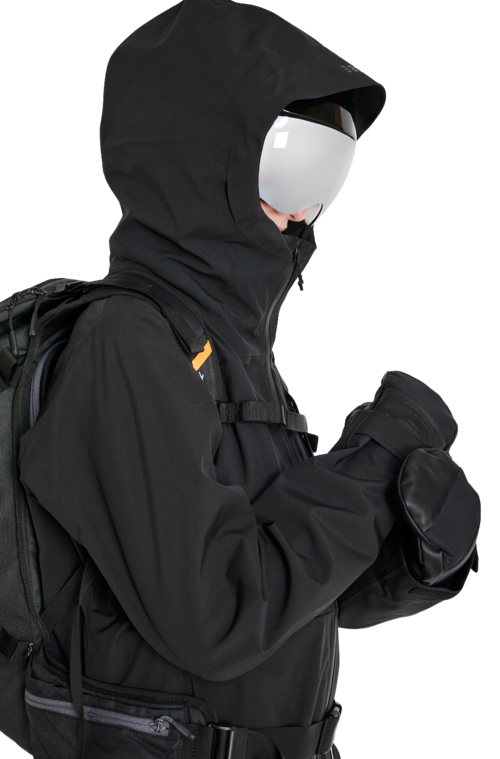
Strobe, a Swedish brand founded in 2021, might be a relative newcomer when it comes to making ski jackets, but its products, which offer decent tech specs at affordable prices, have already made a splash.
The Gentian Ski Jacket, available for men or women, is a case in point. Built from a durable, 100 per cent recycled outer material, this three-layer shell design features a 20k/20k waterproof/breathable membrane that offers more than enough protection for any conditions you’ll find skiing or snowboarding in Europe.
Thoughtful touches such as a helmet-compatible hood, fully taped seams and well-placed pockets make it practical on long days on the mountain, whether you’re working on your tricks or simply cruising around. strobebrand.com
The Surprisingly Useful: Arc’teryx Quantic 16 Backpack – £210

It’s easy to overlook a backpack when you’re skiing or snowboarding – especially if you’re concentrating on freestyle or in-bounds resort skiing. But a well-designed pack that you can leave at the bottom of the snow park while taking laps, and ski down with comfortably at the end of the day, is surprisingly useful.
The Arc’teryx Quantic 16 is a compact yet capable day pack designed specifically with skiers and snowboarders in mind. It strikes a sweet spot between lightweight comfort and real carrying capacity, and hugs your back securely without bouncing around. Vancouver-based Arc’teryx has real pedigree when it comes to outdoor gear, and it shows in the little touches – such as the openable S-curve back panel on this pack. arcteryx.com
The luxury: Rekkie Smart Snow Goggles – £300

Goggles are normally considered a necessity while skiing, not a luxury. But these aren’t your average goggles – they’re a step into the future.
Rekkie Smart Snow Goggles fuse traditional snow optics with augmented-reality technology, projecting useful data such as speed, elevation, compass direction and notifications directly into your field of view via a transparent heads-up display.
That means you can keep your eyes on the terrain while glimpsing performance stats, or even seeing where your riding partners are in the resort, without pulling out your phone. As with any smart tech, there’s a premium price tag, but for tech-loving skiers and snowboarders, these offer something genuinely different. rekkie.com