Charlie Walker recounts his experience in a Russian cell, after being accused of espionage and photographing restricted military sites
By Charlie Walker
The long hours after lunch were always the worst part of the day. Everything fell silent. My cell mates dozed and even the chatter of the guards ceased beyond the thick, steel-plated door. With ringing ears and no distraction, I would lie on my lumpy bunk, fighting back a rising panic. I had no idea when I’d be released, and a recently introduced law concerning the crimes they had accused me of hung heavily over me. It carried a sentence of up to 15 years. Wrestling with a peculiar blend of fear and boredom during those long, quiet afternoons, I would often ask myself why I came to Russia in the first place.
Two months earlier, flying into Siberia for an expedition in the depths of winter, my primary concerns were weather and wildlife. The plan was to trek hundreds of miles across desolate wilderness in the coldest inhabited place on the planet, camping in temperatures down to the –40s. The region I was visiting – Yakutia – is home to brown bears and a large wolf population. The last two weeks of the journey would be spent out on the Arctic sea ice, where polar bears would pose a threat. My goal was to reach remote communities of indigenous Siberian groups – Sakha pastoralists and Eveny reindeer herders – and gain insights into their lives, lived in the harshest of environments, where the savage winters last up to nine months.
Enjoying this article? Check out our related reads…
However, in the weeks before my departure, troops were on the move across Russia. By the time I boarded my flight, as many as 190,000 soldiers were massed along the border with Ukraine. Most people, myself included, assumed this was merely posturing from Putin; a ploy by the wily strategist in the Kremlin to prevent NATO from admitting Ukraine. And then, a few days after my arrival, the invasion began and everything changed. I was still in the regional capital – Yakutsk – gathering supplies for the expedition and could have left the country immediately. Many would later tell me I was foolish not to. However, I was presented with an opportunity to witness life inside Russia during a pivotal moment in world history. I was curious to know what ordinary Russians really thought about the war they suddenly found their countrymen fighting. Most foreigners scrambled to leave, but I decided to stay.

Although I was in a far-flung corner of the country, closer to Alaska than to Moscow or Kyiv, I was still in Russia and would have to be careful. There was a risk that some might view me not as a tourist, but as a representative of Europe, NATO or the West; entities on the other side of a newly fragmented world.
I flew over the Verkhoyansk Mountains to my starting point, Batagay – a town that grew out of a former Gulag camp up in the Arctic Circle. Thirty miles to the west lay the ‘Pole of Cold’, where thermometers once logged –67.8°C; the coldest temperature ever recorded in a human settlement. I walked out onto the frozen surface of the Yana River and began following a zimnik, an ice road plied by hardy truckers for three months each winter. Behind me dragged a sled loaded with food, fuel and camping gear.
For two months, I walked northwards. Except for a couple of passing lorry convoys each day, I was alone on a ribbon of ice snaking through the taiga: the world’s largest forest, covering 13 million square kilometres. I pitched my tent on the snow each night, sometimes enjoying spectacular aurora displays, and sleeping in temperatures down to –50°C. With little idea of what was happening in the wider world during my trek, I savoured the peace and solitude of a place where wolf tracks comfortably outnumbered human footprints. Occasional riverbank ruins punctuated the monotony of the forest; the odd collapsing log cabin and, once, an entire ghost town abandoned in the depression that followed the Soviet Union’s dissolution. One day I walked for many hours through an area scorched by wildfires the previous summer. The forest was a sad, toppling jumble of blackened larch trees, a sea of spent matchsticks.
Roughly once a week, I reached a village and spent a night indoors, chatting and feasting with friendly hosts who taught me about their cultures and traditions. The villages had no running water or indoor toilets, and very limited access to an internet that was now heavily censored. Their information diet came through state-controlled television and radio. I listened to their thoughts on the ‘Special Military Operation’, which ranged from staunch support for Putin’s ‘liberation’ of the Donbas all the way to mortified shame at Russia’s actions. Notably, nobody criticised the president or his war in front of anyone else, presumably for fear their words might later be used against them.

Despite the remoteness, I was increasingly aware that villagers were reporting my presence to the distant authorities and that my movements were being tracked by the FSB, successor agency to the KGB. After walking 965 kilometres, I reached my final destination, the port town of Tiksi, where I was arrested, interrogated and taken to a court hastily convened at 9.30pm. The trial was a sham. No lawyer was offered and proceedings were only partially translated. I was charged with conducting journalism on a tourist visa, asking questions about Ukraine, and ‘photographing restricted military sites’. A falsified witness statement was produced to support the second charge, and no evidence was ever provided for the third.
As with 99.75 per cent of defendants in Russian trials today, I was found guilty. Yet, despite one charge being tantamount to espionage, I was only tried on administrative – rather than criminal – grounds. The penalty was a small fine, a five-year ban from Russia and deportation. I was locked in a bare, windowless cell for the night but told I could take the flight I’d booked back to Yakutsk and should then arrange my own onward travel out of the country.
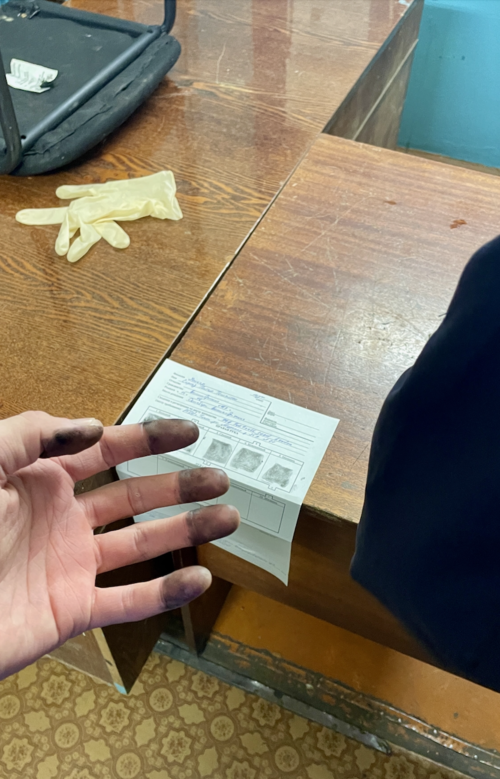
The flight took three hours in an ageing twin-prop Antonov. From my window seat, I gazed down at the icy landscape I had just crossed, relieved that the journey was over and I would be back home in a few short days. However, two uniformed bailiffs awaited my arrival in Yakutsk. I was bundled into a minivan and driven to a thick-walled building with two razor-wire perimeter fences. After my fingerprints were taken with old-fashioned ink rollers, all my possessions were searched, logged and placed in a locker. I was only allowed to keep some clothes, but both belt and shoelaces – potential garrottes – were removed before I was marched into a cell.
It all felt surreal. This was the sort of thing that happened to people on the news, not to me. Although the facility was technically termed a ‘Centre for the Detention of Foreign Citizens’, it was very much a prison. For 24 hours a day, I was locked in the cell with two security cameras that watched my every move. I shared the cell with a young Kyrgyz man caught working without a visa, and a Ukrainian with a rumbling snore and a six-month sentence. He had already spent two years in a different prison for an offence he wouldn’t disclose. We communicated in basic Russian, but conversation soon dwindled. Both men smoked and the cell reeked. When they ran out of cigarettes, they smoked used tea leaves in desperation.

I was told I would be there a few days, weeks or possibly even months, until eventual deportation. There was nothing I could do besides bide my time and carefully guard my sanity. I had never experienced such a complete lack of agency. At times I was overwhelmed by indignation and wanted to scream at the injustice of it all, but it would have been futile. The unpredictability and insecurity was the hardest aspect to bear; the not knowing, and the fact that I was counting the days up rather than down. My greatest fear was that I would be taken back to court and have the charges escalated. The potential for a years-long sentence felt very real, especially with the ongoing war in Ukraine and the usefulness to the Russians of a convicted British citizen who could be exchanged in a prisoner swap.
Meals were handed through a small hatch in the heavy door. The food was simple: porridge, cabbage soup, oily rice with the odd scrap of meat. Bread and black tea made up roughly half the diet. There were daily inspections where numerous guards trooped in to frisk us and search our beds and belongings, presumably for drugs or weapons. The guards seemed to enjoy exerting their authority and screamed at inmates for perceived infractions – making noise or not scrubbing the cell floor sufficiently. One of them frequently called me a spy. I tried to laugh this off, but it grew harder each time.
On Mondays, Wednesdays and Fridays, I was allowed 15 minutes of monitored access to my phone. I would hurriedly call my girlfriend, who was coordinating with the Foreign Office and the embassy in Moscow. The calls were a mixed blessing: a brief period of connection with loved ones and the outside world, followed by a yet deeper disconnection and despondency when the call was over. Mercifully, a local friend delivered some books. These, combined with sit-ups, sleeping and pacing the cell, helped combat tedium and pass the long hours.
After a week, I was handcuffed and led out of the cell. With no warning, and without being asked for my permission, I was thrust in front of a television news camera to face the same accusations levelled at me in court. I answered as frankly and briefly as I could, but felt totally blind-sided and humiliated. Unshaven, sunburned and frostbitten after my trek, I must have looked a mess. Memories of startled, bedraggled foreign prisoners paraded on the news in rogue states flickered across my mind’s eye. I was being re-tried for Russia’s court of public opinion.
After two weeks in the cell without once being allowed outdoors, I was cuffed and taken back to court. I had managed to hire a lawyer to appeal my case, requesting that I be allowed to arrange my own deportation immediately. But the judge rejected the appeal in under five minutes on the grounds that my offences were ‘political in nature’. I was returned to the detention centre and placed in a solitary cell.
A week passed with no update, and then another. I had been behind bars for a month when, all of a sudden, my deportation finally began. My partner and the lawyer had negotiated with the authorities, who eventually allowed us to buy plane tickets to coincide with the deportation of three Central Asian prisoners. I learned that prior to that agreement, the plan had been to detain me for at least two more months.
Shackled to our seats at the back of the plane, I and the other three prisoners were escorted by five marshals on the seven-hour flight to Moscow, where an intimidating SWAT team led me through customs and immigration. Finally, I was handed my phone and passport and assumed the ordeal was at an end. But suddenly I was redirected into a side room where six uniformed officers awaited.
This new security team spent almost two hours questioning me, searching my bags, reading messages and emails on my phone, desperately trying to decipher the messy writing in my diary, and flicking through many hundreds of photos on my camera. I was surprised to see that my memory cards hadn’t been taken or wiped, given that the camera had been in police possession for weeks and I had been accused of photographing sensitive military sites. One officer scrolled back through more than ten years of photos on my phone, scanning for anything incriminating. They seemed determined to prove me a spy and I started to believe I wouldn’t be allowed on my flight. If I was detained in Moscow, it felt certain that the outcome would be serious. I was in the same airport, maybe even the same holding room, where American basketball player Brittney Griner was arrested for possession of a medicinal cannabis vape cartridge; a minor offence in Russia. Three months later, she was still in prison awaiting trial.
My departure time approached. Watching the clock with rising dread, I pleaded innocence to my interrogators, and begged to be released. With less than five minutes remaining until scheduled take-off, I was instructed to pack up and was led to the gate at a run. Waiting Emirates staff were huddled around the door, which closed behind me as soon as I stepped onto the plane. The passengers were all seated and we pulled away from the gate moments later.

As soon as the wheels lifted off the tarmac, I burst into tears: an inevitable release of emotion and anger after a month of steadily building terror. Once safely back in London, I began to understand that despite the injustice of my treatment, I had been incredibly lucky. Two months after my release, Brittney Griner was tried and found guilty. She was sentenced to nine years in prison and transferred to a penal colony. Ten months after her arrest, she was eventually released in a prisoner swap that saw a notorious Russian arms dealer freed.
Three months after I got home, Wall Street Journal reporter Evan Gershkovich was arrested in Yekaterinburg. He was held for well over a year before eventually standing trial and receiving a 16-year sentence for espionage. No evidence was ever released and less than two weeks after sentencing, he was freed in another prisoner exchange. One simple decision from an FSB officer could have seen me subjected to the same treatment.
Russia today is a paranoid nation where most citizens are suspicious of everyone else, especially foreigners. There is a stifling atmosphere of distrust. State-propagated misinformation is ubiquitous and truth has become irrelevant. Many, perhaps most, Russians enthusiastically support Putin and his war in Ukraine. But very few have access to accurate information, even fewer have the means to escape the country, and with protest punished harshly, safely speaking out is impossible. Whether they know it or not, it occurs to me that most Russians are as much hostages of Putin’s regime as I was for a few short weeks in 2022.