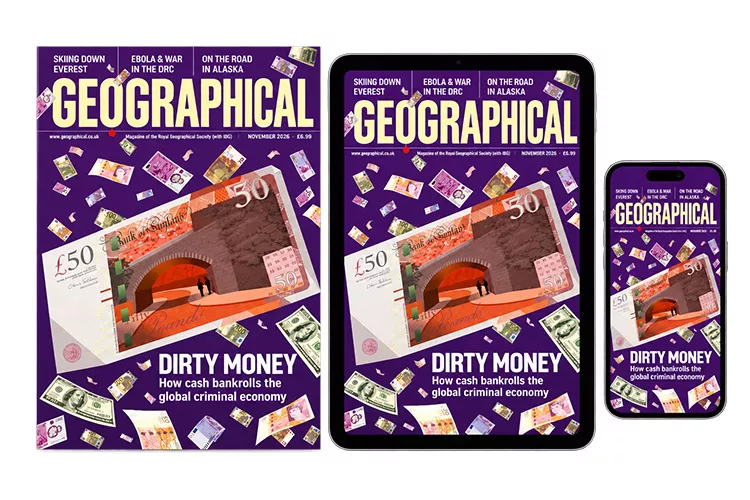
In November’s issue of Geographical Magazine, discover stories from Alaska, DRC, Greenland and more…
In our November cover story, Mark Rowe investigates cash’s hidden role in global crime, from wildlife trafficking to human exploitation. Elsewhere, in Eastern DRC, Olivia Acland reports on how rebel violence, displacement and deep mistrust are hampering efforts to contain a deadly Ebola outbreak in the nation.
This month, the magazine also features a Country Profile on Yemen. Stuart Butler explores a country of ancient cities and dramatic landscapes, where war, hunger and dwindling water supplies shape everyday life.
In Greenland, uncover how a bucolic farming landscape sits at the centre of a battle over rare-earth minerals. Meanwhile, Imogen Edmonds reveals the journeys and explorations made by five women supported by Royal Geographical Society grants, while Tristan Kennedy meets ski mountaineer Jim Morrison who made a pioneering descent of Mount Everest. Diana Maclean traces the evolution of the RGS’s Explore Weekend across fifty years, an event helping to turn ambitious ideas into viable expeditions around the world.
Check out our other issues…
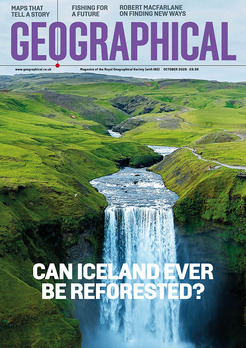
- Out now: October 2026’s Geographical Magazine
- Out now: September 2026’s Geographical Magazine
- Out now: August 2026’s Geographical Magazine
- Out now: July 2026’s Geographical Magazine
- Out now: June 2026’s Geographical Magazine
Our columnists bring an array of topics to the forefront to help you stay on top of the world: Tim Marshall discusses how religion, geography and regional rivalries have shaped the Houthis’ rise; Fabian Stephany looks at how the green transition is requiring a manual workforce that AI cannot replace, while Marco Magrini considers how climate change and artificial intelligence pose very different threats.
Our digital edition is out now, too, giving you access to all the stories in our latest issue, plus our full archive dating back to 1935, with hundreds of magazines to explore. Digital access is available through the Geographical app, and you can now enable notifications to be alerted the moment the latest issue is live. And if you want to enjoy our beautifully designed and produced print magazine, we can post the next edition to you anywhere in the world. Join us and stay on top of the world.
Cashing in

We’re increasingly living in a cashless world. From contactless cards to digital wallets, notes and coins are disappearing from everyday transactions. Yet, strangely, the amount of cash in circulation continues to rise.
In the UK, the value of banknotes in circulation has increased by 63 per cent since 2014, despite fewer than ten per cent of payments now being made in cash. So where is all this money going?
Much of it is finding its way into the shadowy world of organised crime, where untraceable payments help fuel everything from drug smuggling and human trafficking to illegal logging and the wildlife trade.
As governments and financial institutions struggle to keep pace with increasingly complex criminal networks, this in-depth feature investigates the paradox of our supposedly cashless society, tracing the hidden journeys of dirty money and revealing how its circulation connects seemingly ordinary transactions to some of the world’s most damaging crimes.
Bad news for the press
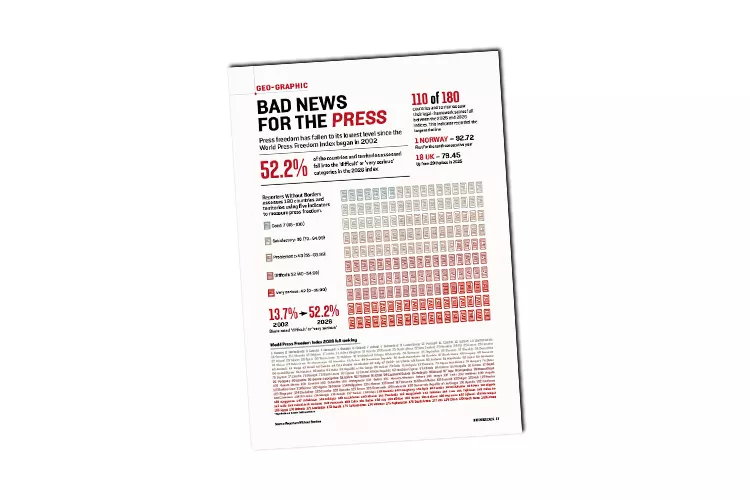
Press freedom around the world has fallen to its lowest level since records began in 2002, according to the 2026 World Press Freedom Index. More than half of the 180 countries and territories assessed are now classified as having ‘difficult’ or ‘very serious’ conditions for journalism, compared with just 13.7 per cent in 2002.
Findings from our latest Geo-Graphic paint a troubling picture of growing restrictions on independent journalism and the right to information worldwide.
Outbreak in the crossfire
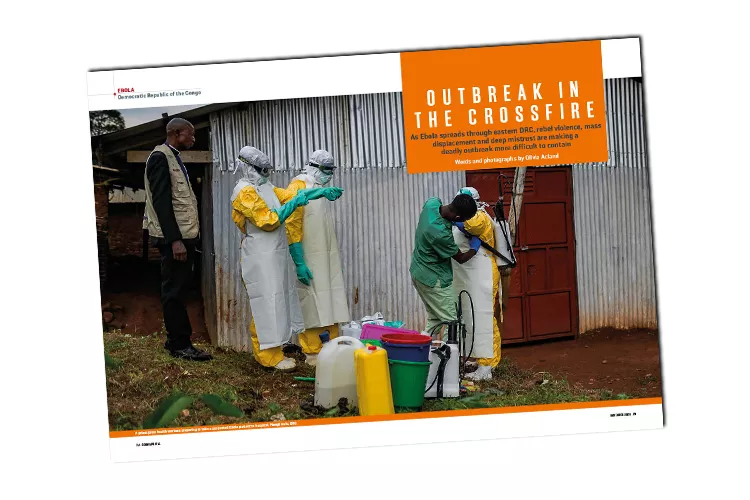
In the dense forests of eastern Democratic Republic of the Congo, two deadly threats are tightening their grip on communities already pushed to breaking point. For decades, violence by armed rebel groups has forced hundreds of thousands of people from their homes, leaving villages destroyed and families living in constant fear. Now, a devastating Ebola outbreak is spreading through the region, claiming thousands of lives and overwhelming an already fragile healthcare system.
For many residents, the threat of Ebola pales in comparison with the daily struggle to survive rebel violence, hunger and poverty. Travelling alongside Congolese soldiers into rebel-held territory and visiting overstretched treatment centres, Olivia Acland witnesses the devastating intersection of conflict and disease in a region where fear and insecurity have become part of everyday life.
Green pastures, rare earths
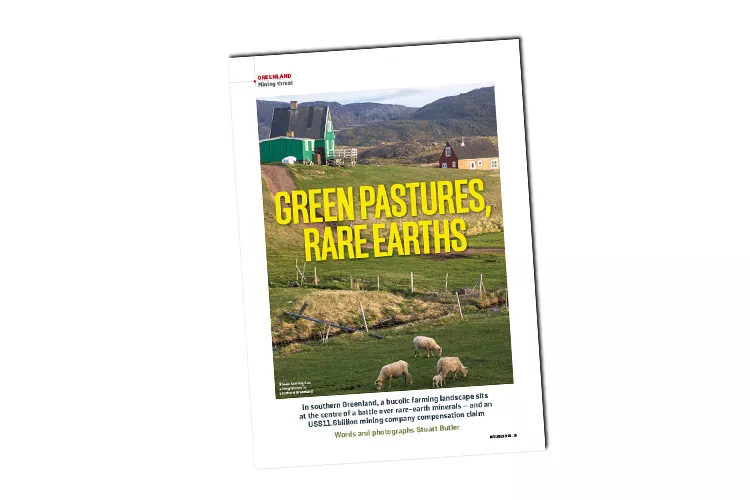
In southern Greenland, sheep farmers have spent generations working the fertile valleys between towering mountains and ice-filled fjords. But beneath their pastures lies one of the world’s largest deposits of rare earth minerals, and an Australian mining company wants to dig them up. Its proposed Kvanefjeld open-pit mine promises jobs and economic growth, but local farmers fear that uranium contamination could make their land unusable, their lamb unsellable and their communities uninhabitable.
Stuart Butler meets families who fear they could be the last generation to work this land and asks a troubling question. Who pays the price when the global race for green energy threatens to sacrifice the people and landscapes it is supposed to protect?
Country profile: Yemen
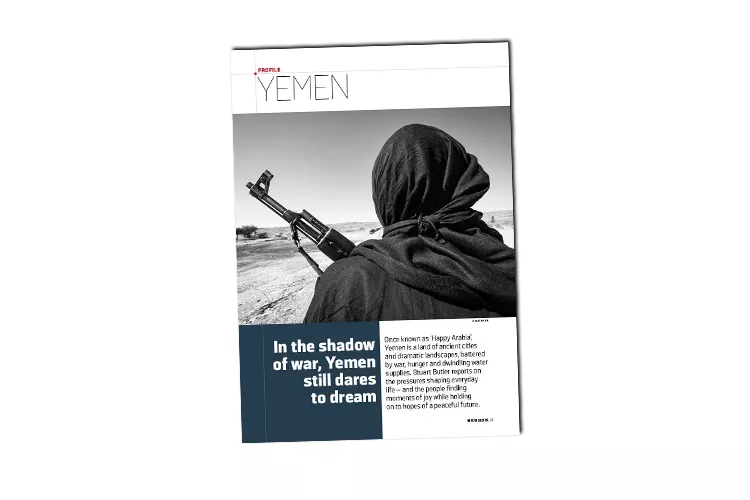
Once known as Arabia Felix, or Happy Arabia, Yemen is now enduring one of the world’s worst humanitarian crises. More than a decade of civil war has devastated the economy, displaced millions and left almost half the population struggling to find enough food.
Severe water shortages, climate change and the widespread cultivation of qat, a thirsty crop chewed for its stimulant effects, are placing further pressure on an already fragile country. Meanwhile, Yemen’s extraordinary cultural heritage, from the ancient tower houses of Sana’a to the mud-brick skyscrapers of Shibam, is increasingly threatened by war and neglect. Yet amid the hardship, ordinary life continues, with families finding moments of happiness and holding on to hopes of a better future. Stuart Butler explores Yemen’s troubled history, deepening environmental challenges and the resilience of people determined to rebuild their lives in our latest country profile.
A state of extremes

Few places capture the tension between wilderness and human exploitation quite like Alaska. From the rugged Dalton Highway, built to serve the Arctic oilfields, to the wildlife-rich waters of the Kenai Peninsula, this vast northern state is a land of extraordinary contrasts.
In this travel feature, Mark Rowe encounters towering mountains, endless tundra and remarkable wildlife alongside the pipelines and industrial infrastructure that underpin Alaska’s oil economy. However, Alaska’s landscape is transforming rapidly – from thawing permafrost threatening the very roads built to support fossil-fuel extraction, to retreating glaciers and shifting wildlife populations revealing the accelerating effects of climate change. Further south, the legacy of the devastating Exxon Valdez oil spill remains visible beneath the region’s pristine beaches.
As political pressure grows to open more of Alaska’s wilderness to drilling and development, Rowe explores the uneasy relationship between conservation, tourism and industry in one of the planet’s most spectacular environments.