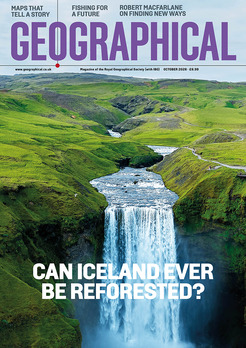
In the September issue of Geographical, head to Ukraine, Egypt, Chile and more
In our September cover story, Mark Rowe investigates how outsourcing is changing the relationship between citizens and the state in the UK. Elsewhere, Claire Thomas reports on the little-known but long-standing tradition of the Mermah in Egypt, a high-energy festival of equestrian skills and how it adjusts to the modern world. Boštjan Videmšek visits Ukraine to see how the country’s soldiers and civilians are coping with the trauma of war.
Victoria Heath explores voyages and volunteering trips that allow travellers to contribute to research and conservation, while Tristan Kennedy tackles the legendary Monte Bondone, where one of cycling’s most brutal battles unfolded. Rory Walsh heads to Glastonbury Tor to see the geology beneath an ancient sacred hill.
Our columnists bring an array of topics to the forefront to help you stay on top of the world: Tim Marshall argues how new oil supplies in Africa and ambitious Gulf pipeline projects are shaping the global energy map; Andrew Brooks looks at how wealth in Dublin doesn’t always reach the people who live there, while Marco Magrini considers how intensifying wildfires threaten to push the climate crisis beyond repair.
Our digital edition is out now, too, giving you access to all the stories in our latest issue, plus our full archive dating back to 1935, with hundreds of magazines to explore. Digital access is available through the Geographical app, and you can now enable notifications to be alerted the moment the latest issue is live. And if you want to enjoy our beautifully designed and produced print magazine, we can post the next edition to you anywhere in the world. Join us and stay on top of the world.
Who runs Britain?

From hospital cleaning and school meals to prisons, social care and asylum accommodation, many of the services we think of as ‘public’ are now delivered by private companies.
In this investigation, Mark Rowe looks at how outsourcing has become woven into the fabric of modern Britain. What began in the 1980s as a drive to cut costs and improve efficiency has grown into a public procurement market worth more than £350billion a year.
Outsourcing can bring expertise and extra capacity, but its record is far from straightforward. Rowe examines the collapse of Carillion, problems in social care and probation, the Post Office Horizon scandal and the huge contracts awarded during the Covid pandemic. He also asks what outsourcing means for the people relying on these services, particularly when decisions are made far from the communities they affect.
With the government now promising to move away from ‘outsourcing by default’, Britain faces a difficult question: after four decades of relying on private contractors, how much of the state can – or should – be brought back in-house?
Minding the gap

In his latest op-ed, Tim Marshall asks whether the Strait of Hormuz is finally losing its grip on the global oil trade. After its closure sent energy prices soaring and countries scrambling for alternative supplies, Gulf states are racing to build pipelines and ports that bypass the strategic chokepoint.
From the UAE and Saudi Arabia to Iraq, billions are being poured into new routes towards the Red Sea, Gulf of Oman and Mediterranean. But escaping Hormuz brings fresh vulnerabilities, longer journeys and higher costs. Marshall explores how the race for energy security could redraw the world’s oil map – and weaken Iran’s greatest geographical advantage.
Riders of Dandara

Claire Thomas steps into the dust, noise and spectacle of Mermah, one of the country’s oldest surviving equestrian traditions. Horses thunder through crowds as riders wield bamboo staffs in contests combining horsemanship, martial skill and music – a centuries-old practice deeply entwined with local identity and celebration.
But behind the exhilarating spectacle, Thomas discovers a more troubling story. Her photographs reveal bloodied mouths, injuries and signs of stress among some horses, raising difficult questions about animal welfare as participation grows and traditional standards begin to fade.
Speaking with riders and community leaders, Thomas explores efforts to revive the principles of care, discipline and honour that once defined Mermah. Alongside the ancient martial art of Tahteeb, she reveals a side of Dandara rarely encountered by visitors to its famous Temple of Hathor – and a community wrestling with how to preserve a treasured living tradition without compromising the animals at its heart.
Haunted by the hum of drones

Boštjan Videmšek examines a mental-health crisis unfolding alongside the Ukraine war itself. More than three million Ukrainians have served since Russia’s full-scale invasion began, and the psychological consequences of years spent under bombardment, displacement and loss are becoming increasingly difficult to ignore.
At the heart of the story is Mihaylo Sahadiak, a 36-year-old soldier wounded during a reconnaissance mission in eastern Ukraine. His account reveals the terrifying reality of modern drone warfare, where the constant whirring of approaching drones can leave soldiers feeling that nowhere is safe. Researchers are now examining ‘dronophobia’, a form of trauma linked to this persistent threat from above.
Videmšek explores the scale of PTSD, depression, addiction and anxiety among soldiers and civilians, while visiting doctors and rehabilitation specialists attempting to meet an extraordinary need for psychological care. With millions of veterans eventually expected to return home, Ukraine is already expanding treatment and rehabilitation services. But the report makes clear that the country’s struggle will not end when the fighting does. For many Ukrainians, the psychological legacy of the war could last for generations.
The world as a laboratory
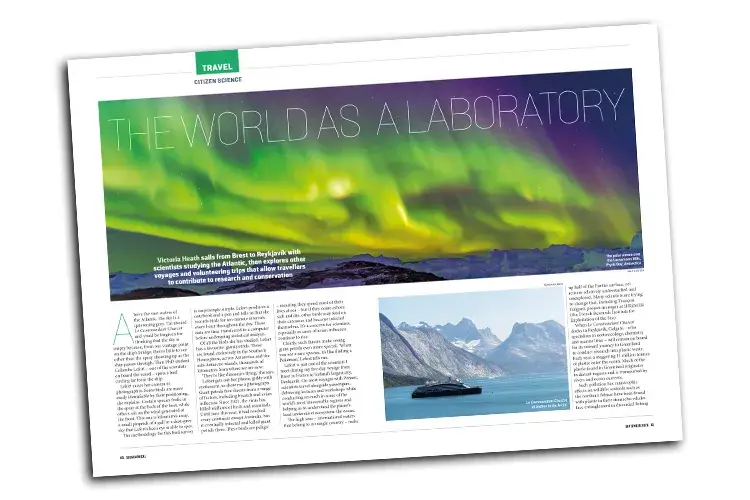
Science and travel don’t have to be separate pursuits. Around the world, a growing number of trips are giving travellers the chance to experience remarkable places while learning about – and sometimes contributing to – the research happening there.
Victoria Heath explores some of the places where tourism and science are coming together. On a voyage from France to Iceland, she meets researchers aboard Le Commandant Charcot looking at seabirds, whales and cloud cover, as well as a scientist heading onwards to Greenland to investigate plastic pollution.
Elsewhere on other trips, travellers can monitor whales and dolphins in the Hebrides, collect data in Antarctica, help conservationists in Greece or record wildlife deep in the Peruvian Amazon.
From floating laboratories to rainforest research stations, Victoria Heath looks at how getting involved with science can offer a completely different way to experience a destination – and give travellers a better understanding of the environments they’ve come to see.