Stuart Butler reports on the pressures shaping everyday life in Yemen – and the people finding moments of joy while holding on to hopes of a peaceful future
In 2015, the Houthis attacked Aden. ‘They occupied the area around my home. There was even a Houthi sniper on a roof near our house.
He shot at anything that moved. He didn’t care who he shot. He even shot children.’
Nasser Abdo still has a sense of shock in his voice as he tells me this over the phone from his home in the Khor Maksar neighbourhood of Aden, Yemen’s second city. ‘If you had to go out to market to get food then it was very dangerous. You had to go very fast.
Related reads…
Two of my neighbours were killed doing this.’ Abdo pauses. ‘I worry about what would happen if the Houthis ever again reach Aden.
It’s something my friends and I talk about a lot.’
Sharing the Arabian Peninsula with some of the richest nations on Earth, Yemen is one of the poorest. Torn apart by internal and external rivalries, battered by years of war and hit hard by climate change, it faces what the UN describes as one of the world’s worst humanitarian disasters.
A UN estimate projected that the conflict would cause around 377,000 deaths, directly and indirectly, by the end of 2021. Almost half the population doesn’t have enough to eat, 2.5 million children under five are acutely malnourished and around five million people have been internally displaced. The economy has collapsed.
But it wasn’t always like this.
Inhabited for millennia, Yemen was known in antiquity as Arabia Felix, or Happy Arabia. Supposedly described by the sons of Noah as a land of milk and honey, it was once home to some of the world’s most powerful kingdoms.
It’s said that Gilgamesh came here to search for eternal life, that the Three Wise Men carried Yemeni frankincense and myrrh to a baby in a Bethlehem stable, and that the Queen of Sheba called Yemen home.
Today, though, Yemen is a place of sadness. Abdo’s work with an NGO takes him to some of the camps for internally displaced people that now ring Aden. ‘It can be terrible,’ he says.
‘Families living with nothing but a plastic sheet. Last time I met a woman with a newborn baby. She had nothing and her baby was sick.
We said we could take the baby to the hospital, but the woman said she didn’t care anymore if the baby lived or died because there was nothing left for her or her child in this life.’
Eye for an eye
Conflict, in one form or another, has long been part and parcel of life in Yemen, and those in control of Sana’a, the capital, are not always in control of the rest of the country. Yemen is as much a patchwork of tribal groups as a nation state, and for many Yemenis, loyalty lies with tribe before country. There are around 200 different tribal groups, split into four tribal federations.
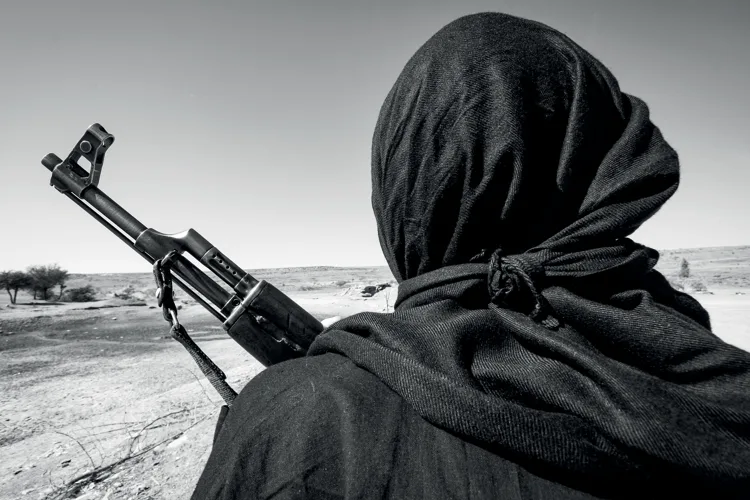
In mountainous northern Yemen and along the Red Sea coastline, known as the Tihama, where tribal structures are strongest, each tribe has a defined territory. Although tribes frequently make short-term alliances with one another, conflict between them is not uncommon and the ‘eye for an eye’ principle is strong in tribal society.
This means that if a member of one tribe kills a member of another, the victim’s tribe will hold all members of the perpetrator’s tribe liable. Weapons are widespread and these tribal conflicts can quickly spin out of control. The fighting in more recent years, though, has been considerably more serious than a localised dispute between tribes.
When the Arab Spring protests erupted across the Middle East and North Africa, people of all backgrounds and political stripes rose up against long-serving president and dictator Ali Abdullah Saleh, who had led the country, in one form or another, since the late 1970s. The protests quickly turned violent, but by 2012, Saleh had lost power.
A transitional government led by Saleh’s former deputy, Abdrabbuh Mansour Hadi, took the reins of power. Meanwhile, an armed political and religious group known as the Houthis, who claimed to defend the rights of the Zaidis, a minority Shia community, were taking control of the city of Sa’da and surrounding areas in the far north.
In 2014, the Houthis came roaring out of the north to take control of Sana’a and much of the rest of northern and western Yemen.
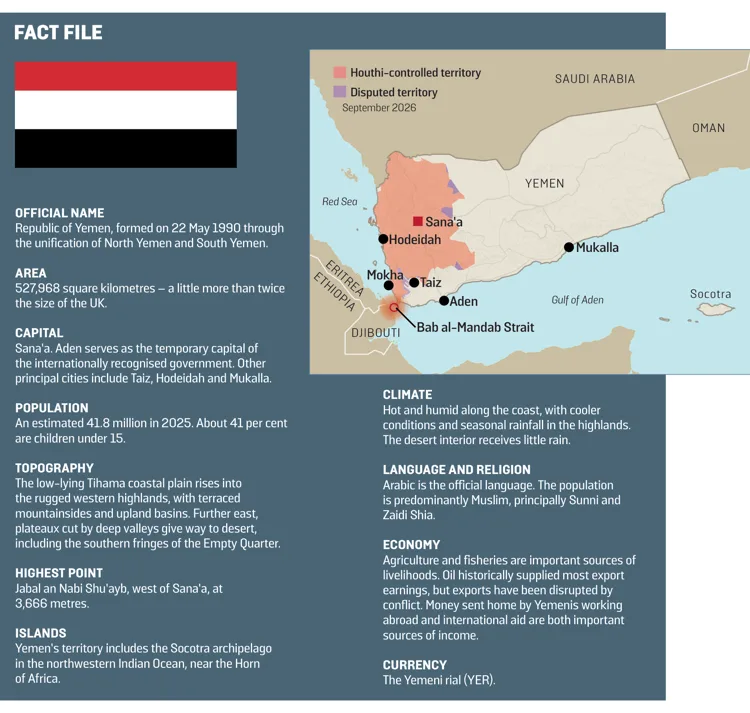
Since the Houthi takeover of Sana’a, Yemen has remained largely split in two. The Houthis control virtually all of the mountainous and comparatively fertile north and west, where the vast majority of the population lives. The internationally recognised government controls Aden and much of the sparsely populated south and east, an area consisting largely of desert.

Once the Houthis had taken Sana’a, neighbouring nations became involved. Most notable was Saudi Arabia. Worried about an Iranian proxy group on its southern border, it launched attacks on Sana’a and other Houthi strongholds in 2015.
This was supposed to be a short conflict that would deliver a decisive blow to the Houthis and return the internationally recognised government to Sana’a. More than a decade later, the Saudis remain bogged down in the conflict.
The land of milk and honey
Bullets might be Yemen’s most pressing problem, but they are far from its only worry. According to the World Food Programme, some 18.3 million people face acute food insecurity. This isn’t because nothing will grow in the land of milk and honey.
The mountainous heartland has long been considered the breadbasket of Arabia.
Abdo takes up the story: ‘The markets in the big towns and cities all across Yemen have plenty of food, but the problem is that most people have no money. Here, in the government-run south, teachers and other civil servants can wait three or four months to get paid, which means they cannot always afford to buy food.
Even the military aren’t paid on time. In the Houthi areas I have heard it’s even worse. This means that many families have had to reduce the number of meals they eat each day.
Many people eat only one small meal a day. In the rural areas it can be even worse, especially in areas close to the front lines. Many markets in rural areas have closed because there isn’t even any food to sell and nobody can safely reach the market anyway.’
Sheba and the glass of water
Of all the legendary peoples and myths associated with Yemen, the story of the Queen of Sheba is perhaps the most important to Yemeni culture. We don’t know her name, or even whether she existed, but her supposed capital was in what is today Marib, a dusty desert town located on the current front line. Axum in Ethiopia is another contender.
One of the key moments in her story relates how she travelled to Jerusalem to meet King Solomon in his great temple. It’s said that he invited her to stay on condition that she take nothing of his. A feast was laid on for the queen, but Solomon ordered his chefs to lace the meal with salt.
In the middle of the night, she awoke terribly thirsty. As soon as she took a sip of water, Solomon shouted that she had broken her promise not to take anything of his. ‘But it’s only water!’ exclaimed the queen.
‘And nothing on Earth is more precious than water,’ he replied. It’s a statement that still rings true in Yemen, where food insecurity is compounded by a chronic water shortage. ‘The lack of water is a big issue in Aden, and throughout all of Yemen,’ says Abdo.
‘The main water tank for the city is close to my house, yet we often have no running water. In Crater, which is the old city centre of Aden, the situation is even worse.’
With annual precipitation typically ranging from 108 to 114 millimetres, no permanent rivers, dwindling groundwater reserves and poorly maintained infrastructure, Yemen is one of the most water-deprived countries on Earth.
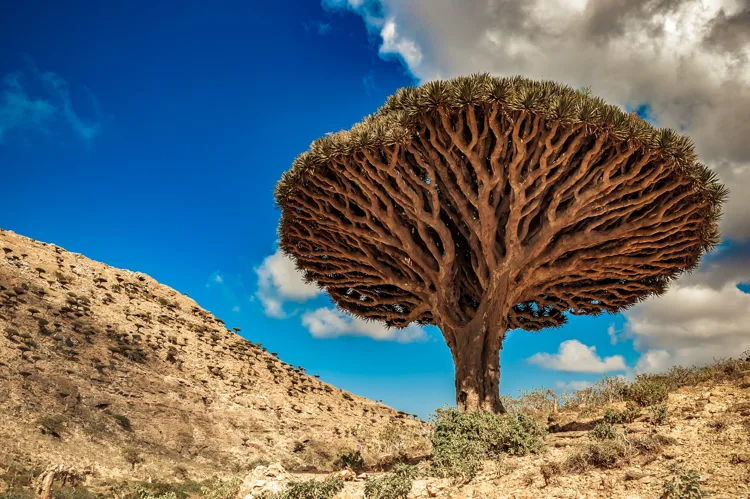
A World Bank study revealed that it had only around 55 cubic metres of renewable internal freshwater resources per person in 2022, compared with a global average of roughly 5,400 cubic metres. In Sana’a, one of the worst-affected cities, the water table is dropping by six to eight metres a year. In the 1970s, it was around 30 metres below ground; today, in some neighbourhoods, it’s 1,200 metres down.
Many towns and cities are now almost entirely reliant on water trucks delivering supplies from elsewhere. The cost puts clean water beyond the reach of many families. Scarcity also fuels conflict, with research indicating that 70–80 per cent of rural conflict in Yemen is related to water.
But damaged and poorly maintained facilities are only part of the problem. Climate change is hitting Yemen hard, and there’s another major pressure: qat.
The drug of a nation
Chewed throughout Yemen, as well as in Somalia and parts of Ethiopia and Kenya, qat is known variously as khat, chat or miraa. It consists of the leaves of a small, unremarkable-looking shrub, Catha edulis, that grows in highland areas of Yemen and parts of eastern Africa.
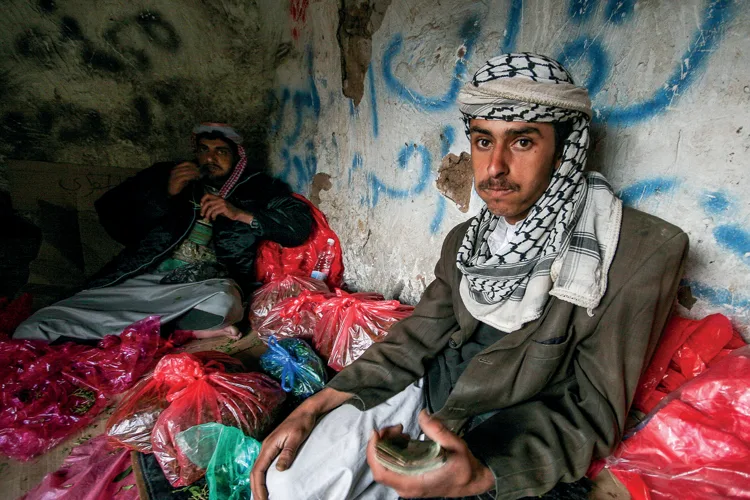
The leaves of the plant are popped in the mouth, gently chewed and allowed to build up against the side of the cheek. Eventually, so many leaves have been added that users’ cheeks start to bulge like a hamster’s. Users say qat gives a gentle high, encourages conversation, reduces tiredness and suppresses hunger.
Classed by the World Health Organization as a drug of abuse that can produce mild to moderate psychological dependence, it’s a controlled substance in many parts of the world, including the UK and much of the EU. For many people in Yemen, however, it’s almost the focal point of the day.
Very much a social drug, qat occupies hours of each afternoon for an estimated 90 per cent of adult Yemeni men and between 50 and 73 per cent of women. This is often done among groups of friends in a mafraj – a quiet room with a view, usually on the top floor of a traditional house.
Although it sounds harmless enough, qat brings serious environmental and social problems. World Bank research highlighted in 2014 estimated that up to a quarter of usable working hours were devoted to qat chewing and consumers spent nearly ten per cent of their income on it.
Qat is also a thirsty plant in a dry country. Its production has expanded at the expense of other crops: it’s now by far the country’s most widely grown cash crop, and cultivation has increased by 40 per cent since the outbreak of war. As production grows, so does its demand for water.
Yemen simply doesn’t have enough for both people and plants.
The chance to dream
Fighting, hunger, water shortages and economic collapse. It can be hard to believe there’s room in Yemen for normal life. Yet, according to Abdo, even amid the destruction and suffering, there are moments of joy.
‘I have two daughters aged five and two. Sometimes my wife and I might take our children to the Aden Mall,’ he tells me. ‘We go to the games centre there and on the fairground rides and we eat in one of the restaurants or cafes.’
Abdo paints a very different Yemen from the one most of us imagine. ‘On other days we might just go down to the ocean to play football and have a picnic,’ he continues. ‘I’m not very good at football, but I only play with my daughters, and they don’t know!
Sometimes we go to the beaches near our house, but otherwise we go to Gold Moh’r Beach. There are always a lot of families there. People swim and there’s a corniche to walk along with benches and children’s playgrounds and places to buy ice-creams.
It’s a nice day out.’
Before I put the phone down and return to my own easy life in Europe, I ask Abdo about his hopes for the future. ‘All I wish for is for my daughters to live in a peaceful Yemen with development and good education and health systems,’ he replies without hesitation. ‘I just want them to have the chance to work and to dream.’
Yemen through time
First millennium BCE
The kingdom of Saba flourishes around Marib, building irrigation systems and growing wealthy through the incense trade, linking Arabia with the Mediterranean and East Africa.
1839
Britain captures Aden, developing the port as a naval base on the route to India. British influence subsequently expands across southern Yemen.
1918
Ottoman rule ends in the north after the First World War. The northern territory gains independence, while Britain retains its southern possessions.
1962
Army officers overthrow the northern monarchy and proclaim a republic, triggering civil war between Egyptian-backed republicans and Saudi-backed royalists.
1967
Britain withdraws after an independence struggle. South Yemen becomes independent on 30 November, with Aden as its capital, leaving two separate Yemeni states.
1990–94
North and South unite on 22 May 1990 under President Ali Abdullah Saleh. A southern secession attempt ends in defeat in 1994.
2011–12
Arab Spring protests challenge Saleh’s rule. A negotiated transition sees him hand power to his deputy, Abdrabbuh Mansour Hadi.
2014–15
The Houthis seize Sana’a in September 2014 and advance south. A Saudi-led coalition intervenes militarily in March 2015, supporting Hadi’s government.
2022
A UN-brokered truce begins in April, reducing fighting and civilian casualties. However, it expires the following October without a permanent peace agreement.
2023–24
Houthi attacks disrupt Red Sea shipping. The USA and Britain begin strikes against Houthi targets in Yemen in January 2024.
September/October 2026
The Houthis capture Mokha in September. In early October, government forces launch a counteroffensive with Saudi-led air support, as renewed fighting displaces thousands
Architecture and UNESCO
Sana’a is one of the world’s oldest inhabited cities. Its old quarter, designated a UNESCO World Heritage site in 1986, is a warren of intertwining lanes and bazaars, dotted with 1,000-year-old mosques and tower houses made from fired red brick and rammed earth. Their stained-glass windows and white gypsum swirls and patterns are a distinctive feature.
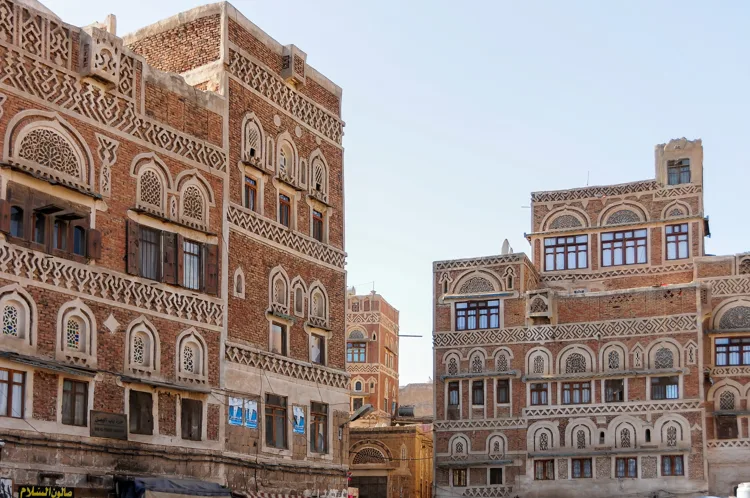
Sadly, parts of old Sana’a have been damaged in the fighting and bombing, but a decade or more of neglect has caused even more damage. Heavy monsoon rains have caused the mud-brick buildings to collapse, while families who left Yemen for other countries in the first days of the war haven’t been able to maintain their houses. The situation isn’t helped by a lack of international aid or the Houthis’ limited interest in protecting old Sana’a.
Sana’a isn’t Yemen’s only architectural wonder, however. In the mountainous north and centre of the country, stone villages are traditionally built on the edge of sheer crags or cling precariously to cliff faces as a form of natural protection from attack.
In eastern Yemen, Wadi Hadramawt is a fertile valley cutting through the arid Hadramawt plateau. It’s in this valley, lined with centuries-old villages and towns, that Shibam can be found. This extraordinary walled town consists of around 500 seven- and eight-storey mud-brick ‘skyscrapers’.
Inscribed onto the World Heritage List in 1982, it’s now on the List of World Heritage in Danger because of a lack of maintenance and investment since the start of the war.