With companies attempting to get permits to mine in the Pacific, is it possible that such devastating activities will be given the green light?
By
A machine weighing more than a blue whale ploughs through the ocean floor, hunting for proverbial gold (in reality, it’s more interested in metals like manganese, nickel and cobalt). It sounds like something from a sci-fi movie, but such a scenario is a reality that those in favour of deep-sea mining advocate.
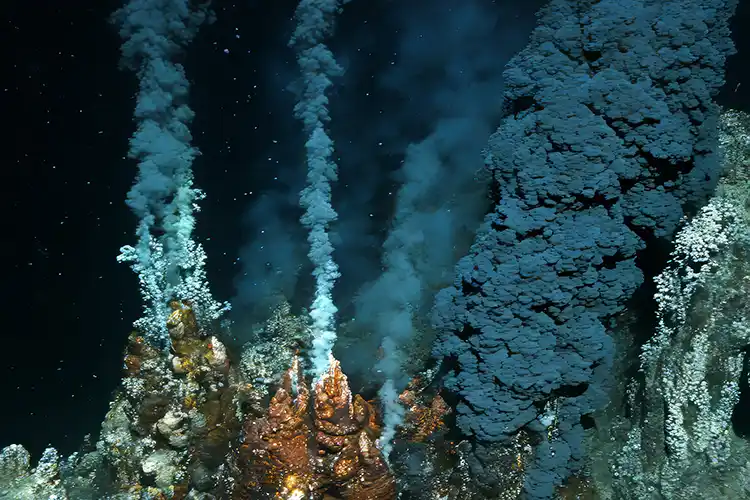
This machine, as well as trawling up metals and minerals, would destroy nodules that contain these elements alongside the ecosystems that thrive around them. This would cause disruption all the way up the food chain that Pacific communities – and all of us – rely upon.
Enjoying this article? Check out our related reads…
Additionally, the deep ocean is a vital carbon sink, absorbing nearly 40 per cent of the carbon dioxide generated by humanity. Risking such a delicate system through deep sea mining could have irreversible impacts on the climate.
Tests for deep-sea mining already show that plumes of pollution occur during the process, as well as the production of underwater noise that would pose extreme disruption to marine mammals who use sound as a primary means of underwater communication and sensing.
Yet despite all of the ways deep-sea mining can harm our environment, there are still those in support of the practice. Those in favour of deep sea mining cite how useful the process will be in excavating valuable rare earth elements – like manganese, cobalt and nickel – to use in the building blocks of electric vehicles and electronics. Estimates suggest that global demand for these elements may double by 2040 in a net-zero emissions scenario.
Although test mining is underway, commercial mining of the deep sea is not yet allowed by international law. Despite years of negotiations, the International Seabed Authority has yet to agree on rules that will govern commercial mining operations in international waters. The latest round of talks ended in July 2025, and negotiations will resume this year.
So, it begs the question: which way will the tide turn? Is deep-sea mining a definitive ‘no-go’, or is the practice on the cards in the future?
Accelerating permits
Organisations and bodies such as the Trump administration are certainly on the side of favour, with the Trump administration pressing ahead by accelerating permits for deep-sea mining.
Only last month, The Metals Co became the first deep-sea miner to seek the US’s approval to mine the international seabed, in a zone between Hawaii and Mexico known as the Clarion-Clipperton Zone. This zone has recently been revealed as a hotspot for new species: researchers discovered more than 5,000 species there that are new to science.
The two zones that The Metals Co has applied to operate in contain an estimated 800 million metric tons of rocks known as polymetallic nodules filled with critical minerals including nickel, copper, cobalt and manganese. Those in support in deep-sea mining say it would lessen the need for large mining operations on land, which are often unpopular with host communities.
Any country can allow deep-sea mining in its own territorial waters, roughly up to 200 nautical miles from shore.
Other advances have been made on contracts for exploration. Currently, The International Seabed Authority has granted 31 contracts for exploration. These cover over 1.5 million square kilometres – an area four times the size of Germany. Most of these contracts cover exploration for deposits in the Clarion-Clipperton Zone, an area rich in mineral deposits loaded with copper, nickel, manganese and other metals.
A few countries have already approved permits to explore mineral resources in their own domestic waters, known as ‘exclusive economic zones’ or EEZs. However, most deep-sea mining interest is in international waters, meaning the future of the industry hinges on how the International Seabed Authority chooses to regulate it.
Only this month, Greenpeace launched a legal challenge against the UK government’s decision to approve the transfer of two deep-sea exploration licences, as covered by Geographical. The environental group is concerned that licenses in the wrong hands could open the door to destructive deep-sea mining that could harm marine wildlife. It also said their transfer was inconsistent with the government’s calls for a moratorium on this harmful industry.
Is deep-sea mining necessary?
For many, the answer is no. That’s because the total supply of critical minerals on land appears to be sufficient to meet global needs –although there must be appropriate measures taken to ensure supply is scaled-up in a way that minimises environmental, social and governance risks.
Some argue that deep-sea mining is an alternative pathway that can circumvent certain risks associated with mining on land. Since extraction occurs exclusively at sea, deep-sea mining is unlikely to be associated with hazards such as deforestation and freshwater pollution. However, others argue that the infrastructure built to process and transport deep-sea minerals would require land acquisition and development, which may impact local communities.
Ultimately, deep-sea mining remains a contested subject, but there is a growing number of organisations, bodies and individuals opposing its widespread rollout.
International opposition
Despite growing demand for deep-sea mining, there has been international opposition to the industry. Businesses such as Google, Samsung and Ecotricity have committed to avoid ocean-minded minerals, with major governments also now calling for a permanent or temporary ban – including France, Spain, Germany and New Zealand. The UK is also calling for a temporary ban, however, it currently sponsors two exploration licenses covering an area larger than England.
As Geographical reported last year, Norway also joined the list of countries to rule out deep-sea mining, with licenses suspended in the Arctic until at least the end of 2029.
Many scientists from around the world are also in opposition to the industry. More than 700 people from 44 countries have signed an open call to pause deep-sea mining.