
• Skip to main content
  • Skip to secondary menu
  • Skip to primary sidebar
  • Skip to footer
Geographical

Geographical

Official magazine of the Royal Geographical Society (with IBG)

  • Geographical Home
  • News
  • Features
  • Opinion
    • Climatewatch
    • Front Lines
  • Podcast
  • Travel
    • Discovering Britain
    • Passport
  • Culture
    • Book reviews
  • Quizzes
    • Crosswords
  • Choose Geography
    • University directory
    • Masters courses
    • Course guides
      • Climate change
      • Environmental science
      • Human geography
      • Physical geography
    • University pages
      • Aberystwyth University
      • Brunel University
      • Cardiff University
      • University of Chester
      • Edge Hill University
      • The University of Edinburgh
      • Newcastle University
      • Nottingham Trent University
      • Oxford Brookes University
      • The University of Plymouth
      • Queen Mary University of London
    • Geography careers
      • Charity/non-profit
      • Education & research
      • Environment
      • Finance & consulting
      • Government and Local Government
    • Applications and advice
  • Magazine
    • Issue previews
    • Subscribe
    • Manage My Subscription
    • Special Editions
    • Geographical Archive
    • Advertise with us
  • Subscribe
    • Direct Debit Changes

Climate change could triple the amount of area affected by wildfires, study finds

9 September 2026
3 minutes

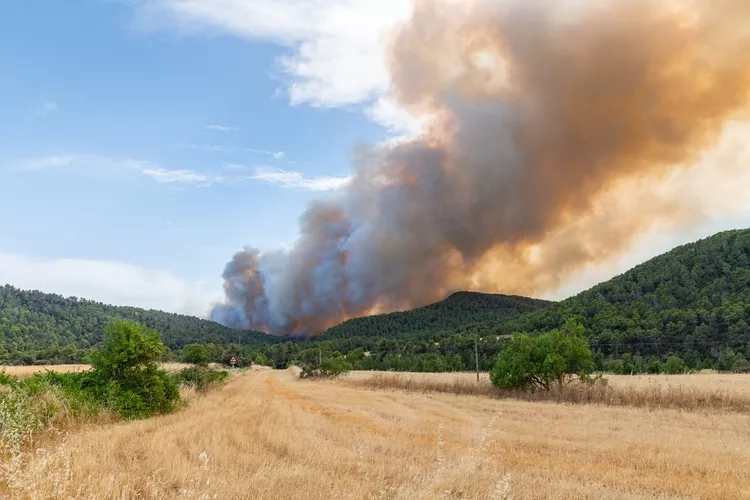
Wildfire in Matarraña, Aragon, Spain, forest fire under smoke
A wildfire in Matarraña, Aragon, Spain. Image: Hector Casasus Hernandez/Shutterstock

In a low emissions scenario, 39 per cent more land would be burned per year by the end of the century compared to average today


By Victoria Heath

As hot, dry, and windy conditions increase across Europe, a new study has revealed how such weather patterns could substantially expand the area of land affected by wildfires.

Led by the Potsdam Institute for Climate Impact Research (PIK), with contributions from the Senckenberg Society for Nature Research, the study found that, in a low-emissions scenario, 39 per cent more land would be burned per year by the end of the century than today’s average. In a high emissions scenario, that figure would jump to around 192 per cent.

Researchers compared projected annual burned area for the years between 2070 and 2100 with modelled results for the period 2000-2030 to reach their conclusions.


Enjoying this article? Check out our related reads…

  • Geo explainer: Why are wildfires getting worse?
  • Global wildfires in 2024 destroyed an area larger than India
  • Are wildfires good for the environment?
  • Scientists reveal our best and worst-case scenarios for a warming Antarctica
  • 2025 wildfires were the costliest and most damaging on record, new research finds

‘Our results indicate there could be widespread increases in burned area even under comparatively low warming of around 1.8°C,’ said lead author of the study, published in Global Change Biology, Maik Billing.

‘But if we emit more, and global temperatures rise by roughly 3.6°C, we see fires become much more prevalent, especially around the Mediterranean and across much of Western and Central Europe, including areas that to date have not experienced many fires,’ continued Billing.

Continued improvements in fire management have the potential to reduce the area burned by 92 per cent in a 1.8°C warming future and by 72 per cent at around 3.6°C.

‘We see fire conditions are increasing, so we need to invest more. If Europe increases investment in wildfire management: training fire crews, proper equipment, good coordination, etc., our projections show that this can make a significant difference,’ said study co-author Thomas Hickler.

 house is completely engulfed in fierce flames as a devastating wildfire burns through the village of Thymari near Athens, Greece,
 A house is completely engulfed in fierce flames as a devastating wildfire burns through the village of Thymari near Athens, Greece. Image: Shutterstock

‘But if fires become really extreme, our ability to contain them might break down, and we do not know yet where this point is. The recent record fires in France clearly show that we cannot simply extrapolate from the experiences of the past.’

This year, a severe wildfire season has ravaged Europe, with around 550,000 hectares burned across the EU as of 12 August 2026 – about two and a half times the 20-year average for this time of year.

Research associate at the World Resources Institute’s Global Nature Watch, Sarah Carter, who was not involved in the study, said that Europe is now the fastest-warming continent on the planet, with southern regions experiencing pronounced and devastating wildfires.
Themes News Europe Wildfires

Protected by Copyscape

Primary Sidebar

SUBSCRIBE

GEOGRAPHICAL WEEKLY LOGO FREE - Sign up to get context, clarity and perspective in a noisy world, every Friday

Popular Now

Hand in ballot box

Brazil’s presidential election heads to runoff in late October

California coast

Kelvin waves: the ocean phenomenon raising sea levels on the US West…

Chinook salmon in water

Why Alaska’s Chinook salmon collapse threatens Yukon River communities

Barcelona, Spain - October 31st 2022 -

Barcelona’s new ‘Netflix-style’ algorithm hoped to combat overtourism

Wind turbines in field

Ministry of Defence objects to at least four wind farms

Footer

  • Facebook
  • Instagram
  • LinkedIn
  • Reddit
  • TikTok
  • Twitter
  • YouTube

Geographical print magazine cover

Published in the UK since 1935, Geographical is the official magazine of the Royal Geographical Society (with IBG).

Informative, authoritative and educational, this site’s content covers a wide range of subject areas, including geography, culture, wildlife and exploration, illustrated with superb photography.

Click Here for SUBSCRIPTION details

Want to access Geographical on your tablet or smartphone? Press the Apple, Android or PC/Mac image below to download the app for your device

Footer Apple Footer Android Footer Mac-PC

More from Geographical

  • Subscriptions
  • Get our Newsletter
  • About Us
  • Contact Us
  • Advertise with us
  • Privacy policy
  • Terms & Conditions

Copyright © 2026 · Site by Syon Media