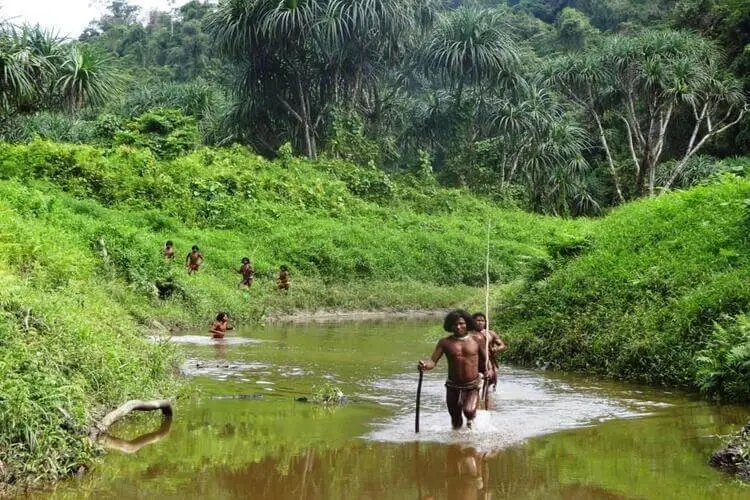
The planned $10billion project will include a mega-port, an international airport and 650,000 settlers – but could devastate 300 uncontacted Indigenous people
By
The UN has called upon India to suspend construction of a mega-project on an island off the nation that could devastate around 300 uncontacted Indigenous people who currently live there.
The proposed $10billion project is expected to take until 2047 and will include a mega-port, a new city the size of Las Vegas, an international airport, a power station, a military base and an industrial park, and accommodate up to 650,000 settlers.
However, critics of the project have said that the nomadic hunter-gatherers who live there – the Shompen – face genocide if it goes ahead.
‘The cumulative effect of these developments and the proposed demographic shift entailing 650,000 settlers, or an 8,000 per cent increase in population, will ensure the death knell of the Shompen. The result will be a collective psychic breakdown, leading to a devastating decline in the population,’ said a letter to India’s government signed by 39 genocide experts.
‘But, even before then, simple contact between the Shompen – who have little to no immunity to infectious outside diseases – and those who come from elsewhere is certain to result in a precipitous population collapse. The mass death of the entire Shompen tribe will ensue. The only way to avoid the obliteration of the Shompen is for the project to be abandoned,’ the letter continued.
The UN Committee on the Elimination of Racial Discrimination (CERD) has urged India to ‘suspend the implementation of the projects on the Great Nicobar and Andaman Islands until a full and independent environmental, economic, social, cultural and spiritual impact study has been completed.’
In response, the Indian Government admitted it could not consult the Shompen about the project, as required under international law, because they are uncontacted.
New research has also shown that giant trees reaching 50 metres or more on Great Nicobar Island may be at risk of being felled by the project. It is estimated that approximately ten million trees will be cut down on the island, of which 95 per cent are in rainforest. Great Nicobar Island is also home to 11 mammal species, 32 bird species, seven reptile species, and four amphibian species found only there.
It is thought that the Indian conglomerate Adani Group is bidding for a contract to build a port as part of the project, after formally registering its interest in constructing a mega-port. Adani is considered the most likely to get the contract when tenders go out.
Enjoying this article? Check out our related reads…
This week, Survival International has called upon London’s Science Museum to stop accepting sponsorship from the Adani Group.
‘Adani has already indicated their eagerness to be part of this calamitous project. By continuing to accept Adani’s sponsorship, the Science Museum is complicit in reputation-washing the conglomerate, whatever human rights and environmental disasters follow.’
‘We urge the Science Museum not to be part of Adani’s PR strategies — choose the Shompen not sponsorship,’ Pearce continued.