The conservation of Cape Verde’s seamounts is essential to protect marine life and biodiversity in our oceans
By
The first comprehensive study on the seamounts of the Cape Verde archipelago, involving over 40 researchers and 20 institutions across Europe, Africa and America, has been published, revealing the rich biodiversity and socio-economic relevance of the seamounts.
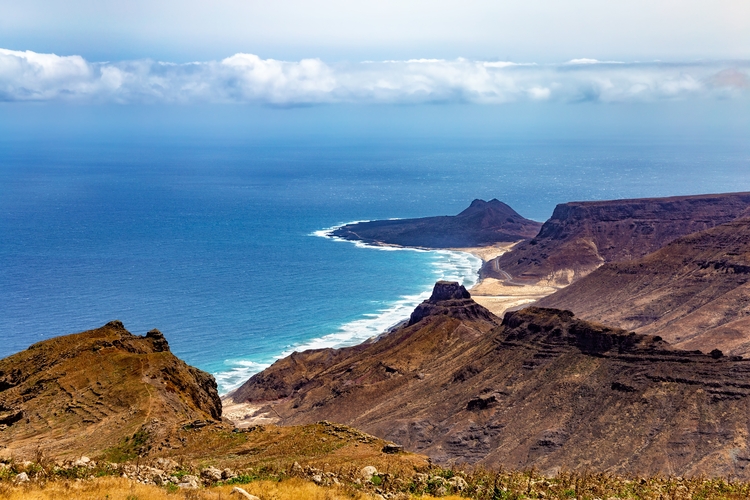
Cape Verde’s seamounts, comprising at least 14 large mountains and several smaller ones, play a vital role in our ocean’s diversity. These volcanic formations concentrate nutrients and modify the circulation of underwater currents, creating an oasis in the ocean, allowing marine life to thrive.
The mountains are home to countless species, ranging from minute micro-organisms, deep-sea corals and sponges, and also predators such as sharks, turtles, seabirds and cetaceans. The location between the colder North Atlantic and the warmer South Atlantic waters increases their productivity and connectivity.
Enjoying this article? Check out our related reads…
The study, led by Covadonga Orejas, a researcher at the Gijón Oceanographic Centre of the Spanish Institute of Oceanography (IEO-CSIC); Veerle Huvenne, a researcher at the UK National Oceanography Centre (NOC); and Jacob González-Solís, professor at the Faculty of Biology of the University of Barcelona, touches on the advantages and disadvantages of human uses of the seamounts, including artisanal and industrial fishing, as well as the risks due to maritime traffic and the potential expansion of deep-sea mining.
The study expresses how important it is for the seamounts to be incorporated into the country’s marine spatial planning and network of marine protected areas, as numerous studies show that they meet the criteria to be internationally recognised as vulnerable marine ecosystems (VMEs) and ecologically or biologically significant areas (EBSAs).
Jacob González-Solís, senior author of the research and a professor at the University of Barcelona, says: ‘As a State Party to the 30×30 biodiversity commitment and the High Seas Treaty, Cape Verde has the opportunity to designate these seamounts as priority areas for conservation and sustainable management.’
This isn’t the first time that Cape Verde waters have come under the radar. A recent study led by GEOMAR Helmholtz Centre for Ocean Research Kiel into its marine biodiversity found that physical ocean processes can influence the plethora of wildlife that lives there. Data collected for over two decades and 34 research expeditions reveal three key physical processes that drive nutrients from the bottom of the ocean to the surface, where they aid the growth of phytoplankton in the Atlantic.
The first process is wind-driven island wakes. Strong winds are deflected off the high volcanic peaks of Santo Antão and Fogo, creating a swirling pattern that generates small eddies. These eddies enhance vertical mixing and nutrient transport in the water column.
The second process involves larger ocean eddies or ‘mesoscale eddies’ with widths of up to 120 kilometres. Forming off the West African coast, they trap and carry colder, fresher and nutrient-rich water towards the Cape Verde Islands. When they encounter islands or shallows, they release their nutrients and mix it towards the surface.
The third and final process is a result of the interaction of tides with the steep ocean floor. The Cape Verde Archipelago sits in a deep-sea basin (the Cape Verde Basin) with depths of 3,000 to 4,000 meters. Regular tidal flows are disrupted by seamounts and island slopes, generating internal tidal waves, which can travel long distances or break when they encounter slopes or shallows. When internal waves break, they release significant energy, increasing vertical mixing. The highest mixing rates ever measured were recorded just south of Santo Antão by GEOMAR.
Assistant Professor of Physical Oceanography at GEOMAR, Dr Florian Schütte explains: ‘All of these processes bring nitrate into the sunlit surface layer, where it stimulates phytoplankton growth – the foundation of all marine life.’
These studies are vital for understanding the seamounts of Cape Verde and why they’re a big piece of the puzzle for marine conservation and biodiversity in our oceans.