From Belfast to Gaza, this year’s winners of the Geographical Better World Awards show how community – and care – can hold the line when everything else feels bleak
From the ongoing devastation in Ukraine and Gaza to the erosion of democracy and the formidable challenge of the climate crisis, the global landscape in 2026 presents a significant challenge to optimism. But the winners of this year’s Geographical Better World Awards remind us that the antidote to despair can often be found in kindness and human connection.
We challenged filmmakers to capture the people and projects striving to make our world a better place. From the many entries received, we narrowed the potential winners down to a shortlist of ten; the final two winners were voted for by you, our readers.
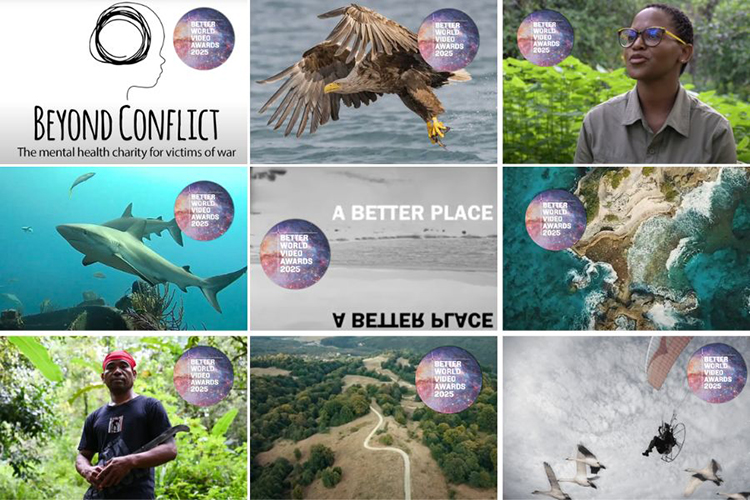
The winners of the Geographical Better World Video Awards 2025, which is sponsored by Aggressor Adventures, are:
A Better Place
Individual Category winner
Echoes of Hope
Group Category winner
More from the Geographical Better World Video Awards…
- 2025 Shortlist: Watch the 10 finalists from the Better World Video Awards
- Prize Details: See what our 2025 winners have won
- Previous winners: A look back at the two winning entries from 2024
We spoke to the filmmakers behind the winning entries to hear about the inspiration behind their films.
For Illia Todchuck, a second-year filmmaking student at Belfast Metropolitan College and an aspiring director, the goal of building a better world is rooted in personal experience. After moving to Northern Ireland from Ukraine three years ago, he documented the power of community firsthand in a film about Ukrainian families building new lives in Belfast with the help of local volunteers.
His winning film – A Better Place, which won the Individual Category in the Better World Awards – stemmed from his desire to tell the real stories of everyday people and to share their views of the world. Over the course of three months, Todchuck interviewed friends, family and strangers on the street across different countries, asking a simple question: what do you think would make the world a better place?

‘I wanted to show that the things that make our world a better place are quite simple,’ Todchuck explains. ‘It doesn’t have to be some epic feat or grand gesture; you don’t have to be a president or a superhero. You can do it anytime, any day. All you have to do is make the effort.’
Todchuck chose not to reveal the question to his subjects beforehand: ‘We wanted to see what would come to their mind first.’ Often, the answers were small: a smile to a stranger, or a helping hand offered to your neighbour. To Todchuck, this is proof that even in the darkest of times, when you might feel helpless, a small action can show others that hope and kindness still exist. He recalls a quote from Christopher Nolan’s The Dark Knight Rises, which he says inspires him: ‘A hero can be anyone. Even a man doing something as simple and reassuring as putting a coat around a young boy’s shoulders to let him know that the world hadn’t ended.’
For his entry A Better Place, Illia Todchuck wins a US$6,000 trip for two to stay at Aggressor Adventures’ exclusive, remote lodge in the magnificent landscapes of northern Thailand.

While Todchuck’s film celebrates the power of the individual, the Group Category winner shines a light on a systemic, yet often invisible, humanitarian crisis.
The winning film, Echoes of Hope, documents the essential mission of the charity Beyond Conflict. Founded eight years ago by journalist and author Edna Fernandes, Beyond Conflict was born from a conversation with a young Yazidi woman who, having escaped from sex trafficking, told Fernandes that her people were ‘drowning in memories’. ‘When I asked her, “What can we do to help?”, she told me that they desperately needed mental health support on the ground for civilians.
It was a conversation that stuck with Fernandes, who, after some research, realised that there were no dedicated mental health charities in the UK for victims of war. ‘If you want to build an enduring peace, you have to address the psychological fallout,’ she says. ‘It’s clear that, if they’re not addressed, mental health issues are handed down from generation to generation.’

The film, directed by Tom Wright and narrated by Sir Terry Waite, showcases the charity’s work through the eyes of its partners on the ground in places such as Ukraine, Gaza and Bangladesh. In 2025 alone, the charity supported nearly 4,000 children in Gaza through recreational play camps that provide therapy to young victims of conflict. They also support the Return to Life project in Israel, which helps families of hostages and survivors of the Nova attack.
Crucially, Beyond Conflict operates as a nonaligned, voluntary organisation that empowers local experts. ‘They are the heroes,’ Fernandes says of the partners who often risk their own lives to deliver care. The charity’s ultimate goal is to see mental health support recognised as a frontline humanitarian service, as essential as any other form of humanitarian aid, but one that can help to safeguard the future of entire societies.
If you would like to support the vital work that Beyond Conflict is doing to help victims of war, terrorism and displacement, please make a donation here.
For their entry Echoes of Hope, Beyond Conflict wins a £3,000 advertising campaign with Geographical.