Climate scientist Nicolas Cassar talks to Victoria Heath about how travel can be a force for good
 Nicolas’s travel insights
• When travelling, make sure to choose lower- carbon options
• Travel isn’t just a personal journey, but a chance to give back
• Respect the environments and cultures you visit
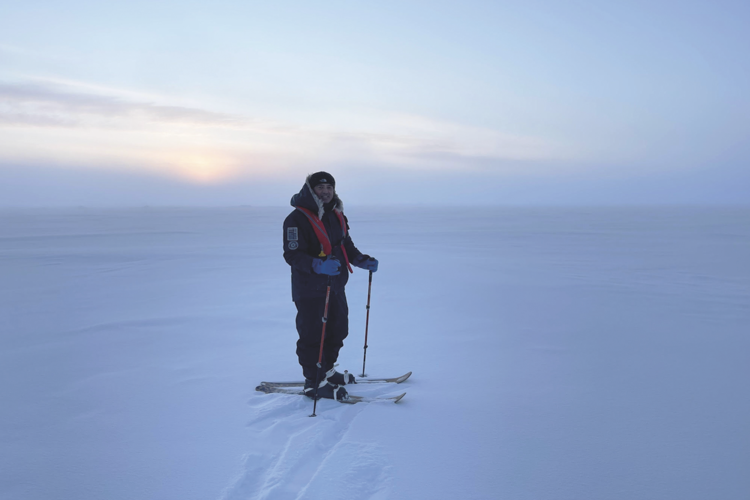
It’s a bitingly cold day in the Arctic. Scientist Nicolas Cassar and I are on board Le Commandant Charcot, an icebreaker vessel halfway through its journey from Longyearbyen in Svalbard to Nome in Alaska with 200 guests. Yesterday, we reached the North Pole.
Not only is Cassar lecturing guests on board about his scientific endeavours, but he’s also carrying out fieldwork and observations as part of his larger research projects. For Cassar, this is one of more than a dozen trips he has made to the Arctic. Most, if not all, of these journeys have been in the name of science, on board research vessels.
Enjoying this article? Check out our related reads…
In the laboratories lying in the belly of Le Commandant Charcot, below the decks occupied by passenger cabins and lavish restaurants, Cassar takes samples from a piece of equipment recently returned to the surface. It has been collecting seawater up to 1,000 metres below the surface. These samples will be sent to Duke University in the USA – where Cassar teaches.
Such scientific endeavours are vital in a region particularly affected by the effects of climate change. The Arctic is warming four times faster than the rest of the planet – a serious dilemma fuelling the research Cassar and his colleagues are carrying out in his laboratory back at Duke. To keep within the 1.5°C goal of the Paris Agreement, Cassar explains, it’s pivotal to begin geoengineering – an umbrella term encapsulating any environmental processes that are manipulated to counteract the effects of global warming. It’s an industry expected to be worth £1.2trillion by 2050.
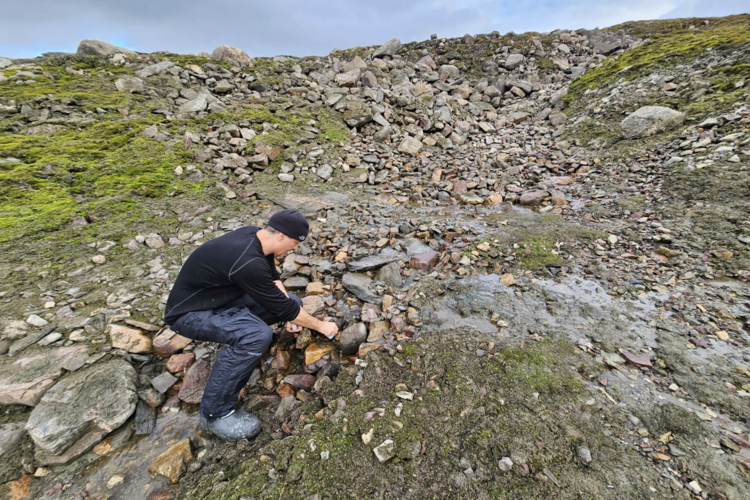
One such example of geoengineering that’s piquing Cassar’s interest is ocean alkalinity enhancement: a process in which alkaline chemicals are added to seas in order to mitigate ocean acidification. Since the Industrial Revolution, our oceans have become 30 per cent more acidic. In a business- as-usual scenario, this will rise to 50 per cent by 2100. Considering vast swathes of marine species – such as coral – depend on a stable pH to survive, geoengineering is becoming an increasingly necessary intervention.
Still, Cassar is clear: geoengineering alone is not enough for us to fall within the 1.5°C target. We must also heavily curtail carbon dioxide emissions across the world. Using the analogy of nature as a heavy smoker, he explains the need for both geoengineering and carbon dioxide reduction in tandem. ‘Treatments to help someone stop smoking only work if you reduce smoking in the first place.’
As Cassar explains, science’s role is rooted in the ‘is’. Essentially, it should tell society what is – the hard, unadulterated facts from research – while policy dictates what ought to be done to fix a particular problem. Although they may sound like separate entities, Cassar insists that the two must work together.
On our fragile planet, you might assume Cassar remains sceptical about the benefits of travel. Conversely, he sees it as a force for good. For Cassar, travel can be viewed through the lens of a return-on-cost ratio. There is always a cost (the denominator), which can be reduced through lower- carbon options and respecting the environments we visit. The numerator is the return – not just memories, but lessons. When these are shared with others, Cassar explains, we act as ambassadors for the places we have visited, helping to spread knowledge more widely.
Considering the state of our planet, it can be easy to paint a bleak picture of its future. At times, making the necessary steps to protect it can seem like an uncharted, almost impossible gulf to cross. Yet Cassar remains ever the optimist.
‘Never let a good crisis go to waste,’ Cassar says, quoting Winston Churchill. And it’s true. While climate change may pose one of the biggest challenges to the world, it also affords us the opportunity to make real scientific progress in ways we may not have otherwise considered.