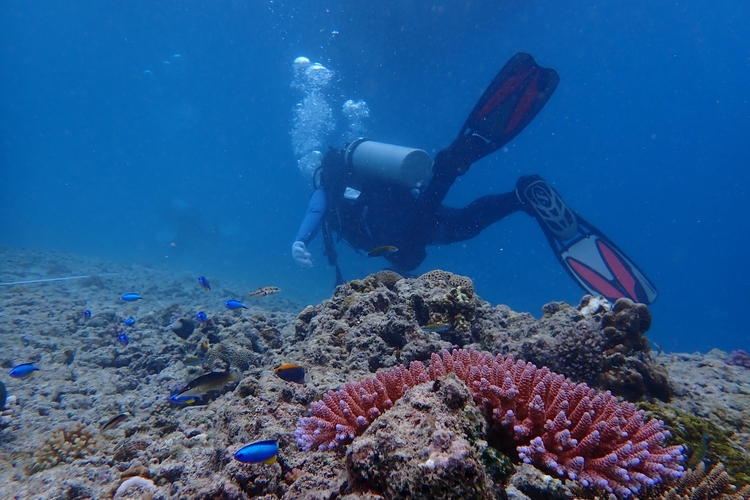
New study reveals how even well-intentioned scuba divers contribute to reef damage in the world’s oceans
By
Scuba diving is often seen as a sustainable way to experience coral reefs. However, research from the University of Sydney has found that scuba divers often damage coral reefs.
The study analysed the behaviour of more than 700 scuba divers across notable diving spots in the Philippines and Indonesia. Taking data from more than 300 hours of underwater observation, the researchers noted 4,981 reef contact events among 411 divers. Around 41 per cent of these contacts caused discernible damage to coral, resulting from direct breakage and the stirring of sediment, which can stifle reef life.
‘This work documents the unsustainable underwater footprint of scuba diving tourism on coral reefs,’ said the lead author of the study, Dr Bing Lin.
Enjoying this article? Check out our related reads:
A key finding is that most of the damage is unintentional. More than 80 per cent of damaging contacts were unintentional or unnoticed by the diver, illustrating how routine tourism activity can steadily degrade reef systems over time. Furthermore, most divers in the study reported very high pro-environmental attitudes, suggesting a sense of care about reef conservation. This stands in sharp contrast with the outcomes of some scuba-diving activity.
The research identified several factors linked to reef damage. Divers using underwater cameras, gloves or pointer sticks had higher contact rates, while the behaviour of peers also played an important role – when one diver touched the reef, others were more likely to follow.
Wildlife encounters were found to significantly increase damage. The presence of marine animals increased intentional reef contacts by 220 per cent, unintentional reef contacts by 85 per cent, and damaging contacts by 106 per cent. This is largely because divers would shift their position to observe the wildlife.
The study also found that a small minority of divers accounted for a disproportionate share of reef damage, highlighting how targeted interventions could bring substantial benefits.
‘It’s difficult to quantify the true scale of the reef contact problem,’ said Dr Lin. ‘But what is clear is that unregulated underwater tourism is an overlooked local driver of damage that adds to, and amplifies, other acute and chronic reef stressors.’
With coral reefs already under pressure from a host of challenges, including climate change, pollution and overfishing, the need for improved management around scuba diving is crucial.
Practical solutions such as improved buoyancy training, stricter controls on equipment use, more comprehensive environmental briefings, and higher certification standards for divers and dive operators are some of the ways damage could be reduced.
The study revealed several interesting psychological patterns. Firstly, around 75 per cent of divers rated themselves as ‘above average’ in their ability to avoid reef contact compared to their peers. This can be seen as an example of the illusory superiority effect, where people overestimate their abilities relative to others.
Additionally, the study documented the well-known Dunning-Kruger effect in divers, where people with lower skill levels disproportionately overestimated their abilities because the level of expertise needed to recognise risks just isn’t there.
This overconfidence creates a major gap between perception and reality and essentially fosters continued practices which damage coral. In matched observations, divers underestimated how often they came into contact with the reef by nearly fivefold.
Ultimately, behaviour, training, and industry standards need to change to avoid undermining the ecosystems that scuba diving depends on. According to Dr Lin, a clear mentality shift is required, ‘Divers need to understand that they are a part of the problem before we can convince them to become a part of the solution.’
How else are coral reefs being damaged?

Reflecting how deeply intertwined global climate processes are with some of nature’s most important and fragile ecosystems, in terms of reach, coral bleaching is arguably the most significant challenge for coral reefs. From January 2023 to September 2025, intense global coral bleaching driven by heat stress affected 84 per cent of the world’s reefs, with 83 countries, territories and economies impacted.
Warmer ocean temperatures driven by climate change are a leading cause of coral bleaching. This happens when the algae is expelled from the coral. The problem stems from the symbiotic relationship between the algae and coral, which becomes stressed in the event of warmer oceans. The coral loses its major source of food and turns into a white or pale colour, where it is bleached and left at a higher risk of disease and mortality.
Just a one degree Celsius temperature increase for four weeks can cause bleaching, but corals can recover if conditions return to manageable levels.
However, mass coral bleaching events are becoming more common. The Great Barrier Reef has experienced five mass bleaching events in the last eight years. In 2020, severe bleaching was detected across many regions of the Great Barrier Reef, with one survey recording that 60 per cent of reefs suffered moderate or severe bleaching.