A journey through Chile’s far north reveals how the Atacama shaped global agriculture, redrew borders and left a political legacy that continues to resonate
By Shafik Meghji
The Atacama is the driest desert on Earth beyond the poles. It averages less than a millimetre of rain a year; some areas haven’t seen a single drop in centuries.
As a region, the Atacama is loosely defined: in popular usage, it refers to the northern quarter of Chile, a 966-kilometre plateau stretched taut like fresh bedsheets between the Pacific Ocean and the Andes, though some geographers include within it the coastal strip of southern Peru and areas of neighbouring Bolivia and Argentina.
The mountains in the east form a rain shadow over the Atacama, whose extreme aridity has produced an otherworldly landscape, a realm of blindingly white salt flats, smouldering volcanoes, undulating sand dunes, grumbling geothermal fields, gaping canyons and seemingly endless tracts of rust-coloured dust and brittle, grey rock.
Beyond a few coastal cities such as Iquique, a scattering of remote villages centred around oases, the stark region is sparsely populated by humans and animals alike.
Yet Indigenous peoples have lived in the Atacama for more than 11,000 years. The north of the region was home to the Chinchorro culture, whose members used expert mortuary practices to preserve the bodies of the dead. Hundreds of mummies dating back more than 7,000 years – pre-dating their counterparts in Egypt by two millennia – have been discovered near the city of Arica.
Enjoying this article? Check out our related reads…
Over the last 200 years, the region has been an arena for conflict and geopolitical struggles, the source of immense wealth and a dumping ground for dictators, the birthplace of political movements and a place of repression, a playground for travellers and a laboratory for studying the nature of life itself.
Biological life may be virtually non-existent in parts of the Atacama, but the region has, counterintuitively, powered an agricultural revolution in the Global North. It started with seabirds. Tens of millions of cormorants, pelicans and boobies populate islands off the coast of northern Chile and southern Peru.
For centuries, Indigenous peoples such as the Chincha gathered the resulting excrement, which was rich in nitrogen, phosphate and potassium, and used it as fertiliser. The great mounds of this guano – which reached heights of nearly 50 metres on some islands – were preserved by the hot, bone-dry climate of the Atacama.
During the 15th and 16th centuries, most of this area was part of Tawantinsuyu, the Inca Empire. Innovative agricultural practices – including the use of terraced fields to create microclimates and complex irrigation systems – allowed the Inca to overcome challenging conditions such as scant rainfall, thin soils and fluctuating temperatures, and played a vital role in their imperial expansion across what is now Peru, western Bolivia, southwest Ecuador, southwest Colombia, northwest Argentina and northern Chile.
This included the use of guano, which helped to sustain the agricultural growth that provided food for more than eight million people.
Although Indigenous peoples in the Atacama continued to use guano, it was largely ignored by the Spanish, who were blinded by fever dreams of gold and silver.
Yet in the mid-19th century, the resource became a valuable commodity once again. At this point, the newly independent Peruvian government was in a bind. Wrestling with political and economic instability, the country was lumbered with large debts to British banks, which had financed the fight against Spanish colonial rule a few decades earlier, while its mines
were floundering.
Fortunately, or so it seemed, Peru was home to the greatest guano reserves on the planet, notably on the Chincha Islands off the coast of the northern Atacama. At the start of the century, the German naturalist and explorer Alexander von Humboldt brought samples of Peruvian guano back to Europe to be studied. Influential work by his similarly illustrious countryman Justus von Liebig – the pioneering chemist behind the meat-packing plant of Fray Bentos in Uruguay – later re-emphasised the value of the resource as a fertiliser.
With Europe and North America grappling with depleted soils, growing populations and the momentous changes of the Industrial Revolution, guano seemed like a gift from the heavens, and a British businessman, William Gibbs, moved swiftly to monopolise the industry.
His family company, Antony Gibbs & Sons, which had been operating in South America since the 1820s, signed deals with the Peruvian and Bolivian governments to become the sole exporter of guano in 1842. The trade made Gibbs one of the richest men in the UK, with his firm earning around £100,000 annually – roughly equivalent to £8million today– at its height.
Between 1840 and 1870, around 12 million tons of guano were exported from Peru. But the guano trade was built on the backs of enslaved and indentured labour. People were trafficked from China in the wake of the First Opium War, as well as Rapa Nui and Polynesia, and forced to toil in horrific conditions to dig out the ‘white gold’ alongside Indigenous and working-class Peruvians, convicts, conscripts and army deserters.

The trade had unexpected geopolitical consequences. Britain’s monopoly on Peruvian guano fuelled US imperialism. The 1856 Guano Islands Act authorised US citizens to seize any unclaimed island with guano reserves. Guano also provided the impetus for major public health reforms in London.
Working after dark, ‘night soil’ men had long emptied the thousands of cesspits in the capital, selling the contents to farmers to use as fertiliser. But the mass import of guano removed the need for night soil. This combined with London’s growing population, the loss of the city’s remaining farmland and the popularity of the recently invented water closet, which meant sewers originally designed to carry rainwater now transported raw sewage into rivers.
The result was the spread of disease, the pollution of the Thames and, ultimately, the Great Stink of the hot, dry summer of 1858. The stench was so bad it prompted the temporary closure of the Houses of Parliament. Belatedly spurred into action, the government commissioned Joseph Bazalgette, chief engineer of the Metropolitan Board of Works, to create a modern sewage system for London. The bulk of his network of tunnels and pumping stations is still in use today.
Into the desert
To appreciate the immense scale and uncanny qualities of the Atacama, you need to travel overland. My nearly 2,000-kilometre journey began on an overcast day on the southern fringes of the desert in the pleasant but underwhelming city of La Serena, a seven-hour drive north of Santiago.
I went by bus 450 kilometres north to the city of Copiapó, entering the Atacama proper. Beyond La Serena’s drab suburbs, punctuated with palm trees with chubby, pineapple-like trunks and pieces of graffiti (‘End the genocide against the Mapuche’; ‘Quality education now’), we drove through scrubland and rocky, hilly terrain, with the Pacific to our west.
There was extensive road-building work underway. Bulldozers, steamrollers and diggers lined the highway, alongside impromptu settlements to house the workers and migrants heading south to Santiago.
The heat rose and the desert grew starker as we neared Copiapó, an inland city founded to exploit silver, gold and copper reserves in land originally occupied by the Diaguita people. By the time we arrived in the early afternoon, the sun was searing and would remain so for the rest of my time in the Atacama.
Laid out in South America’s familiar grid system, under the Inca. But it was only in the second half of the 19th century, thanks to advances in the refining and extraction processes, increasing demand for fertilisers in Europe and North America, and the waning of the guano age, that global attention turned to the region’s abundant reserves.

The first major oficinas salitreras – self-contained mining and refining settlements, the largest of which resembled small cities – opened in the late 1860s and were soon connected by a railway network.
When Antony Gibbs & Sons moved into the industry, the map of western South America looked very different from today, with the Atacama proper then divided between Chile, Peru and Bolivia.
The nitrate fields belonged to the Bolivian province of Antofagasta and, to the north, the Peruvian province of Tarapacá, which included the city of Iquique and also held significant Copiapó is a difficult place to love, with a spray of ugly modern towers, the result of the grubby, short-lived wealth brought by mining.
The city briefly hit the international headlines in 2010 when 33 men working in a mine to the north were trapped 700 metres underground by a cave-in for 69 days before being rescued. Copiapó allowed me to break my journey north before I headed further into the desert.
The saltpetre boom
Amid widespread unhappiness at the British stranglehold over the guano industry, the Peruvian government ended the export monopoly of Antony Gibbs & Sons in 1861. But the company quickly found an opportunity to exploit another unheralded Atacama resource. The desert was home to the world’s largest reserves of sodium nitrate, also known as Chilean saltpetre, a powerful fertiliser also used in the manufacture of explosives.
Indigenous peoples in the Atacama had carried out small-scale nitrate mining for centuries, including guano reserves. Although Chile had few nitrate reserves of its own, Chilean businesses and workers were commonplace in the neighbouring regions. But national frontiers in this part of the world had long been contested.
In the late 19th century, Chile, Peru and Bolivia were heavily in debt – generally to British banks – and had entrenched rivalries. In 1879, war broke out. The initial trigger was the Bolivian government’s decision to increase taxes on a powerful Anglo-Chilean company operating in the region, the Antofagasta Nitrate and Railway Company, whose key shareholders included Antony Gibbs & Sons and Agustín Edwards Ossandon, scion of a wealthy Chilean family with British roots.
This went against an agreement Bolivia had previously signed with Chile and, urged on by the firm’s stakeholders, the Chilean government seized the port of Antofagasta the following year. In response, Bolivia and Peru – which had a joint defence pact – declared war on Chile.
The resulting conflict, the War of the Pacific, lasted five years, claimed thousands of lives and had ramifications for all three countries that are still felt today.
Chile emerged victorious, claiming the nitrate regions of Antofagasta and Tarapacá, and even, for a time, occupying the Peruvian capital, Lima. The war dramatically expanded Chile’s territory and made nitrate the centrepiece of the national economy for the next four decades. By contrast, Bolivia was left landlocked.
In some respects, the country has never recovered from the defeat: the lost coastline – which was rich in metals such as copper as well as nitrate – has become a phantom limb and a source of enduring anger. Bolivia has taken its case to the International Court of Justice, and every 23 March marks what it regards as a historic injustice with the Day of the Sea commemorations. Peru’s territorial losses were also significant, if not quite as debilitating. They were compounded by the 1865–79 Chincha Islands War, in which Spain temporarily seized the guano-rich archipelago, prior to the start of the War of the Pacific.

Shorn of its nitrate reserves, with the guano age shuddering to a halt as a result of over-exploited reserves, and back in debt to British banks, Peru fell into civil war. The real winners of the War of the Pacific were British robber baron firms such as Antony Gibbs & Sons, which dominated the nitrate industry for the next 40 years.
The British share of total nitrate output rose from around 13 per cent before the war to 60 per cent in the immediate aftermath.
No one benefited more than John Thomas North, the ‘Nitrate King’. The son of a coal merchant, he was born in Leeds in 1842 and apprenticed as a teenager to millwrights and engineers before finding work in Peru, where he made his fortune, with business interests ranging from coalfields to railways.
Commonly suspected of helping to instigate the War of the Pacific, North took advantage of inside information and contacts – notably Robert Harvey, the Peruvian government’s nitrate ‘inspector general’ – and bought up Peruvian nitrate concessions at bargain prices during the conflict.
Through his Liverpool Nitrate Company Ltd – which had Harvey as a director – North became the major force in the Atacama. Following the end of the war, he and his counterparts ramped up production, creating a highly industrialised landscape – known as the nitrate pampa – with railway links to ports in one of the harshest terrains on Earth.
This set off a stock market boom in London and helped turn the Atacama into something resembling a state within a state.
The backbreaking, labour-intensive work to exploit the unrefined saltpetre, known as caliche, was carried out by tens of thousands of working-class and Indigenous people from southern Chile, Peru, Bolivia and Argentina.
The managers, engineers, chemists and senior staff were generally foreign, predominantly British. From the 1870s, they oversaw a decades-long nitrate boom. At the height of the industry, British firms owned around a third of the 118 oficinas salitreras.
Mesmerising salt flats
An eight-hour bus journey took me to Antofagasta, where the British history became even more apparent. On the edge of the coastal city, tucked between a five-star hotel, a trio of charmless apartment blocks and a school playground, stood what looked like the ruins of an ancient citadel. Brick terraces rose up a slope, supported by sturdy walls, battlements and a tower with narrow windows that resembled the arrow slits used by archers in medieval castles. With tall, desolate hills behind and the Pacific in front, the structure felt impregnable.
The Ruinas de Huanchaca were actually the remains of a foundry built in the 1890s to process silver from the Pulacayo mine in southwestern Bolivia. Owned by the British-backed Huanchaca Mining Company of Bolivia, it was briefly the most modern foundry in South America, but plummeting silver prices, a flooded mine and technological advances led to its closure in 1902. Later ravaged by a fire, which provided the misleading aged sheen, the ruins now served as a stage for everything from car shows to ballet performances.
The onsite museum housed a prototype Mars rover tested in the Atacama and fossilised teeth the size of a human hand from a 100-tonne prehistoric shark. Initially following the route of the Antofagasta (Chili) and Bolivia Railway, I headed northeast into the interior, catching a bus to San Pedro de Atacama, northern Chile’s tourist hub.
The scenery grew more dramatic as we ascended to a 2,440 metre plateau, climbing hills and cutting through mountains, the terrain shifting from chalky red to caramel brown and burnt orange.
Although located in an oasis, San Pedro de Atacama provided little respite from the blistering temperatures.
A monitor at the town’s museum warned of ‘extreme heat’ and advised visitors to spend no more than 15 minutes in the sun. It was the first time in a week I’d encountered foreign tourists en masse. San Pedro de Atacama’s popularity comes from the surrounding area, which is home to some of the most mesmerising landscapes in South America: gleaming salt flats, high altitude geyser fields, wind-sculpted sand dunes and lagoons dotted with flamingos.
The region is also a hub for astronomy and astro-tourism, the lack of light pollution and 300-odd cloud-free days a year resulting in a series of observatories.

An old railway carriage in the abandoned town of Humberstone. Image: Shutterstock
South of Antofagasta, the European Southern Observatory is currently building the Extremely Large Telescope, whose 39-metre main mirror will form the ‘world’s biggest eye in the sky’.
Heading northeast from San Pedro de Atacama, the bus cut through the so-called ‘Valley of Death’. The only signs of humanity were the road ahead, the odd abandoned tyre and several shrines – some with shaded seating areas and Chilean flags, one ostentatiously augmented with a car mounted on a platform.
After a change of buses in Calama, a six-hour journey took me from the salmon-pink desert to a greyer, rockier zone. Just north of the city, we skirted Chuquicamata, one of the world’s deepest open-pit mines. This multi-billion-dollar concern and other mines in the Atacama have made Chile the world’s biggest producer of copper, responsible for a quarter of global output.
Zigzagging along a mountain road, we passed a much smaller mine with a handwritten ‘for sale’ sign outside and María Elena, the last nitrate plant still operating in the Atacama, its layout designed to resemble the Union flag.
The landscape shifted to tumbling sand dunes as we approached Iquique, a bigger, smarter and more prosperous city backed by red-smudged hills.
Modern high-rises encircled the centre, whose architecture looked like a seaside take on the historic San Telmo neighbourhood of Buenos Aires, with wooden boardwalks, palm trees and a mix of restored and attractively peeling Victorian- and Georgian-style mansions, the former homes of nitrate managers and engineers, weatherboarded and painted in ice-cream shades. There was a faded old theatre, restaurants, and bars spilling out onto the street. Children splashed in the fountains of Plaza Prat, in the centre of which stood a British-style clock tower. Streets were named Thompson and Wilson.
Meeting the nitrate king
In 1889, William Howard Russell, an acclaimed Irish reporter for The Times, was preparing for a holiday in Egypt with his wife when he had a chance meeting with the Nitrate King at a party in London.
Having risen from ‘mechanic to millionaire’, acquiring the honorific title ‘colonel’ from the Tower Hamlets regiment of volunteer engineers along the way, North invited Russell over to the Atacama to report on the transformation of ‘wastes without a sign of life or vegetation… into a centre of commercial enterprise… animated industry and prosperous life’. A stalwart foreign correspondent who had covered the Crimean War and the Indian Rebellion of 1857, Russell swiftly decided that Egypt could wait. He and his wife subsequently sailed to Chile with North and his entourage.
In the resulting book, A Visit to Chile and the Nitrate Fields of Tarapacá, published in 1890, Russell provided
a glimpse into North’s wealth, power and monopolistic business practices, though the man himself always remains just out of focus.
After docking in Valparaíso, the reporter sat in on a meeting between North and the Chilean president, José Manuel Balmaceda. Championing a policy of ‘Chile for the Chileans’, Balmaceda had ambitions of nationalising the nitrate industry and the infrastructure on which it depended. North, naturally, was keen to head off any curtailment of his activities.
According to Russell, the meeting was amicable. Nevertheless, Balmaceda later cancelled North’s nitrate railway concession, amid a constitutional crisis. A civil war broke out in Chile in 1891, with Balmaceda accusing North and his British counterparts of funding the unrest.
The president was overthrown and subsequently committed suicide. John Gordon Kennedy, Britain’s minister resident and consul-general to Chile, later refused to deny a Times report that ‘British and Chilean business interests had instigated the rebellion’ against Balmaceda.
After meeting Balmaceda, Russell and North sailed north to Iquique, the second most important port in Chile after Valparaíso, thanks to the nitrate industry, where they were warmly welcomed by the large British ‘colony’.
The Nitrate King’s monopolistic influence quickly became apparent. Alongside a chain of highly profitable oficinas salitreras and the railway network upon which the nitrate was transported to port, North supplied drinking water to parched Iquique via a trio of specially designed 800–900-tonne ships. He also had a bank and was involved in a ‘flourishing company’ to supply gas to the city’s residents.
Russell and North were hosted and wined and dined in style by the British residents, who had grown rich on the back of the nitrates boom, lived in stucco-covered mansions painted cream, blue or orange, and frequented the local racecourse, cricket ground and theatre. ‘With money in your purse there is very little you can desire which you cannot buy in Iquique,’ wrote Russell.
Yet Russell was also struck by the city’s precariousness. He wrote: ‘Day after day the wonder of this artificial existence was at work under our eyes, but it was only on reflection that its strangeness struck you, and that you were led in a vague way to think what would happen if water and food failed, if the condensers and steamers ceased to work… and if the provision stores gave out.’
After a leisurely stay, Russell and North boarded a private train at the Nitrate Station, a ‘little Crewe full of life and energy’, filled with British train drivers, engineers and clerks, ‘piles of jute-bags’ from Dundee, fuel from Cardiff, ‘machinery from Leeds and Glasgow’. It transported them up to the nitrate pampa, the ‘sandy, salty, waterless waste’ littered with oficinas, silver mines and trenches left over from the War of the Pacific.
They stopped at the Ramirez oficina, the largest nitrate producer in Chile at the time. Owned by North’s Liverpool Nitrate Company, it produced around 14,000 tonnes of nitrate a month. Russell’s account provides an insight into the stark differences in status and lifestyles of the predominantly British administrators, managers and senior staff and their Chilean, Peruvian, Bolivian and Argentine workers.

The former rushed to show their loyalty to North, ‘firing off squibs and crackers, cheering and waving flags’. They could enjoy plush hotels, restaurants and bars such as the one at the Pozo Almonte oficina, which offered foie gras, Périgord truffles and bottles of Château Lafite. He reported: ‘I dare no more than hint at the orgies here, of which drunkenness is the most innocent incident.’
By contrast, the workers subsisted in ‘squalid-looking settlements’ and shanty towns that lacked sanitation and were surrounded by an industrial landscape of boilers, chimneys, tanks, vats, crushers, corrugated-iron workshops and offices, mounds of waste materials, railway lines and mules pulling carts, hissing steam and noxious smoke clouding the air.
They worked shifts lasting 12 hours or more at high altitude in the torrid heat, overseen by private police forces and paid in ‘fichas’. These tokens could only be used in the company’s own shops, which sold food, drink and supplies at inflated prices. The practice continued even after it was made illegal by the Chilean government in 1924.
Dissent was met with repression that sometimes escalated into massacres. In 1907, for example, day labourers went on strike demanding a pay rise and improved living and working conditions.
Thousands of nitrate workers and their families marched to Iquique as the strike spread across northern Chile, prompting President Pedro Montt to declare a state of emergency. Six workers were killed by the army at the Buenaventura oficina. Their funerals took place the following day and around 15,000 miners and their families gathered at the Santa María school in Iquique, where they were attacked by the army. Soldiers stormed the building, firing indiscriminately, and killed an estimated 2,000–3,600 men, women and children, before tipping their bodies into mass graves.
From boom towns to concentration camps
When you reach the summit, the only way is down. The First World War was a high-water mark for the British and Anglo-Chilean nitrate firms as demand soared from Allied ammunition factories. At this point, the Atacama was one of the most valuable places on Earth and nitrate accounted for as much as 80 per cent of Chile’s exports. But while the war prompted a short-term profit surge,
it also triggered the collapse of the industry. Germany’s nitrate supplies were cut-off by a British-led blockade during the conflict, which forced the country to seek out alternatives. Chemists Fritz Haber and Carl Bosch subsequently developed an industrial process that combined nitrogen in the air with hydrogen to produce ammonia, launching the era of artificial fertilisers.
After the war, this method proved to be a cheaper and quicker way to supply farmers and arms manufacturers in Europe and beyond than the nitrate refineries of the Atacama. Haber and Bosch both won the Nobel Prize, while British investment in Chilean nitrate slowly fizzled out during the 1920s.
With the world gripped by the Great Depression, the industry as a whole soon followed suit. The oficinas salitreras were shut down, dismantled and stripped for parts, leaving behind islands of empty buildings, broken machinery and precipitous slag heaps.
Beyond the scarred landscape and redrawn borders, the nitrate industry left an enduring legacy in Chile. The protests, strikes and uprisings of its workers – including the creation of a short-lived ‘anarchist republic’ at the nitrate town of La Coruña, which came to a bloody end at the hands of the army – helped to lay the foundations for the country’s trade union movement and left-wing political parties.
But the response of successive governments to calls for social justice and progressive reforms – particularly the use of the military to crack down on dissent – also created a template.
The Atacama remained a lawless zone for much of the 20th century. Previously, Chilean parents had evoked the spectre of British pirates to scare their children into behaving. After the collapse of the nitrate industry,
the isolated port of Pisagua took their place. Far-right governments, presidents and dictators turned the former boomtown into a concentration camp. Gay men were sent here in the late 1920s by the Carlos Ibáñez del Campo dictatorship, followed by interned citizens of Axis nations when Chile entered the Second World War on the side of the Allies. In the late 1940s, overseen by a young Augusto Pinochet, then an army captain, Pisagua was used to detain around 500 socialists, communists and anarchists.

After rising to power in a military coup in 1973, Pinochet used the town as a concentration camp for some 800 political dissidents, who faced horrific conditions, torture – reportedly at the hands of a notorious Nazi fugitive, Walther Rauff – and often summary execution. A mass grave containing 20 bodies was discovered here in 1990.
Other nitrate towns were also used as detention and torture camps under Pinochet. Chacabuco was used to detain 2,000 political prisoners at a time – including children – surrounded by electric fences and enduring horrific treatment. Elsewhere in the nitrate pampa, the armed forces used the abandoned towns and towering slag heaps for target practice and military drills.
Pinochet himself had close ties to Britain. As files declassified in 2020 revealed, the Foreign Office’s secretive Information Research Department sought to protect what it considered to be British interests in Chile during the 1960s and ’70s.
After failing to prevent the election of Salvador Allende – over fears he would ‘be manoeuvred by the communists, either willingly or otherwise, and that the end-product might well be a Government on the Cuban pattern’ – it conducted a propaganda campaign to damage and discredit his presidency while legitimising and boosting his opponents.
In 1973, the Conservative government of Edward Heath welcomed the Pinochet coup, with Foreign Secretary Alec Douglas-Home writing: ‘For British interests… there is no doubt that Chile under the junta is a better prospect than Allende’s chaotic road to socialism, our investments should do better, our loans may be successfully rescheduled, and export credits later resumed.’
Pinochet became a close ally of Margaret Thatcher, allowing a British surveillance team to use a Chilean military base to monitor Argentine air force operations during the Falklands War while also supplying crucial intelligence reports. Under his rule, Chile was also a testing ground for the free-market, untrammelled deregulation, and privatisation policies to which Thatcher also subscribed.
In 1998, eight years after the end of his dictatorship, Pinochet was arrested in London for crimes against humanity on the basis of an international warrant issued by a Spanish judge. He was supported by Thatcher, who claimed Britain owed the dictator a debt of gratitude for his help during the Falklands War. Despite the British courts dismissing Pinochet’s claim for immunity, Home Secretary Jack Straw controversially allowed him to return home due to ill health rather than face trial in Spain.
Nostalgia tourism
We drove on to the UNESCO World Heritage site of Humberstone. Originally known as La Palma, the town was founded in 1872 by a nitrate firm set up by James Thomas Humberstone, an entrepreneur and chemical engineer from Dover. One of the biggest oficinas salitreras, La Palma, passed through several foreign owners before being taken over by the Chilean government, which renamed it Humberstone in 1932.
At its height, the town had a population of some 3,500. Much of the surviving architecture dates from the 1920s and ’30s, with a strong Art Deco style.
As a result, Humberstone has the vague feel of West Coast Americana. It resembled a small but complete city, with tidy rows of prefabricated houses; the size and amenities of each one outlining the rank of the occupant. Some have been turned into mini museums. One of the most evocative was filled with letters that shed light on day-to- day life in the oficina: one revealed a ‘strike’ by housewives who refused to cook for their husbands until they received better-quality charcoal for the ovens; another complained about the cost of building a new tennis court.
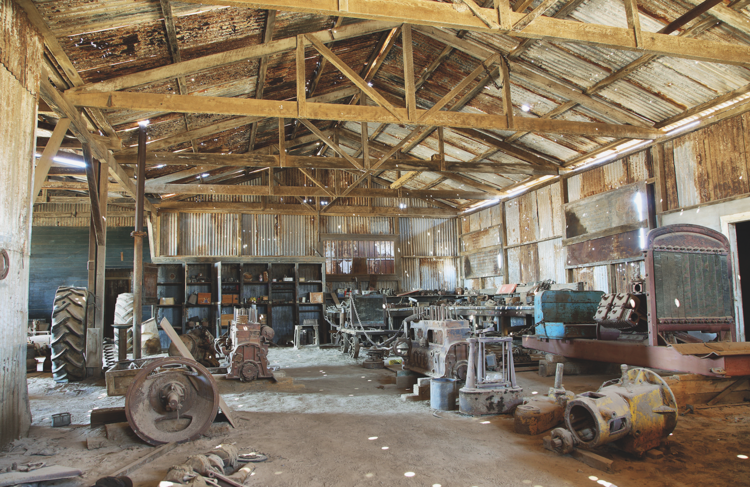
As well as the homes, there was a host of other buildings, including a hospital, radio station and shops, as well as a main square. The hotel had a restaurant, bar and billiard room; there was a separate entrance at the back for workers, who were forbidden from using the front door,
a reminder of the strict hierarchy in place during the tail-end of the nitrate era, even after marginal improvements to employment conditions.
There was also a large swimming pool with a diving board, a school with graffiti-covered desks and a clock tower stuck permanently at four o’clock. My favourite building was a glorious theatre-cum-cinema, which once screened musical performances and Mexican films. Now hushed, it was supposedly haunted.
The restoration work was ongoing when I visited, but it already felt as if it had gone too far. The abandoned character had been replaced by an ersatz, film-set vibe. But when I wandered to the edge of town, beyond the factories, warehouses and a solitary train engine, the desolation returned. The scorching, shadeless desert stretched into the distance, a reminder that despite the ambitions of the nitrate barons, the Atacama remained untamed.

An edited extract from Small Earthquakes: A Journey Through Lost British History in South America by Shafik Meghji (Hurst & Co)