A quietly-released climate report raises significant alarms over the UK’s environmental security in the future
By
Food shortages. Mass migration. Political extremism. Nuclear conflict. Arguably, all of these potential scenarios are important enough to warrant significant discourse. Yet, despite these scenarios being purported as potential consequences to climate-driven ecosystem collapse in a UK government report last autumn, the report was quietly released.
Commissioned by DEFRA – the Department for Environment Food and Rural Affairs – the assessment considered how environmental degradation could impact UK national security. It can be accessed here.
Just before the report was supposed to be launched, it was reportedly blocked by Number 10. Eventually, through pressure from campaigners and a freedom of information request, a 14-page version of the report was made available – but crucially with no launch announcement, or even a press release, on 22 January. As well as this, The Times reported this version had been significantly ‘abridged’, with many of its starkest conclusions omitted.
Enjoying this article? Check out our related reads…
The assessment reinforces how nature underpins national and international security. Biodiversity and healthy ecosystems provide essential services – water, food, clean air, climate regulation, medicines and economic resources. Yet these benefits may be under threat.
The report states that ‘critical ecosystems that support major food production areas and impact global climate, water and weather cycles’ are already under stress and as such, represent a national security risk. If they failed, the consequences would be severe: a loss of water security, reduced crop yields, loss of arable land, collapse of fisheries, novel zoonotic disease and loss of pharmaceutical resources.
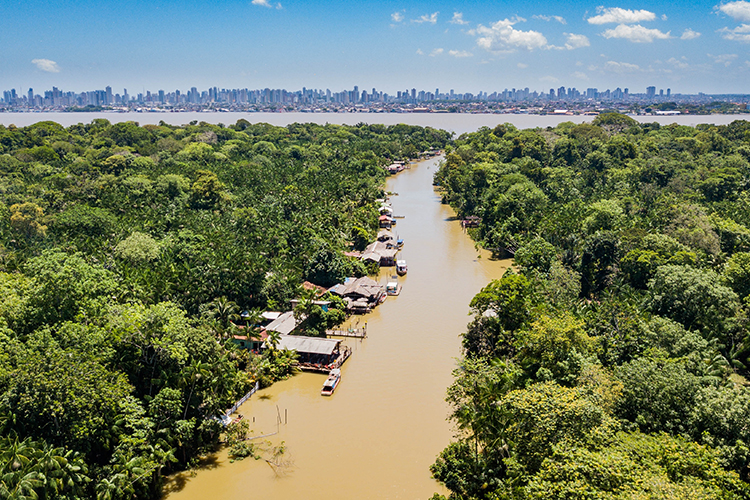
The assessment also identifies key ecosystems whose decline would have especially far-reaching effects: the Amazon and Congo rainforests, boreal forests, the Himalayas and south-east Asian coral reefs and mangroves. Severe degradation or collapse of these would likely disrupt global climate systems, water cycles, food production and weather patterns.
It judges ecosystem collapse as plausible in some regions by 2030, with other regions (including rainforests and mangroves) under serious threat by 2050.
Another unredacted version of the report, seen by the Times, paints an even bleaker picture. It states that the degradation of the Congo rainforest and the drying up of rivers fed by the Himalayas could cause people to flee to Europe, causing ‘more polarised and populist politics’ and putting more pressure on national infrastructure.
It also suggests that if Himalayan water supplies were to decline, tensions would ‘almost certainly escalate’ between China, India and Pakistan – potentially leading to nuclear conflict. The UK, which imports 40 per cent of its food, would struggle to feed itself, the unredacted report says.
The UK government has not publicly explained why the launch of the report was cancelled. According to some experts, the reasons for cancelling the report are two-fold: firstly, as the report’s conclusions were ‘too negative’, and secondly, its findings would draw attention to the government’s failure to act.
In response to the Times‘ article, a DEFRA spokesperson said: ‘Nature underpins our security, prosperity and resilience, and understanding the threats we face from biodiversity loss is crucial to meeting them head on. The findings of this report will inform the action we take to prepare for the future.’