As the climate warms below, the edge of space is cooling down – and it could soon disrupt essential communication networks
By
In late October 2025, Hurricane Melissa – the most powerful storm of the year – hit Jamaica and Cuba with 300km/h winds, obliterating local infrastructure and leaving 77 per cent of Jamaica without power. Richard Thompson, the acting director general of Jamaica’s Office of Disaster Preparedness and Emergency Management, called it ‘a total communication blackout’. In the days that followed, emergency radio broadcasts and satellite links became the only reliable lifelines for coordinating rescues and keeping isolated communities informed.
Radio is a cost-effective way to reach large populations in the wake of a disaster, especially when local infrastructure has been destroyed. But as the climate crisis makes disasters like Melissa more frequent and severe, it’s also quietly undermining our ability to keep these last-resort communication systems running.
Enjoying this article? Check out our related reads…
Huixin Liu, an atmospheric scientist at Kyushu University in Japan, explains that while increasing CO₂ levels trap heat near the Earth’s surface, they have a very different effect in the ionosphere, some 100 kilometres above us. Here, the air is so thin that molecules behave differently; rather than trapping heat, they radiate it out into space. As a result, the upper atmosphere isn’t warming – it’s cooling.
‘This cooling doesn’t mean it is all good,’ says Liu. ‘It decreases the air density in the ionosphere and accelerates wind circulation.’ Her team’s research, published in Geophysical Research Letters, warns that these atmospheric shifts are creating plasma irregularities that could jeopardise global communications.
One specific concern is ‘sporadic-E’ – dense layers of metal ions that form at altitudes between 90 and 120 kilometres. These layers have naturally occurred for decades, triggered by seasonal wind patterns and the vaporised trails of meteors. Historically, radio operators have used these layers to ‘bounce’ signals over the horizon. However, Liu’s simulations show that under high CO₂ concentrations (reaching 667 parts per million), these layers become stronger, persist longer into the night, and drop to lower altitudes.

These changes can disrupt the high-frequency and very-high-frequency bands used by aviation and maritime industries for air traffic control and ship-to-shore broadcasting – and the emergency radio networks that provide a critical lifeline when disasters strike.
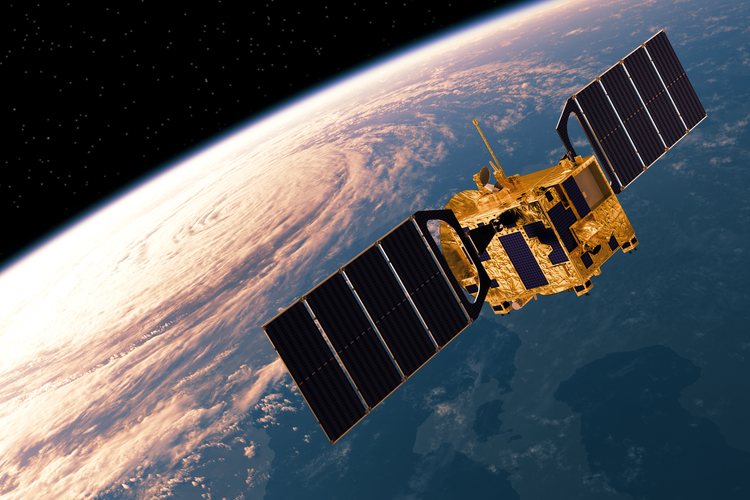
Beyond disrupting radio waves, Liu notes that a drop in air density also makes the space environment more unpredictable, altering the orbits and lifespans of satellites. In a study published in Nature Sustainability, aerospace engineers at MIT found that decreasing density reduces atmospheric drag – a force that pulls old satellites and other debris down to altitudes where they will encounter molecules and safely burn up.
By simulating how carbon emissions affect orbital dynamics, the team estimated the satellite-carrying capacity of low Earth orbit. Their findings are stark: by 2100, the number of satellites that can safely occupy popular orbital regions could shrink by 50 to 66 per cent compared to year-2000 emission levels.
The upper atmosphere is in a fragile state, says lead author William Parker. ‘This shift is colliding with a massive surge in satellite launches, particularly from mega-constellations such as SpaceX’s Starlink. The study warns that if we exceed orbital capacity, we could trigger “runaway instability” – a cascade of collisions creating so much debris that satellites can no longer safely operate.
‘We rely on the atmosphere to clean up our debris,’ says Parker. ‘If the atmosphere is changing, then the debris environment will change too.’ Liu urges the telecommunications industry to account for an evolving atmosphere in its long-term planning, adding: ‘Global warming affects not just the Earth, but extends well into space.’