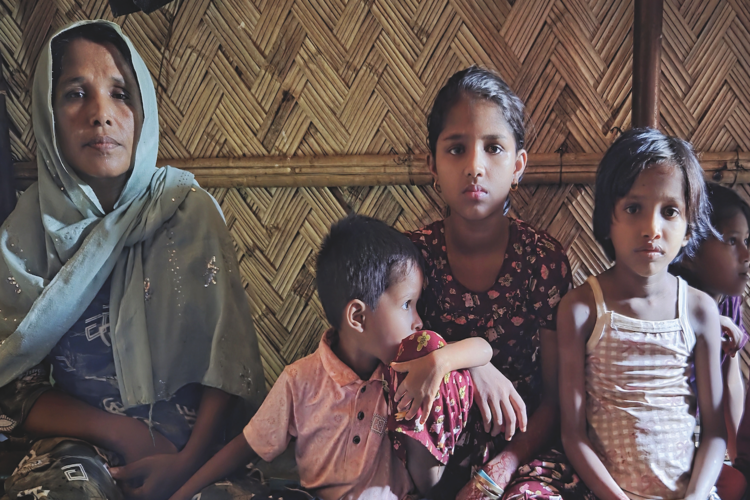
On the ground in Cox’s Bazar, survival of the Rohingya refugees has become a daily act of endurance
Report and photographs by Boštjan Videmšek
On 22 August 2024, the Myanmar army bombed Mundu village near the border with Bangladesh. Thirteen-year-old Mohammed Shahaib and his two sisters were playing in the local school playground. They ran to seek shelter, but a bomb exploded nearby, killing one of Mohammed’s sisters and wounding the other. Pieces of shrapnel were lodged in the boy’s right thigh.
His father, Zacharia, managed to get him and his sister to the local doctor, who treated the wounds, saving their lives. The family then fled to Bangladesh.
Check out our related reads…
It took them 17 days on foot, making their way through the hellish, battle-scarred fields of western Myanmar before they reached the Naf River and the border with Bangladesh.
‘I am always scared at night – so very scared…’ Mohammed told me as he waited for the day’s round of physiotherapy at the Handicap International humanitarian organisation facilities in the camp the family now calls home. Zacharia, who always accompanies his son during the therapy sessions, explained that Mohammed’s sleep was riddled with shrieks and convulsions.

‘In my dreams, I can sometimes see my sister and our neighbours getting killed…’ the boy said quietly. Having braved such terror, he was now clearly suffering from post-traumatic stress disorder. ‘But I am already feeling much better!’ he quickly added, not wanting to appear ungrateful. ‘The exercises here have helped a lot. And I am also able to go to school, which is very important!’
A huge smile broke over the wounded boy’s face.
Camp life
The plight of the Rohingya is one of the world’s worst refugee crises. The Buddhist majority in Myanmar has long persecuted them. The military junta, as far back as 1982, stripped them of all their rights and in the decades since, their land has been expropriated and they have been forced to flee to neighbouring Bangladesh. Today, more than 1.2 million of the predominantly Muslim community are living in appalling conditions in 33 highly congested camps near Cox’s Bazar and Bhasan Char. They aren’t legally allowed to work, they haven’t even been granted refugee status, and now humanitarian aid has been cut back to desperate levels.
The newer arrivals are forced into the world’s largest complex of refugee camps, where there’s no such thing as dignity, privacy, hygiene or opportunity. Even worse: the camps function as an open-air prison, and the inmates face an epidemic of hunger.
During the monsoon season, the camps are assaulted by cyclones, heavy downpours and winds that smash their flimsy shelters as if they were made of Styrofoam.
During the frequent droughts, fires pose the greatest threat; cooking in the open and in overcrowded conditions has led to regular devastating blazes.
A feeling of hopelessness
‘It is so very hard… We are barely able to survive,’ Zacharia told me. ‘We found shelter with my sister in a small shack. There is not enough food. We are not permitted to work or leave the camp. We cannot go back home. We have lost everything.’
Back in Myanmar, Zacharia worked as a shoemaker. He had hoped to use his skills to find work, but soon found that impossible. A feeling of utter hopelessness permeates the camps. ‘Which is why my boy’s will to live is so wonderful!’ Zacharia immediately cheered up as he looked at his young son. Having finished the first five grades of primary school in Myanmar, Mohammed now attends the first grade of the education centre at the Kutupalong refugee camp complex located in Bangladesh’s poorest province, Cox’s Bazar, at the Myanmar border. It’s one of the few schools still running in the camps.
Over the past year and a half, some 150,000 new refugees from Myanmar have poured into the Kutupalong complex – the largest of the camps. Myanmar’s Rakhine state is being consumed by an indescribably brutal war and the genocide perpetrated on the Rohingyas rages on unabated.
While most of the Rohingyas were chased from their homes in 2017 by the Myanmar military junta, with the support of Buddhist monks and the tacit acceptance of the 1991 Nobel Peace Prize winner Aung San Suu Kyi, the chasing is now being done by the Arakan Army. The rebel militia formation has forged a coalition with several other organisations of its kind, aimed at overthrowing Myanmar’s military dictatorship.
The Arakan Army currently controls almost the entirety of Rakhine state and the entire length of its border with Bangladesh. The China- and Russia-supported junta only controls 21 per cent of Myanmar’s territory, according to a BBC investigation. Forty-two per cent of Myanmar is now controlled by various ethnic militias. The rest is a dangerous, contested no-man’s land.
Less and less food
‘For several days, the government forces bombed our village. When the soldiers entered the village, we were driven away. My husband was killed. We had to run,’ 25-year-old Fatema told me, in her tiny hut built out of bamboo and covered with a roof made of tin and plastic.
She and her three small children fled to Bangladesh, passing numerous Rohingya villages that had been burned to the ground. The journey to the border took five days. When Fatema and her children reached the refugee camps, they were starving and exhausted. They didn’t know a soul in Bangladesh.

‘Some kind people came by and invited us to stay with them at one of the camps. I will always be grateful to them,’ Fatema recalled in her hut, where 12 people currently share less than eight square metres of living space.
The inside of the dwelling felt stultifyingly hot and damp. It was made of bamboo because the Bangladeshi authorities frowned on the construction of any ‘permanent infrastructure’. Even though it was still some time before noon, the sun had already overheated the tin-and-plastic roof. Rivulets of sweat trickled down our faces as we talked.
‘Life here is extremely, extremely difficult,’ Fatema said. ‘We are hungry, and we get less and less food. The first four months I spent at the camp, I received no help at all.’ Her thoughts then turned to her former life: ‘It used to be good. Our family was able to work the land, we had our house and our field. I want to return!’
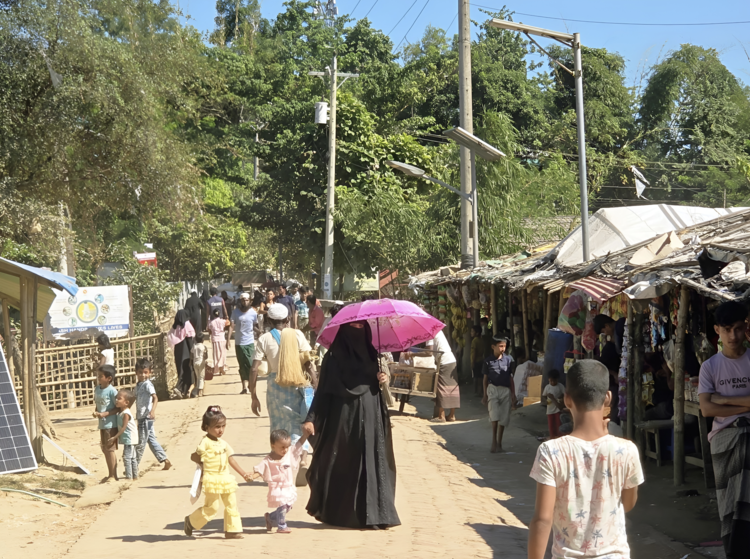
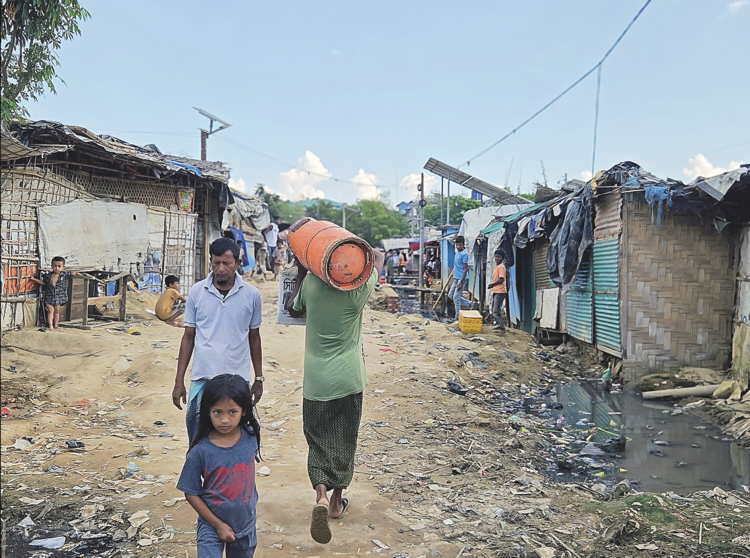
Next to Fatema, an exhausted man was sleeping on the ground, huddled protectively over a sleeping toddler. In front of the hut’s entrance, a never-ending human procession rolled along a narrow, muddy thoroughfare. It was mostly formed by children, scores of them naked. Eighty-seven per cent of the camps’ residents are women and children. Two-thirds of all those gathered here behind the barbed wire and the sentry towers are under the age of 18.
Interspersed among the endless procession of children were a number of women. Virtually all of them wore burqas, while many also carried umbrellas to shield them from the sun. Chickens chased each other around the children’s feet. The drainage canals swarmed with hens feasting on discarded scraps and human waste. Half- comatose, scab-covered dogs lay about in the sun. The reek of faeces was overpowering.
Some roofs are fitted with solar panels, with the electricity mostly used for lighting and refrigeration. A number of huts had been transformed into small shops, even though commerce is officially forbidden. The camp authorities have even banned the use of cash, forcing international humanitarian organisations to issue digital vouchers to the refugees.
The true dimensions of the camp complex could only be glimpsed from the tops of the nearby hills. One bank of the Naf River was dominated by the green slopes of Myanmar, the other by rows and rows of ramshackle dwellings extending to the horizon.
Eight years of despair
Like the majority of the camp dwellers, the Noor family fled to Bangladesh in 2017, when the ruling junta undertook an extensive programme of ethnic cleansing of the Muslim minority. This period also marked the beginning of the Rohingya military organisation, culminating in the formation of the Arakan Rohingya Salvation Army.
After the guerrillas raided a few government outposts, a genocidal wave of revenge was unleashed. Hundreds of thousands were forced to run for their lives.
Thousands perished during the flight, most of them due to sinking boats chartered from smugglers and used to attempt to cross the Naf River. Thousands more simply disappeared – some into the illegal labour market, some into sexual slavery. More than 800,000 refugees were ultimately settled in the camps close to the border.
Eight years on, the endless throng of desperate yet incredibly resilient people is still here. Meanwhile, conditions back home in Myanmar have deteriorated further. Much the same can be said for their host country of Bangladesh.

‘In Myanmar, we had our house and our patch of land. Here we have nothing,’ said Mrs Noor, a visibly exhausted mother of five. Two of her children, 14-year-old Kaias and 27-year-old Salam, suffer from cerebral palsy.
Worse living conditions for enduring such a merciless affliction could hardly be imagined. Yet during our visit, the Noor family’s small, hot and tidy hut was nonetheless permeated by a buoyant mood. The mother, who wished to remain unnamed, related how back in 2017, humanitarian workers helped the family find a makeshift roof over their heads. Given Kaias’s and Salam’s condition, this was a matter of life and death.
‘Our neighbours were always there to help us,’ the mother was quick to point out. ‘People help each other around here. There is a feeling of solidarity.’
After being savagely beaten by Myanmar soldiers, her husband still has trouble walking. Solidarity may still persist among many of the camp dwellers, but there is also great fear of kidnappings and robberies. At night, the complex is ruled by criminal gangs.
‘We are so poor we have nothing to steal,’ Mrs Noor smiled wryly. ‘We really have nothing, you know. Most of all, we need a small solar panel so we could sometimes have light at night… And to power the ventilator for the heat during the day.’
When earlier last year the complex was visited by the UN secretary-general António Guterres, he described the camps as ‘a stark reminder of the world’s collective failure to find solutions.’ Years ago, Guterres described the Rohingyas as ‘one of, if not the, most discriminated people in the world.’ At the end of last year, it was announced that the International Court of Justice will hear a landmark case accusing the Myanmar junta of committing genocide against the Rohingya, at the start of this year.
Soon after being sworn in, Donald Trump discontinued a large part of US international humanitarian and developmental aid programmes. Most severely affected was the USAID organisation, which used to be the first on hand at various crisis sites across the globe. But the USA isn’t the only country to have significantly reduced its contribution to the international humanitarian kitty. Among others, the UK and Germany followed suit.
To provide a modicum of assistance to the refugees in Bangladesh, US$934.5million was needed this year. Yet according to UN data, only 38 per cent of the sum was secured by mid-October. It bears mentioning that the budget for helping the Rohingya refugees had been modest enough even before the large cuts to the international humanitarian system, which many claim is on the verge of collapse.
In 2025, the European Union allocated €32.3million for humanitarian aid to Bangladesh. A year before that, the sum was €54million.
Given that the horrific fate of the Rohingyas resides at the bottom of the global geopolitical priority ladder, the consequences of the drastically emptied humanitarian budgets are devastating. Key international humanitarian organisations were forced to reduce the level of aid to ‘life-saving operations’. This doesn’t include education, a particularly harrowing development for the Rohingyas with their already high levels of illiteracy.
Over the past several months, 55 per cent of the camps’ education centres have been closed due to budget cuts. Tens of thousands of children were pushed out into the extremely dangerous streets.
The nearly bankrupt humanitarian community was also forced to reduce food rations. Until this summer, every refugee family received a monthly food subsidy of US$12. The system was at least moderately functional, even if inadequate. In September, it was announced that the subsidies were to be reduced to US$6, which was then put on hold. But without adequate international funding, aid workers in the camps are anticipating further drastic cuts.
The consequences are as dire as they were predictable. There is now growing hunger across the camps, especially among infants and small children. A UNICEF report last year said that there has been a 27 per cent rise in children needing emergency treatment for severe acute malnutrition.
Strict quotas on drinking water have also been imposed in the camps, as well as on soap. Maintaining personal hygiene became increasingly difficult in these nightmarish conditions, posing enormous health risks to the entire compound and beyond. The humanitarian workers I talked to kept mentioning the possibility of cholera outbreaks. Infant mortality in the camps was also on the rise, as well as opiate addiction, the opiates being cheap and easily accessible.
A generation in jeopardy
‘At the moment, there are 14,500 severely malnourished children at the camps – as a direct consequence of the budget cuts,’ I was told by Owen White Nkhoma, a UNICEF nutrition specialist. ‘Taking care of them is our focus. We are at a critical juncture. The relief budgets are empty. The entire humanitarian system has been affected. We need money to continue our programmes here. Otherwise, I fear the food rations are going to be reduced even further.’
Nkhoma’s testimony offered more proof that the recent cuts are a matter of life and death.
‘We are dealing with the breakdown of the global humanitarian system!’ he went on. ‘And the Rohingyas have it especially bad, since they are entirely dependent on humanitarian aid. An entire generation of children is in dire jeopardy. We are already detecting a significant drop in immunity. The children here are experiencing a slowdown in their development. They, for example, learn to walk and talk later than they used to. The process starts in the womb. We are facing a vicious cycle and irreversible damage. For purely political reasons, we are standing at the edge of a precipice.’
All told, the Kutupalong complex holds 32 camps (plus one on the island of Bhasan Char). At the UNICEF nutrition clinic located at Camp Number 15, a crowd of burqa-wearing mothers and their malnourished children were waiting for their examinations. The goal was for humanitarian workers to assess each child’s malnutrition level and respond based on the limited options available.
The children seemed very uncomfortable as the girths of their biceps and the fat on their upper arms were measured. The most frail-looking among them started to cry.
Thirty-five-year-old Jita Bibi, a mother of four, sat in exhaustion under some children’s drawings hung on the wall, as huge fans brought some relief from the heat and humidity. Every now and then, the power went out and we found ourselves in pitch darkness, pierced only by the sounds of children.
A two-year-old boy named Mohammed rested quietly in Jita’s lap. Until very recently, the boy, who has Down syndrome, was severely malnourished. Over the last few days, he was brought back from the brink of death with the help of a ‘therapeutic nutrition package’.
‘Mohammed’s condition has improved a great deal,’ Jita reported quietly as she cooed the boy through a mild shiver. ‘I thought he was getting enough food, but he wasn’t. And then the rations were further reduced. All of us were starving.’
Jita also told me that she was ill during pregnancy, resulting in complications during labour. At the camp, her family was entirely reliant on others, since her husband’s disabilities prevented him from getting work. Their monthly food budget is spent within the first ten days. For the other 20, they starve.
Little wonder, then, that the examinations at the nutrition clinic determined that Jita’s other three children were also severely malnourished. They, too, were helped back on their feet by the UNICEF urgent relief programme.
‘We want to return home,’ Jita said, smiling wistfully. ‘But right now, it is not safe. Over here, I am haunted by memories.’
When I asked a few questions about safety conditions at the camps, she froze. Then, like virtually everyone I spoke to, she mentioned the kidnappings. The perpetrators mostly targeted teenage boys. Next to hunger, ransom-motivated kidnappings are seen as the main threat faced by the camps’ families.
Jita was also fearful of fires and earthquakes. Her hut was located under a hill and looked flimsy enough to be swept away by a strong downpour. Such an occurrence would hardly be abnormal for a rainy season spent at the Kutupalong camp complex.
Preying on despair
Kidnappings, theft and sexual violence are rampant. The kidnappings follow the classic pattern, with the perpetrators contacting the victim’s family and demanding a steep ransom. The relatives have little choice but to go into debt in order to pay up. And the only place where they can usually get credit is with the criminal groups behind the kidnappings.
According to our sources, several hundred families have thus incurred debts that will last for many generations. A number of kidnappees were not returned even after the ransom was paid. Some of the camp’s inhabitants – mostly women – are also being kidnapped into sexual slavery.
The situation grows worse by the day. Dozens of inhabitants have been reported missing. A number of corpses were found by the Bangladeshi police in the immediate vicinity of the barbed-wire camps. Over the last few weeks, the number of kidnappings has risen sharply after the humanitarian cuts forced many of the families’ fathers and brothers to seek sources of survival outside the camp. Once outside, the Rohingyas are easy prey for the smugglers and human traffickers.
We decided to visit a group of teenage boys who had recently completed a vocational training course but were now left to fend for themselves.
They first told us of their hopes and dreams: ‘I want to become a doctor, so I can help people!’
‘I am going to build my own plane and become a pilot! Then I will be able to fly away from here.’
‘I want to be an engineer. Everyone needs them!’ ‘I want to go abroad. Anywhere!’ ‘I just want to continue with my education. Here, they only have primary school.’ ‘I want to go home and live safely and with dignity. I want to help rebuild our village, which has been burned to the ground.’
Yet soon enough, the boys’ conversation turned to the brutality of their surroundings. All they could talk about were the kidnappings and the need for safe spaces – or, actually, any sort of spaces.
‘We don’t dare get around much,’ one of the boys explained. ‘You can be kidnapped at any moment.
But the outside of the camp is even more dangerous! However, we have to go out to work to survive – even if it is officially forbidden. Many people I know have been kidnapped or robbed. My brother was one of them. They demanded US$5,000. My family borrowed the money and paid the ransom. My brother eventually came back after three months.’

This first story seemed to break a mental dam. Countless others ensued, with the boys struggling to outshout each other with their horrors.
They told me of the mounting hunger; one of them described it as ‘the force behind the camp’s instability.’ They also related what they had heard of the drugs and weapons being smuggled out of Myanmar. They informed me that many people failed to report the kidnappings to the police since they feared revenge – and with good reason.
Armed Bangladeshi policemen maintain a presence in the camps, along with a number of secret agents. But investigation into internal Rohingya disputes doesn’t seem to be much of a priority.
The camps’ criminal gangs often have ties to various armed groups from Myanmar. These groups find easy prey for new recruits amid the utter despair permeating the camps.
Good for endurance
‘The cuts have severely affected education,’ said Amd Rasho, an education specialist with the Norwegian Refugee Council, the organisation that runs 15 of the complex’s education centres. ‘The decision was made that education doesn’t belong in the life-saving category. It was not the right decision. For the Rohingyas, education is of vital importance! Ninety per cent of all 15- to 22-year-olds are unschooled. It is a horrible development.’
Talking to Rasho, a Syrian Kurd, was a refreshing experience, given his strong dislike of the euphemisms used by many NGO workers, who brand people as ‘beneficiaries’ and litter their explanations with acronyms.
‘The cuts have rendered the young here even more vulnerable – even more exposed to arranged marriages and child labour,’ he said. ‘In an existentially threatened community like this, survival trumps everything else.’
Rasho also pointed out the drastic shortage of teachers in the camps – especially female teachers. The reasons are partly cultural. The traditionally conservative Rohingya community became even more conservative in exile, and the standing of women has been significantly weakened.
We took a stroll around the education centres and found most of them deserted. One, however, was filled with youthful exuberance.

On entering, we found a colourfully decorated classroom attended by white-shirted boys and an infectiously energetic teacher. The boys were taking turns reading aloud. Among the most enthusiastic pupils was 15-year-old Mohammed, who later told me he wanted
to become a doctor.
He also volunteered that the local school meant a safe place for him and for the other children fortunate enough to attend it. When we asked whether he was sometimes hungry during school-time, he proudly replied that he loved school so much that it always made him forget his hunger.
‘What about after class?’ I pursued. This time, Mohammed failed to respond. But the huge grin adorning his cheeks was extinguished in an instant.
‘When the classes end, I feel very uncomfortable,’ he eventually explained in a hushed tone. ‘I’m afraid of being outside. The school is safe.’
At the school entrance, his parents were already waiting to pick him up.
On one of the local sandy football pitches, a group of volunteer firemen were perfecting their skills while a group of young teenagers played football. One of the boys was observing the action, seated up on the juncture between a goalpost and the crossbar. A slightly older boy took a powerful and – one had to guess – carefully aimed shot from some 20 metres out, and smashed the ball straight at his high-perched peer’s head.
The boy fell as if shot by a rifle and lay motionless on the ground.
Along with several colleagues, I ran to his aid. Fortunately, the shade he was transported to by the other youngsters quickly did him a world of good. After a few deep breaths and an attack of the shivers, he was back on his feet.
‘What?!’ the boy who felled him responded to my accusing stare. ‘It’s good for endurance!’