In a valley in Pakistan’s Karakoram range, three alpinists climbed a virgin north face with no fixed ropes – here is their story
By
The Chapursan valley, in the remote northwestern Pakistani region of Gilgit-Baltistan, is not a place that sees many foreign visitors.
Surrounded by the jagged, 6,000-metre-plus peaks of the Karakoram, it’s at least a three-day drive from Islamabad along increasingly rutted roads. Meanwhile, geopolitical tensions around its borders – with China’s Xinjiang Province to the north and Afghanistan to the west – mean the area is often completely off-limits to outsiders.
Enjoying this article? Check out our related reads…
In early 2024, however, the Pakistani government decided to open up the region to climbers, allowing permits to be issued for the Chapursan valley and its surrounding peaks for the first time in years.
At around the same time, a 26-year-old American alpinist named Dane Steadman was ‘doing what a lot of people with the alpine compulsion do, which is cruising around Google Earth looking at things that look fun to climb’, he said, when he alighted on Yashkuk Sar I – an imposing, 6,667-metre peak overlooking the valley with an attractive-looking buttress up its north face. ‘I figured out only two teams had ever been into this valley,’ Steadman told me, ‘and the peak had never been climbed.’ So he set about organising an expedition – gathering gear, arranging local support and preparing himself physically and mentally.
I met Steadman, a mellow Wyoming native with an impressive handlebar moustache, in San Martino di Castrozza in the Dolomites. Along with his climbing partners, August Franzen and Cody Winckler, he’d been invited to come and collect a prestigious Piolet d’Or award for the ascent.
Known as ‘the Oscars of mountaineering’, these golden ice axes are given out every year to a select few climbs who epitomise the spirit of alpinism. The climb up the north face of Yashkuk Sar I ticked all the boxes, according to the judges (who are respected mountaineers in their own right).
The summit itself was a world first and access presented significant challenges – the expedition took Steadman months to organise. But perhaps most importantly, the line they chose up the buttress was aesthetically pleasing, and completed in pure alpine style – with no fixed ropes, equipment caches, or outside assistance.

Listening to Steadman and Franzen talk through the climb in the warmth of a hotel lobby, it was difficult to imagine the physical hardships involved. But the presentation they gave at the award ceremony – complete with videos and dramatic photos of their tent perched on precarious ledges above a gaping void – helped fill in the gaps.
Perhaps the biggest challenge they faced was simply the lack of information, as they scouted a completely new route up a totally virgin peak. The protruding buttress of rock and ice that Steadman had seen online seemed safe at first. What they hadn’t reckoned with was the pinnacles that stuck out from the buttress, each one topped with a treacherous, mushroom-like build-up of snow. ‘You can never see that level of detail on satellite imagery,’ Steadman explained. Even from the ground, where they’d spent weeks in base camp waiting for a weather window and inspecting the 2,000-metre vertical wall above their heads, the sheer size of these obstacles wasn’t obvious.
It was only during their second night on the face, when a mushroom collapsed above them and a huge avalanche swept across the line they’d been planning to climb the next day, that the danger became fully apparent. ‘Up until that point we felt like wherever we wanted to climb, the buttress was fairly safe,’ said Steadman.
‘And then it was all at once: “Oh no. We’re wrong.’ The three were almost certain the only way out was to go down. ‘I had this deep, sinking feeling,’ Franzen said. ‘We had come so close, but now all the signs pointed to having to retreat. I remember being in our tent, just sitting in silence, wondering who was going to say it first.’
With some time to kill until morning, however, Steadman re-examined the photos of the mountain he’d downloaded to his phone and, before long, identified an alternative route. After three more days of hard climbing, and two more nights of very little sleep, the trio reached the summit. Physically, the climb was tough. Emotionally, it was arguably tougher still – especially for Franzen. ‘I never wanted a line more than this,’ he said.
As well as the weight of his rucksack, helmet, tent, climbing rack and all the other gear you need to climb big mountains, he’d been carrying a heavy emotional burden. Four years prior, his first love, Kalley Rittman, had been killed in an accident near their home in Valdez, Alaska.
She was out climbing with Brian Teale – a trip Franzen would have been on, had he not changed his plans at the last minute. ‘She was 23,’ he told me.
Two years after Rittman’s death, Teale himself was also killed, falling from scaffolding at work. As he climbed Yashkuk Sar I, Franzen used ice axes engraved with each of their names. In his pack, he carried a small bag containing their ashes. He’d taken these ashes on previous expeditions, but always made the decision that it was not the time or place to say goodbye,’ he explained.
This time, however, standing in one of the remotest regions on the planet, on a spot ‘where no-one else had ever been before,’ he felt different. ‘We took a moment, first for ourselves and one another,’ he said. ‘Then, after we had celebrated as a team, I decided that this was a fitting place. I was ready for that symbolic act of letting go,’ he recounted.
Franzen knelt in the snow, his friends put their hands on his shoulders, and he poured the ashes onto his glove. After pausing for a beat, he opened his hand. ‘There were no words exchanged,’ he said. ‘It was just the whistle and the howl of wind.’
Three items you’ll need if you want to try mountaineering
The Essential: Petzl Meteor helmet – £85

Whether you’re scaling unclimbed peaks in the Greater Ranges or tackling a simple route in the Scottish Highlands, a helmet is one of the few genuinely
non-negotiable pieces of mountaineering equipment.
The Petzl Meteor has become a go-to option because it combines that protection with exceptional comfort. The in-mould construction keeps weight impressively low (just 235 grams in size S, or 245 grams for M/L) without sacrificing safety.
The helmet is also well-ventilated, so you’re less likely to overheat during long
approaches or sunny alpine climbs. The slim profile means you’ll almost forget you’re wearing it – which is exactly what you want. A helmet you’re happy to keep on all day is ultimately the safest choice. petzl.com
The Surprisingly Useful: Berghaus Ridgeseeker jacket – £360

A good shell jacket is standard mountain kit, and if you’re climbing in the Karakoram you’ll want something super-high-end. But most of us – for whom winning a Piolet d’Or is as likely as walking on the moon – are better off with something more affordable, versatile and all-round useful.
Berghaus’s Ridgeseeker jacket is a great example. It’s made of 3L Gore-Tex, which gives it waterproofing and breathability ratings high enough to
handle anything the British weather might throw at it. The cut allows good movement when climbing or scrambling and the adjustable hood fits over a helmet but doesn’t feel bulky when worn alone.
Multiple pockets are easy to access when wearing a harness or pack, and the tough fabric can handle rough rock and repeated use. A jacket that performs everywhere is one less thing to think about when packing for the mountains. berghaus.com
The Luxury: Petzl Nomic ice axe – £270
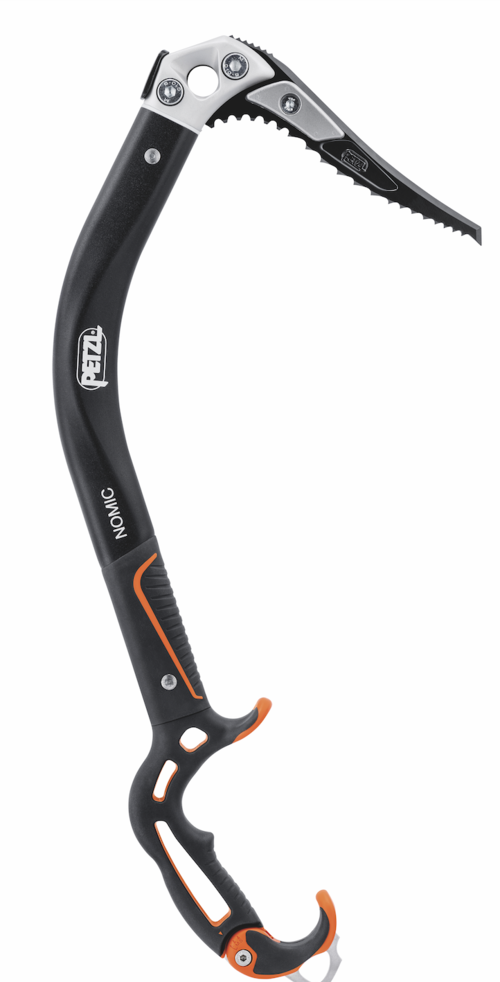
High-performance technical ice axes don’t come cheap. But for climbers pushing into steeper ice or mixed terrain, investing in a really good set of tools can transform how confidently and efficiently you move.
Petzl’s Nomic has become something of a benchmark among technical climbers
for exactly this reason. The aggressively curved shaft makes placements easier on steep terrain, while the well-balanced head swings cleanly into ice with minimal effort.
Adjustable grip rests allow you to fine-tune the handle for gloves, conditions, or climbing style, and the modular pick and head weights mean you can adapt it for anything from waterfall ice to technical mixed routes. It’s the sort of beautifully engineered tool that feels like a luxury in hand – but one that earns its keep when routes get serious. petzl.com