After years of criticism over water use, pollution and working conditions, the cut flower industry in Kenya is trying to show it can have a greener future
Words and photographs by Stuart Butler
Valentine’s Day hadn’t got off to a good start.
Once again, I’d failed to get my wife some flowers, and she wasn’t happy. Every year it’s the same story, and every year I pull out the same excuse: ‘Most bunches of flowers come from East Africa and are shipped halfway across the world. It’s bad for the environment. By not having any flowers, you’ve probably saved some cute baby zebras.’ The withering look she gave me indicated that she wasn’t convinced.
Enjoying this article? Check out our related reads…
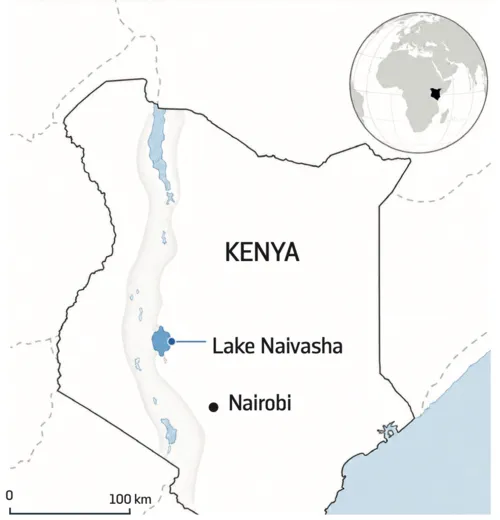
Some weeks later, I’m standing with Eddy Verbeek in a vast plastic greenhouse filled with the shocking pinks, vivid greens and deep purples of thousands of flowers and bedding plants. ‘Over the years, we’ve experimented with various natural biological controls in our greenhouses. Some have been more successful than others.’ Eddy is the director of Florensis Flowers, a flower and bedding plant farm located on the shores of Kenya’s Lake Naivasha, and he’s explaining to me how the Kenyan cut-flower industry has been busy transforming itself into a world leader in sustainable flower production.
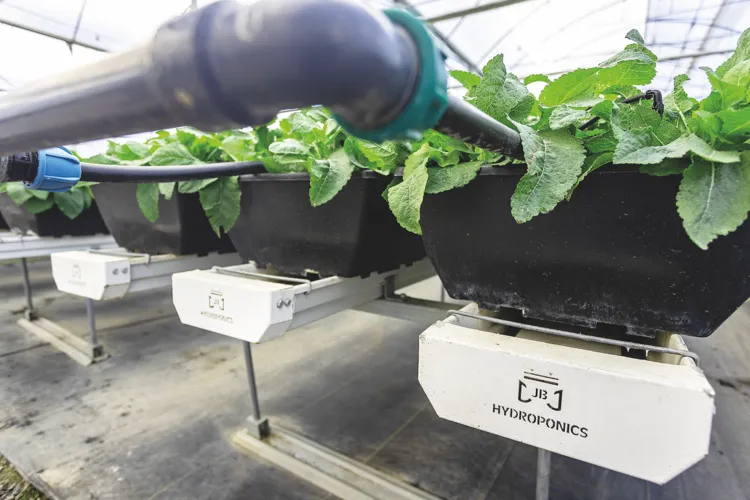
The use of hydroponics is one of the ways that flower producers have reduced their environmental footprint
‘We once tried to use chameleons as a form of pest control, but, because of cultural beliefs, many people here are scared of chameleons and, on the very first day we released them into the greenhouses, my staff almost went on strike.’ Chuckling at the memory, Eddy, who, like many of the directors of the big Kenyan flower farms, comes from the Netherlands, goes on: ‘After the chameleon episode, we opted for a more culturally acceptable kind of natural pest control: a flock of small quail. The staff had no problem with these, but unfortunately, this didn’t work either because a group of mongooses discovered them and, every night, they’d break in and cause chaos running around trying to catch the birds.’
The act of gifting flowers to one another as a way of conveying emotions goes back a long way. More than 4,000 years ago, the Ancient Egyptians presented flowers to their gods, and bouquets were placed in tombs. After them came the Ancient Greeks, who turned the giving of flowers into a romantic gesture. By the European Middle Ages, certain flowers had come to have symbolic meanings, and entire messages could be conveyed through the types of flowers a person was given. This reached its peak in the Victorian period, when flower messages – known as floriography – became so complex that dictionaries were produced to help the receiver translate them.
Today, with the giving and receiving of flowers continuing to be used to express thanks, love and sorrow, the production of cut flowers has become a huge worldwide industry. In 2025, the global trade was valued at US$38.5billion, and by 2031, it’s expected to have grown to US$52.78billion.
For more than 200 years, the centre of the trade has been the Netherlands, which remains one of the world’s key flower-trading hubs, but over the past couple of decades, flower producers in other parts of the world have been eating away at Dutch dominance. The East African country of Kenya is one of those places.

The cut-flower industry first took root in Kenya in the late 1960s, with flower cultivation centred on the Rift Valley, particularly around Lake Naivasha. With an ideal climate – cold at night, warm in the day and with lots of sunshine and reliable rainfall – it quickly became clear that this part of the country had all it took to produce beautiful blooms. Even so, at first, Kenyan growers only supplied a tiny local market and it wasn’t until the 1980s that international buyers began to take note of the quality of flowers – and roses in particular – being produced in Kenya.
From that moment on, the scale of the flower industry expanded rapidly. As well as climatic advantages, Kenya is strategically positioned to supply markets in Europe, the Middle East and parts of Asia. All of this meant that, by 2023, Kenya was among the world’s leading flower exporters, with about 40 per cent of the roses sold in the EU coming from here. The Kenyan flower industry, which contributes about 1.5 per cent to the country’s GDP, earned Kenya around US$835million in export revenue in 2024 and directly employs around 200,000 people, while supporting more than two million livelihoods.
Although the cut-flower industry has brought huge economic advantages to communities around Lake Naivasha and other flower-growing parts of the country, the flowers have come with some thorny problems.
There are eight large lakes in Kenya’s Rift Valley, and Lake Naivasha, the second largest, is one of the few freshwater lakes. Not so long ago, the lake was surrounded by swamp, acacia woodland and savannah grasslands. Wildlife was abundant, with great herds moving up to the lake shore from as far away as the Serengeti. The fresh water of the lake, which is a protected Ramsar site, also attracted – and still does – masses of birdlife, making Lake Naivasha one of Kenya’s top birdwatching sites. But what made the lakeshore so attractive to wildlife also attracted people. It was the British colonists who first noted that the climate around the lake was ideal for farming, and they cleared large parcels of woodland for cattle ranching. In more recent times, the lake’s proximity to Nairobi, Kenya’s capital, has meant that Lake Naivasha has become a favoured weekend break for city folk. While both these aspects brought development to the lakeshore, it was the flower industry that really changed everything.

Through the first decade of this century, a string of reports appeared in the world’s media decrying the catastrophic state of Lake Naivasha. Headlines declared that this biologically important lake was drying out, the riparian forests were vanishing, fish stocks were collapsing and the large herds of animals that once grazed around the lakeshore were becoming just a memory. The blame was placed squarely on the 50 or so flower farms that had sprung up along the lakeshore during the previous years. There were allegations of unsustainable water use, and with each rose requiring around ten litres of water, it was hard to deny that the flower farms were negatively affecting the lake’s water levels. There were also multiple reports of pesticide and fertiliser run-off pouring back into the lake and poisoning it, and lakeside habitat being destroyed to create more space for plastic greenhouses. In addition, other reports revealed dangerous working conditions and staff harassment on the flower farms. The farms fought back by claiming it was other industries and upstream deforestation that was the problem, although they acknowledged that population growth was partly driven by people moving to the area to work on the flower farms. Whether or not there was truth in these claims was, by then, a moot point. The damage was already done, and Kenyan flowers began to be seen less as a symbol of love and more as a symbol of toxic destruction.
Fast forward to today and the situation in and around Lake Naivasha is very different. Having been put under enormous pressure, the Kenyan flower industry vowed to clean itself up, and Kenya is now widely regarded within the industry as a leader in lower-impact flower production. So much so that studies have shown that buying Kenyan-grown roses to give to someone in Europe can result in a smaller environmental footprint than buying flowers grown in Europe.
‘There are several reasons why buying Kenyan-grown flowers has less of an environmental footprint than buying homegrown European flowers,’ Joost Zuurbier, the Dutch director of Bilashaka Flowers, tells me as we sit on the veranda of his home on the shores of Lake Naivasha. ‘But the most important reason is to do with climate. To successfully grow roses year-round, you need an average temperature of around 20°C. In the past, you could only buy roses in Europe during the summer. But Valentine’s Day, which is one of the busiest periods of the year for a rose farmer, is right in the middle of winter. So, to supply winter roses, farmers in the Netherlands and elsewhere in Europe began growing flowers in heated greenhouses. Imagine how much energy that consumes! Out here in Kenya, we don’t need to heat our greenhouses, and this means that a flower farm in the Netherlands creates far more greenhouse emissions than one in Kenya, even when you take transporting the flowers to Europe into account.’ Joost explains that in the past, flowers had to be transported by air to Europe to arrive fresh. But now, thanks to advances in shipping and storage technology, it’s increasingly possible to use sea transport, which means larger quantities of flowers can be moved around with less environmental impact.
‘It’s not just climatic considerations and advancements in shipping, though, that have helped make our flowers so sustainable. We took lots of small steps to improve sustainability. Let’s go and look at some compost!’ Joost suggests.
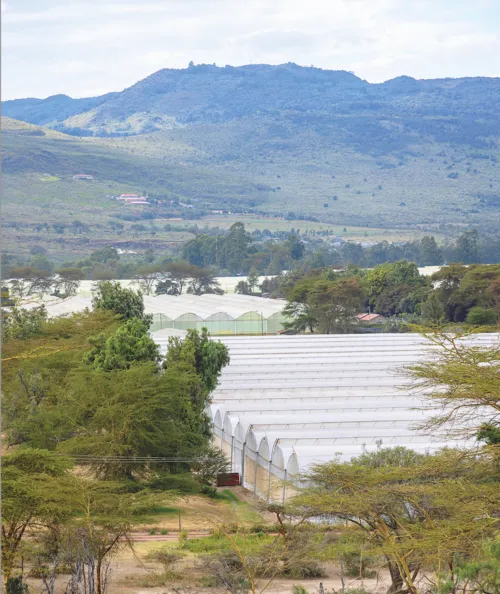
Walking past a large plastic greenhouse, we come to an open area where a dozen waterbuck and zebras are picking through piles of compost in search of tasty morsels. ‘The animals love this. We get all sorts coming here for a meal. There was a big group of buffalo earlier this morning,’ says Joost, smiling at the sight. ‘In the past, most farms just used chemical fertilisers, and this led to pollution. We’ve created a totally natural compost from plant cuttings and other organic waste. We estimate that our compost has increased flower productivity by 80 per cent and has massively reduced reliance on chemical-based fertilisers. Most of the farms around here are doing something similar. So, this has done a lot to help reduce chemical run-off pollution into the lake.’
He then goes on to tell me that Bilashaka Flowers is a completely closed system, with no effluent at all. ‘It’s all properly cleaned and goes back to watering the farm. None of it ends up directly in the lake. Our farm has no discharge into the lake at all. This isn’t the case for all Naivasha flower farms, but even those that do still discharge into the lake, almost all of them use papyrus wetlands as an effective way of treating the water naturally.’ The flower farms employ a lot of people. In the case of Bilashaka, they have 1,400 direct employees, who live with their families in nearby villages. Most of the villages around Lake Naivasha have only minimal waste-collection facilities, and this is something that Joost and his team have tried to address. ‘We give the family of every employee a recycling bin. A local youth group gathers and sorts this waste and then makes money by selling the items that can be recycled. Just this small action has had a notable impact on the amount of discarded plastic in our local environment and on the lake.’

Back at Florensis Flowers, Eddy tells me that most of their biological and environmental projects have proven more successful than the chameleon and quail experiments. ‘All of our newer greenhouses have hydroponic systems that dramatically reduce our water use.’ But what he’s most proud of is the farm’s reforestation project. ‘Twenty hectares of degraded lakeshore were reforested with native acacia trees, and this has brought back some of Naivasha’s wildlife.’ Stepping outside of the greenhouse, we wander down to the staff football pitch, which is situated next to the reforestation project, only to find it occupied by a small herd of waterbuck and an elegant yellow-billed stork. ‘It’s okay playing football when they’re here,’ a worker at the farm tells me. ‘The problems start when the hippos come out onto the pitch,’ he says, only half-jokingly.
According to the Kenya Flower Council (KFC), most of the country’s flower farms are working hard to reduce their environmental footprint. More than 60 per cent of member farms now use renewable energy sources, 92 per cent rely on integrated pest management, which involves using beneficial insects and organic approaches to reduce pesticide use, and 85 per cent have adopted efficient irrigation systems. In addition, the KFC also claims that growers are embracing hardier flower varieties that can withstand changing climatic conditions while reducing dependence on pesticides and excessive water use.
However, reducing environmental damage wasn’t the only thing that Naivasha’s flower farms had come under pressure from international media to improve. There was the human element as well and, in many respects, this is where both Bilashaka and Florensis really shone, as Eddy from Florensis readily admitted.
‘I guess our real focus is on community development. We put great value on our staff. We’ve established a children’s day-care centre for staff with younger children, and a lactation room for breastfeeding mothers. This is a quiet and comfortable room with all the necessary pumps, storage bottles and fridges. We also give all new mothers a gift pack containing items they might need.’ As we talked, Eddy led me around a community library and cyber centre that the farm had built for employees, and a storage area where staff could buy reduced-price gas bottles, since most cooking in Kenya is done on small gas stoves. ‘In many ways, all this is more than any flower farm in the Netherlands would offer its staff. Our community projects are so well regarded that the king and queen of the Netherlands even came to visit us and see our community projects!’

Heading into the office complex at Bilashaka Flowers, Davis, the head of HR, tells me that they too put a similar emphasis on staff welfare. ‘We’re a long-established Fairtrade company. When a flower distributor buys our flowers, ten per cent is added to the price, which automatically goes towards our community and environmental projects. It’s not the management who decides how this money is spent, though. We put out a call for ideas for projects that would benefit the community or environment and then our employees vote on it. Through this money, we have helped to fund a secondary school, which provides an education to 800 kids. Plus, we funded a primary school, a clinic and various capacity-building projects for local communities. We also provide free lunches to all our employees, as well as free medical care for them and their families at the clinic. Our labour turnover is very low, and so is our absentee rate. People are genuinely happy to come to work.’
On my final morning in Naivasha, I took a walk along the lake close to one of the flower farms. Ahead of me, a small herd of zebra nibbled at the grass and, out on the lake, a hippo snorted. There is still much work to be done if Lake Naivasha is to be saved, but what I’d seen over the past few days showed that perhaps the flower farms and the local wildlife could happily exist side by side. And so, vowing to be less forgetful next Valentine’s Day, I bent down to pick one of Kenya’s sustainable roses to give as a gift to my wife.