
• Skip to main content
  • Skip to secondary menu
  • Skip to primary sidebar
  • Skip to footer
Geographical

Geographical

Official magazine of the Royal Geographical Society (with IBG)

  • Geographical Home
  • News
  • Features
  • Opinion
    • Climatewatch
    • Front Lines
  • Podcast
  • Travel
    • Discovering Britain
    • Passport
  • Culture
    • Book reviews
  • Quizzes
    • Crosswords
  • Choose Geography
    • University directory
    • Masters courses
    • Course guides
      • Climate change
      • Environmental science
      • Human geography
      • Physical geography
    • University pages
      • Aberystwyth University
      • Brunel University
      • Cardiff University
      • University of Chester
      • Edge Hill University
      • The University of Edinburgh
      • Newcastle University
      • Nottingham Trent University
      • Oxford Brookes University
      • The University of Plymouth
      • Queen Mary University of London
    • Geography careers
      • Charity/non-profit
      • Education & research
      • Environment
      • Finance & consulting
      • Government and Local Government
    • Applications and advice
  • Magazine
    • Issue previews
    • Subscribe
    • Manage My Subscription
    • Special Editions
    • Geographical Archive
    • Advertise with us
  • Subscribe
    • Direct Debit Changes

A huge hole almost the size of Portugal found in Antarctic sea ice

7 October 2026
3 minutes

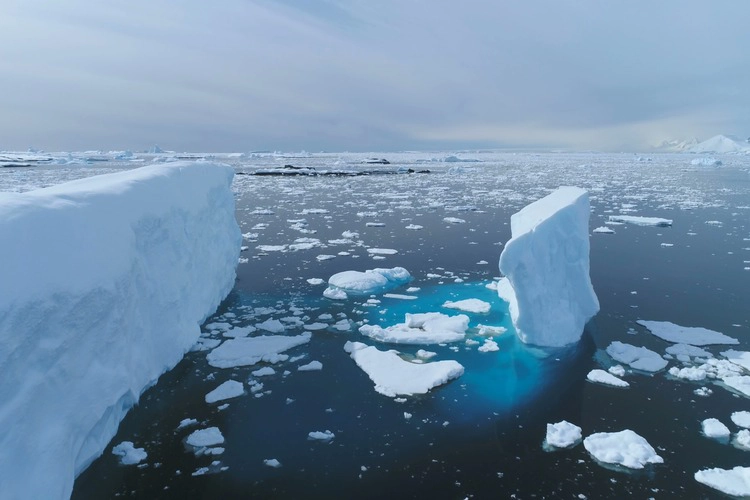
Antarctica Iecberg Aerial View.
The hole was located in the Bried Bay area. Image: Shutterstock

Satellite imagery reveals huge hole in ice caused by extreme weather conditions such as intense atmospheric rivers and marine heatwaves


By Victoria Heath

A study has revealed how a hole almost the size of the landmass of Portugal opened up in Antarctica’s sea ice in Breid Bay in August 2024. This type of hole has not been observed in this area since 1979.

Extreme weather conditions, including a series of intense atmospheric rivers, known as ‘rivers in the sky’, and marine heatwaves, caused the hole – known as a polynya. Atmospheric rivers transported large amounts of moisture from lower latitudes into the Antarctic region, alongside strong winds that caused a phenomenon known as ‘Ekman suction,’ bringing warmer water to the surface. In addition, marine heatwaves further contributed to sea ice not freezing.


Enjoying this article? Check out our related reads…

  • Controversy over tropical ozone hole
  • Geo Explainer: The Great Blue Hole Belize
  • Geo explainer: What is the ozone layer and what’s happening to it?
  • Sky rapids behind extreme flooding in the Middle East
  • Global warming projected to divert ‘atmospheric rivers’ to Asia’s cities

The research team from India, led by earth scientist Jeebanjyoti Swain, said these Antarctic polynyas will become more frequent in the future as climate change strengthens atmospheric rivers and makes heatwaves more persistent.

‘The low sea‐ice conditions and polynya formation may become frequent in regions where sea‐ice has historically remained stable,’ said the research team.

Why is sea ice so important?

At any given time, sea ice around the world covers roughly three to six per cent of the Earth’s surface area.

In particular, sea ice around Antarctica plays a vital role in the global climate, influencing ocean circulation and temperature, ocean-atmosphere interactions, and providing crucial habitats for marine ecosystems. At its maximum extent, Antarctic sea ice peaks in September to October, covering more than 18 million square kilometres.
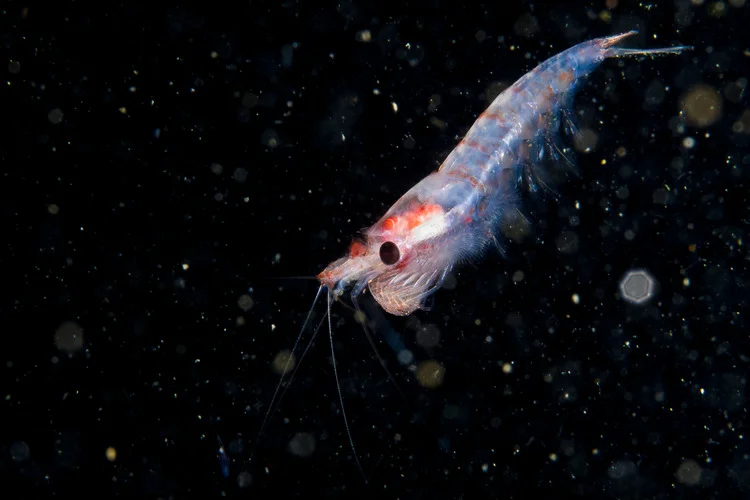
Krill drifting underwater in the St. Lawrence estuary in Canada
Krill play a vital role in the Antarctic food web chain – melting sea ice can impact their survival. Image: Shutterstock

Snow-covered sea ice can reflect more than 80 per cent of incoming solar radiation; however, when it melts, it exposes the darker (and less reflective) water beneath. As such, the planet’s surface becomes darker and warmer overall.

The effects of melting sea ice are particularly pronounced in Antarctica, especially on certain species such as krill. A key species for the Antarctic food chain, a lack of krill can have reverberating effects on other marine and terrestrial wildlife.

Geographical also reported earlier this year that emperor penguins in Antarctica face threats to their survival due to melting sea ice. The birds depend upon ‘fast ice’ to survive – sea ice connected to land, seabeds or ice shelves – where they then nest and lay eggs. However, this ice is melting.

WWF-supported studies have revealed an estimated 22 per cent regional decline in emperor penguins in Western Antarctica between 2018 and 2023.
Themes News Antarctica

Protected by Copyscape

Primary Sidebar

SUBSCRIBE

GEOGRAPHICAL WEEKLY LOGO FREE - Sign up to get context, clarity and perspective in a noisy world, every Friday

Popular Now

Planet Earth, view from space. Our planet with world ocean and clouds on a starry sky. Earth Observation. England, France, La Manche or English Channel and sun glint. Elements of furnished by NASA.

A hole in Earth’s ozone layer is officially the largest recorded in…

Ballot paper into box US flag in background

What is the right to vote worth when the road disappears?

Thermometer displaying a high temperature in degrees Celsius and Fahrenheit with a radiant sun on a background of blue sky. Concepts of summer, hot weather, excessive temperatures and heat waves

This year ‘virtually certain’ to exceed 1.5°C, Copernicus warns

December 2026 Geographical Magazine cover

Out now: December 2026’s Geographical Magazine

Images released by Survival in 2024 showed dozens of Mashco Piro people dangerously close to logging concessions

Peruvian government blocks proposal to protect uncontacted Indigenous people’s territory

Footer

  • Facebook
  • Instagram
  • LinkedIn
  • Reddit
  • TikTok
  • Twitter
  • YouTube

Geographical print magazine cover

Published in the UK since 1935, Geographical is the official magazine of the Royal Geographical Society (with IBG).

Informative, authoritative and educational, this site’s content covers a wide range of subject areas, including geography, culture, wildlife and exploration, illustrated with superb photography.

Click Here for SUBSCRIPTION details

Want to access Geographical on your tablet or smartphone? Press the Apple, Android or PC/Mac image below to download the app for your device

Footer Apple Footer Android Footer Mac-PC

More from Geographical

  • Subscriptions
  • Get our Newsletter
  • About Us
  • Contact Us
  • Advertise with us
  • Privacy policy
  • Terms & Conditions

Copyright © 2026 · Site by Syon Media