
• Skip to main content
  • Skip to secondary menu
  • Skip to primary sidebar
  • Skip to footer
Geographical

Geographical

Official magazine of the Royal Geographical Society (with IBG)

  • Geographical Home
  • News
  • Features
  • Opinion
    • Climatewatch
    • Front Lines
  • Podcast
  • Travel
    • Discovering Britain
    • Passport
  • Culture
    • Book reviews
  • Quizzes
    • Crosswords
  • Choose Geography
    • University directory
    • Masters courses
    • Course guides
      • Climate change
      • Environmental science
      • Human geography
      • Physical geography
    • University pages
      • Aberystwyth University
      • Brunel University
      • Cardiff University
      • University of Chester
      • Edge Hill University
      • The University of Edinburgh
      • Newcastle University
      • Nottingham Trent University
      • Oxford Brookes University
      • The University of Plymouth
      • Queen Mary University of London
    • Geography careers
      • Charity/non-profit
      • Education & research
      • Environment
      • Finance & consulting
      • Government and Local Government
    • Applications and advice
  • Magazine
    • Issue previews
    • Subscribe
    • Manage My Subscription
    • Special Editions
    • Geographical Archive
    • Advertise with us
  • Subscribe
    • Direct Debit Changes

Global warming projected to divert ‘atmospheric rivers’ to Asia’s cities

29 September 2026
3 minutes

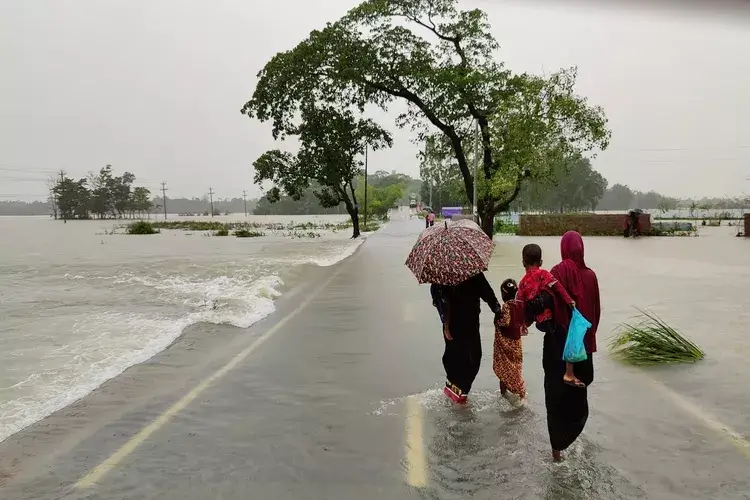
Sylhet, Bangladesh - 30 May 2024: Climate change and water coming down from the mountains have flooded the lowlands of Sylhet.
Flooding in Sylhet, Bangladesh. Image: Shutterstock

Urban areas, particularly in regions in northern China, India, and Bangladesh, could see more extreme rainfall from atmospheric rivers


By Victoria Heath

Climate change could increase the number of people in Asia exposed to extreme rainfall from atmospheric rivers, a new study funded by China’s National Key R&D Program and China Agricultural University’s 2115 Talent Development Program has found.

Atmospheric rivers are also known as ‘rivers in the sky’, as they appear like bodies of water when viewed from a satellite. They can be anywhere from 402 to 604 kilometres (250 to 375 miles) wide. On average, the Earth has four to five active atmospheric rivers at any one time.


Enjoying this article? Check out our related reads…

  • Sky rapids behind extreme flooding in the Middle East
  • Trump set to dismantle major US climate research climate centre
  • Phenomena: St Elmo’s fire explained
  • Controversy over tropical ozone hole
  • Why are the world’s driest places getting wetter?

The new study made two key findings: first, changes in atmospheric circulation could reduce or suppress atmospheric rivers in some lower-altitude areas. Secondly, as warmer air can contain more moisture, atmospheric rivers affecting subtropical and midlatitude regions can become wetter and potentially produce more extreme rainfall.

Across more than half of the parts of Asia affected by atmospheric rivers, more people could be exposed to the extreme rainfall they bring. The biggest increases are expected in cities in northern China, India and Bangladesh. There, exposure could rise by 24 to 59 per cent.

An average atmospheric river carries enough water vapour to match the flow at the mouth of the Mississippi River. Video: Scripps Oceanography

Atmospheric rivers, on average, transport water at more than two times the rate of the Amazon River.

Similar to a conveyor belt, they transport moisture from the tropical and subtropical oceans before releasing it as rain or snow in cooler regions. More than 50 per cent of rainfall in parts of the coasts of North America, France, Spain, Portugal, the United Kingdom, South America, Southeast Asia, and New Zealand is from atmospheric rivers, research shows.

In the US alone, they are responsible for more than 80 per cent of flooding on the West Coast, costing more than $ 1billion in damage every year.

In February 2022, an atmospheric river led to Brisbane experiencing more than 80 per cent of its normal annual rainfall in just six days, inundating more than 15,000 homes and killing nine people.

Moving atmospheric rivers

A 2024 study found that atmospheric rivers have shifted by about 6 to 10 degrees toward the poles over the last 40 years. One reason for this is cooling sea surface temperatures in the eastern tropical Pacific, which push atmospheric rivers toward the poles.

However, during El Niño conditions, warmer sea surface temperatures cause atmospheric rivers to remain closer to the equator, causing the mechanism to operate in the opposite direction.

In the subtropics, atmospheric rivers are becoming less common – meaning longer droughts and a decreased supply of water.

When atmospheric rivers move to either pole, higher-latitude communities – such as the US Pacific Northwest and Europe – could experience more extreme rainfall, flooding and even landslides. Meanwhile in the Arctic, a greater presence of atmospheric rivers could lead to increased sea-ice melting.
Themes News Asia China Cities Extreme weather Floods Global Warming India Water

Protected by Copyscape

Primary Sidebar

AUTUMN SALE

GEOGRAPHICAL WEEKLY LOGO FREE - Sign up to get context, clarity and perspective in a noisy world, every Friday

Popular Now

QUIZ: US State Capitals

QUIZ: US State Capitals

Numerous flags with sky in background

QUIZ: Flags of the World – Asia

AI data centre

Who owns the AI alarm?

Smoke from wildfire

Almost 40 per cent of the world’s population exposed to harmful ozone…

Aerial of the Ilulissat Icefjord, UNESCO World Heritage Site, Western Greenland, Denmark, Polar Regions

New map reveals Greenland’s hidden landscape

Footer

  • Facebook
  • Instagram
  • LinkedIn
  • Reddit
  • TikTok
  • Twitter
  • YouTube

Geographical print magazine cover

Published in the UK since 1935, Geographical is the official magazine of the Royal Geographical Society (with IBG).

Informative, authoritative and educational, this site’s content covers a wide range of subject areas, including geography, culture, wildlife and exploration, illustrated with superb photography.

Click Here for SUBSCRIPTION details

Want to access Geographical on your tablet or smartphone? Press the Apple, Android or PC/Mac image below to download the app for your device

Footer Apple Footer Android Footer Mac-PC

More from Geographical

  • Subscriptions
  • Get our Newsletter
  • About Us
  • Contact Us
  • Advertise with us
  • Privacy policy
  • Terms & Conditions

Copyright © 2026 · Site by Syon Media