
• Skip to main content
  • Skip to secondary menu
  • Skip to primary sidebar
  • Skip to footer
Geographical

Geographical

Official magazine of the Royal Geographical Society (with IBG)

  • Geographical Home
  • News
  • Features
  • Opinion
    • Climatewatch
    • Front Lines
  • Podcast
  • Travel
    • Discovering Britain
    • Passport
  • Culture
    • Book reviews
  • Quizzes
    • Crosswords
  • Choose Geography
    • University directory
    • Masters courses
    • Course guides
      • Climate change
      • Environmental science
      • Human geography
      • Physical geography
    • University pages
      • Aberystwyth University
      • Brunel University
      • Cardiff University
      • University of Chester
      • Edge Hill University
      • The University of Edinburgh
      • Newcastle University
      • Nottingham Trent University
      • Oxford Brookes University
      • The University of Plymouth
      • Queen Mary University of London
    • Geography careers
      • Charity/non-profit
      • Education & research
      • Environment
      • Finance & consulting
      • Government and Local Government
    • Applications and advice
  • Magazine
    • Issue previews
    • Subscribe
    • Manage My Subscription
    • Special Editions
    • Geographical Archive
    • Advertise with us
  • Subscribe
    • Direct Debit Changes

Almost 40 per cent of the world’s population exposed to harmful ozone pollution in 2026

30 September 2026
3 minutes

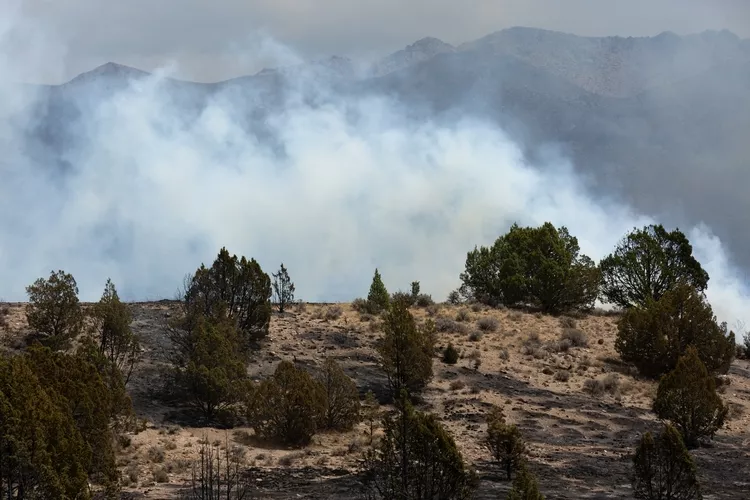
In 2026, factors such as major heatwaves and wildfires – pictured above – have been more prevalent,  leading to the production of high levels of ground-level ozone as explained below. Image: Shutterstock

Extreme heat and human-caused air pollution have led to dangerous levels of ground-level ozone, affecting almost 40 per cent of the world’s population this year


This year, nearly 40 per cent of the world’s population has been exposed to ground-level ozone – a pollutant created when specific pollutants react with sunlight and high temperatures – affecting human health and ecosystems alike.

The findings were published by the Copernicus Atmosphere Monitoring Service (CAMS) yesterday. In 2026, factors such as major heatwaves and wildfires have been more prevalent, allowing organic compounds from sources such as transport, industry, domestic solvents and vegetation to react in sunlight under favourable conditions – leading to the production of high levels of ground-level ozone.


Enjoying this article? Check out our related reads…

  • Geo explainer: What is the ozone layer and what’s happening to it?
  • Controversy over tropical ozone hole
  • Ozone layer remains on track to recovery in coming decades
  • Forever chemicals and the toxic legacy of CFC replacements
  • A rise in space tourism poses serious risks to Earth

In the first eight months of 2026, the new findings show that just five per cent of the world’s population has been exposed to ‘Good’ levels of ozone within WHO guidelines.

Asia is the region most impacted by ozone pollution globally, followed by Europe and North America. Industrial and transport pollution, as well as natural sources of precursor emissions, contributed to Asia’s high level of ozone throughout the year so far, exposing 60 per cent of the continent’s population to extremely high levels of ozone in 2026.

50 per cent of Europe’s population was exposed to ‘Poor’, ‘Very Poor’ or ‘Extremely Poor’ ozone this year, partially explained by repeated heatwaves contributing to ozone exposure during summer months.

The Woolsey Fire, California, USA
A wildfire ravaging through California. Image: Shutterstock

In North America, extreme wildfires this year contributed to ozone production. More than two-thirds of the continent’s population experienced ‘Poor’, ‘Very Poor’ or ‘Extremely Poor’ ozone exposure. Total estimated emissions in North America remain slightly above the 2026 average26, with fire activity in Canada and the western United States increasing rapidly in July.

In contrast, Oceania is the cleanest region in terms of ozone pollution, along with South America, which also saw relatively low levels. Eighty-one per cent of South America’s population was exposed to ‘Good’ or ‘Fair’ ozone, while 56 per cent of Africa’s population was under the same threshold.

The new research also showed how pollution crossed borders and continents. Wildfire smoke from North American fires in 2026 spread to the Arctic Ocean and Greenland, and even as far as parts of Europe, contributing to greater concentrations of PM2.5. Southeast Asia also saw seasonal fires that spread haze across countries such as Thailand and Laos. In addition, Saharan dust travelled beyond North Africa, reaching Cape Verde and the Canary Islands, reducing air quality.

‘Atmosphere Watch shows that air pollution knows no border. Wildfire smoke, ozone and dust can travel thousands of kilometres, affecting communities far from their source. As the international community prepares for COP31, these findings are a timely reminder that climate change, air quality and public health are deeply interconnected challenges that require coordinated global action,’ said director-general of the European Centre for Medium-Range Weather Forecasts Florian Pappenberger.

‘Through the Copernicus Atmosphere Monitoring Service, ECMWF is helping make informed decisions by providing the trusted data and forecasts needed to understand and respond to these growing risks.’

Themes News Wildfires

Protected by Copyscape

Primary Sidebar

AUTUMN SALE

GEOGRAPHICAL WEEKLY LOGO FREE - Sign up to get context, clarity and perspective in a noisy world, every Friday

Popular Now

QUIZ: US State Capitals

QUIZ: US State Capitals

QUIZ: Karst Landscapes

QUIZ: Karst Landscapes

AI data centre

Who owns the AI alarm?

dummy-img

QUIZ: Flags of the World – Asia

Solar ambulance

Solar-powered ambulance brings healthcare to off-grid communities

Footer

  • Facebook
  • Instagram
  • LinkedIn
  • Reddit
  • TikTok
  • Twitter
  • YouTube

Geographical print magazine cover

Published in the UK since 1935, Geographical is the official magazine of the Royal Geographical Society (with IBG).

Informative, authoritative and educational, this site’s content covers a wide range of subject areas, including geography, culture, wildlife and exploration, illustrated with superb photography.

Click Here for SUBSCRIPTION details

Want to access Geographical on your tablet or smartphone? Press the Apple, Android or PC/Mac image below to download the app for your device

Footer Apple Footer Android Footer Mac-PC

More from Geographical

  • Subscriptions
  • Get our Newsletter
  • About Us
  • Contact Us
  • Advertise with us
  • Privacy policy
  • Terms & Conditions

Copyright © 2026 · Site by Syon Media