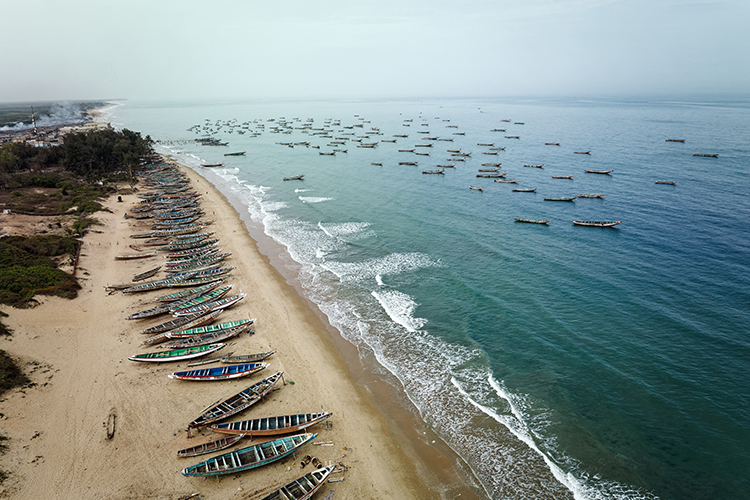
Senegal has pledged to expand its protected coastal fishing zone, offering hope to small-scale fishers hit by collapsing stocks and industrial competition
By
There was a time when sardinella, a small, silvery pelagic fish that forms the backbone of the Senegalese diet, was abundant in West Africa’s coastal waters.
Today, like 57 per cent of Senegal’s fish populations, sardinella stocks are in a state of collapse. The consequences for the country’s small-scale fishers have been dire, with job losses and an alarming rise in food insecurity leaving communities facing increasingly difficult and dangerous choices.
Enjoying this article? Check out our related reads…
In response to the crisis – and warnings from the Fishery Committee for the Eastern Central Atlantic, which has called for an immediate 60 per cent reduction in fishing mortality to give fish populations a chance to recover – the Senegalese government has pledged to expand its inshore exclusive zone (IEZ) from six to 12 nautical miles, a move that would effectively prohibit industrial fishing across the entirety of the country’s territorial seas, reserving these coastal waters exclusively for small-scale fishers.
An estimated 600,000 people depend on Senegal’s small-scale fishing sector for their livelihoods, from boat crews to an entire chain of fish processors, fishmongers and boat and net repair workers who sustain the industry, as well as the families they support with income. But this sector is now under intense pressure from the rapid expansion of industrial fishing – largescale fleets, many of them foreign-owned, that deploy trawlers to harvest fish on an unsustainable scale.
A global problem, overfishing is a particular concern across West Africa, where fish provide up to 80 per cent of daily animal protein intake, far exceeding the 18 per cent global average.
A 2025 report from the Environmental Justice Foundation, based on interviews across the Canary Islands and Senegal, revealed that the collapse of local stocks is forcing fishers to attempt the perilous Atlantic crossing to the Canary Islands – widely considered the deadliest maritime migration route from West Africa to Europe, which claimed nearly 10,000 lives in 2024.
‘I worked as a fisherman for almost ten years. But over the years, things became so hard,’ says Idrisa Seye, a former fisher from Senegal who made the journey to Tenerife in the hope of supporting his family.

Aissata Dia, who heads West African advocacy at international NGO Blue Ventures, says that while countries are all facing similar challenges – namely, the loss of traditional fishing grounds to industrial encroachment, a lack of transparency regarding foreign fishing licences, and the compounding pressures of climate change – there’s no one-size-fits-all solution. Factors such as a country’s economic and social reliance on its fishing sectors – which is particularly high in Senegal and Ghana – its political landscape and its coastal geography all demand a tailored approach.
Blue Ventures supports small-scale fishing communities – such as those in Senegal – to lead their own campaigns, providing them with the resources and coordination necessary to defend their coastal resources from industrial fleets. This focus on strengthening local leadership is essential because, as Dia notes, local communities are frequently sidelined in decision making. ‘Our early scoping work revealed a clear, recurring issue: small-scale fishers feel that their voices are being excluded from the conversation.’ But the tide may now be starting to turn.
In 2025, after intense campaigning from small-scale fishing coalitions, Ghana signed the Fisheries and Aquaculture Act into law, a landmark reform that expanded protection for artisanal fishing grounds and tightened controls on illegal industrial trawling. Dia says that its success has helped build a compelling case for Senegal to follow suit. ‘We are really keen to see all countries in the region take similar decisions, because if only Senegal or Ghana extend or enforce their IEZs, it simply moves the pressure elsewhere.’
However, advocates such as Dia emphasise that a commitment on paper is only the first step. For IEZs to work, they must be rigorously enforced. Even after expanding limits on industrial fishing, persistent illegal encroachment in Ghana’s coastal waters shows that legal status alone isn’t enough.
In Senegal, efforts are underway to formalise the role of small-scale fishers in reporting illegal activity by offering them insurance coverage against related risks. ‘Enforcement of IEZs must remain a responsibility of the authorities, but it needs to be supported by the wider community. Our fishers are our eyes, and they are the ones who are first affected if there is any problem.’
Everyone is now waiting for the government to formalise its pledge into binding, enforceable law, a process that has slowed recently as the new government, which took office in June, settles into its role. It’s the first step in what Dia says will be a long process; nevertheless, she remains optimistic: ‘It is a very good step that Senegal has established a status for surveillance fishers. It is rewarding to see that we are getting closer to a world where the interests of those most affected by overfishing are prioritised.’