
• Skip to main content
  • Skip to secondary menu
  • Skip to primary sidebar
  • Skip to footer
Geographical

Geographical

Official magazine of the Royal Geographical Society (with IBG)

  • Geographical Home
  • News
  • Features
  • Opinion
    • Climatewatch
    • Front Lines
  • Podcast
  • Travel
    • Discovering Britain
    • Passport
  • Culture
    • Book reviews
  • Quizzes
    • Crosswords
  • Choose Geography
    • University directory
    • Masters courses
    • Course guides
      • Climate change
      • Environmental science
      • Human geography
      • Physical geography
    • University pages
      • Aberystwyth University
      • Brunel University
      • Cardiff University
      • University of Chester
      • Edge Hill University
      • The University of Edinburgh
      • Newcastle University
      • Nottingham Trent University
      • Oxford Brookes University
      • The University of Plymouth
      • Queen Mary University of London
    • Geography careers
      • Charity/non-profit
      • Education & research
      • Environment
      • Finance & consulting
      • Government and Local Government
    • Applications and advice
  • Magazine
    • Issue previews
    • Subscribe
    • Manage My Subscription
    • Special Editions
    • Geographical Archive
    • Advertise with us
  • Subscribe
    • Direct Debit Changes

How ‘underwater umbrellas’ could transform the future of coral reefs

7 October 2026
3 minutes

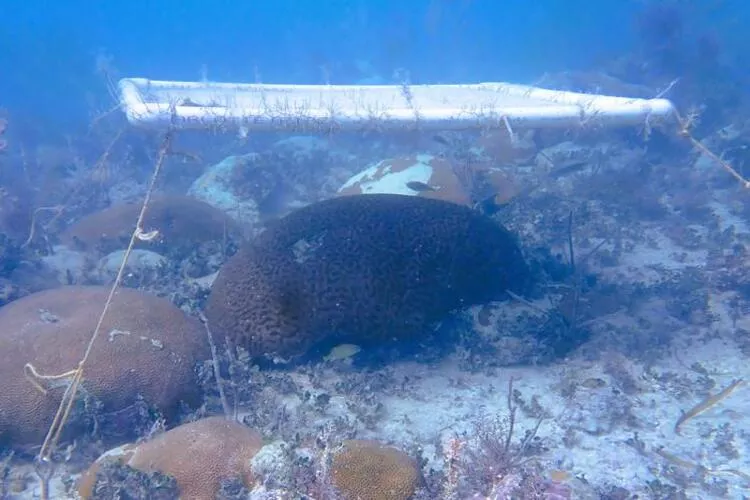
A shaded coral photographed by Karen Neely.
One of the underwater umbrellas in use. Image: Karen Neely

Placing temporary shade on vulnerable Caribbean corals could partly reverse bleaching caused by marine heatwaves


By Victoria Heath

Around the world, climate change is the biggest threat to coral reef survival. As land temperatures rise, so do ocean temperatures, causing a ‘bleaching’ effect as corals turn pale white. The impact of coral bleaching is vast: it destroys the foundation of marine ecosystems, strips coastlines of natural protection, and threatens global food security.


Enjoying this article? Check out our related reads…

  • ‘Catastrophic’ mass bleaching event hit Great Barrier Reef in 2024, study finds
  • Geo explainer: The threats to coral reefs
  • Climate extremes triggered rare coral disease and mass mortality on the Great Barrier Reef
  • Scientists discover how coral skeletons can harm reefs in world oceans
  • Great Barrier Reef’s coral cover has sharply declined, new study finds

Now, scientists believe they have found a way to protect some especially vulnerable Caribbean corals from coral bleaching: umbrella-like underwater shades.

These shades don’t cool the water; instead, they prevent UV and irradiance damage, which can worsen heat damage to corals.
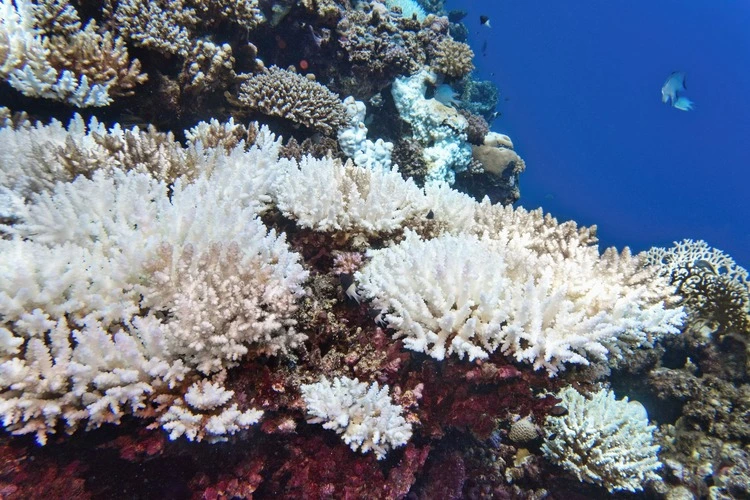
Coral bleaching of Acropora hard corals - process when corals become white due to loss of symbiotic algae and photosynthetic pigments caused by higher ocean water temperature. Global warming impact.
Coral bleaching can have cascading impacts on marine life. Image: Shutterstock

In their study, scientists set up 20 custom-made shades across 10 colonies of two brain coral species in the Florida Keys, and selected 20 matching corals as controls. Umbrella-like shades, constructed of nylon cloths attached to pipes, were temporarily fixed to the seabed and floated over the coral. Divers came every two weeks to track colour changes and take tissue biopsies from the corals.

They found shaded corals lost less colour than expected, with some even recovering partial colour after shades were installed. No dead coral were reported, even under the most intense periods of thermal stress.

‘Scaling is the big limitation of this study; shading is not a cure-all for coral reefs, and its use would require hard decisions about what corals are worth saving,’ said Dr Karen Neely of Nova Southeastern University, lead author of the article published in Frontiers in Marine Science.

‘We found it was effective on two highly susceptible coral species, so it is likely to be useful for most others, but additional studies would be needed to confirm that. It is also likely that thermal stress would reach a point at which no amount of shading could help a coral, but only future experimentation would be able to define the bounds of that.’

How else can coral reefs be protected?

Effectively enforcing Marine Protected Areas (MPAs) can be a great way of allowing corals to regrow. In doing so, fish populations can be restored, reef structures can become more stable, and biodiversity can be boosted.

However, just six per cent of coral reefs globally are situated within effectively managed MPAs, leaving around 66 million acres of coral reefs unprotected.

Better wastewater management can also help protect these ecosystems, as runoff from cities, farms, and sewage systems can suffocate coral and fuel algal blooms. To do this, interventions such as upgrading wastewater systems, managing stormwater and restoring coastal vegetation can be implemented.

In addition, global collaboration between locals, governments, NGOs and industries is also a solution to conserving coral reefs.
Themes News Conservation Oceans

Protected by Copyscape

Primary Sidebar

SUBSCRIBE

GEOGRAPHICAL WEEKLY LOGO FREE - Sign up to get context, clarity and perspective in a noisy world, every Friday

Popular Now

Hand in ballot box

Brazil’s presidential election heads to runoff in late October

California coast

Kelvin waves: the ocean phenomenon raising sea levels on the US West…

Chinook salmon in water

Why Alaska’s Chinook salmon collapse threatens Yukon River communities

Barcelona, Spain - October 31st 2022 -

Barcelona’s new ‘Netflix-style’ algorithm hoped to combat overtourism

Wind turbines in field

Ministry of Defence objects to at least four wind farms

Footer

  • Facebook
  • Instagram
  • LinkedIn
  • Reddit
  • TikTok
  • Twitter
  • YouTube

Geographical print magazine cover

Published in the UK since 1935, Geographical is the official magazine of the Royal Geographical Society (with IBG).

Informative, authoritative and educational, this site’s content covers a wide range of subject areas, including geography, culture, wildlife and exploration, illustrated with superb photography.

Click Here for SUBSCRIPTION details

Want to access Geographical on your tablet or smartphone? Press the Apple, Android or PC/Mac image below to download the app for your device

Footer Apple Footer Android Footer Mac-PC

More from Geographical

  • Subscriptions
  • Get our Newsletter
  • About Us
  • Contact Us
  • Advertise with us
  • Privacy policy
  • Terms & Conditions

Copyright © 2026 · Site by Syon Media