
• Skip to main content
  • Skip to secondary menu
  • Skip to primary sidebar
  • Skip to footer
Geographical

Geographical

Official magazine of the Royal Geographical Society (with IBG)

  • Geographical Home
  • News
  • Features
  • Opinion
    • Climatewatch
    • Front Lines
  • Podcast
  • Travel
    • Discovering Britain
    • Passport
  • Culture
    • Book reviews
  • Quizzes
    • Crosswords
  • Choose Geography
    • University directory
    • Masters courses
    • Course guides
      • Climate change
      • Environmental science
      • Human geography
      • Physical geography
    • University pages
      • Aberystwyth University
      • Brunel University
      • Cardiff University
      • University of Chester
      • Edge Hill University
      • The University of Edinburgh
      • Newcastle University
      • Nottingham Trent University
      • Oxford Brookes University
      • The University of Plymouth
      • Queen Mary University of London
    • Geography careers
      • Charity/non-profit
      • Education & research
      • Environment
      • Finance & consulting
      • Government and Local Government
    • Applications and advice
  • Magazine
    • Issue previews
    • Subscribe
    • Manage My Subscription
    • Special Editions
    • Geographical Archive
    • Advertise with us
  • Subscribe
    • Direct Debit Changes

Funding gap from Colombia earthquake puts 57,000 people at risk two months on from disaster 

29 October 2026
3 minutes

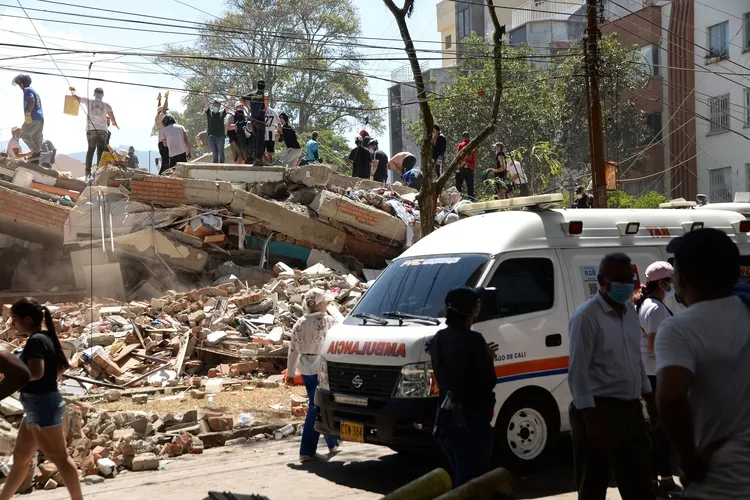
Cali, Colombia, August 10, 2026. Rescue operation in Cali, Colombia, following the devastating 7.4-magnitude earthquake that struck on August 10, 2026; volunteers rescuing people.
Volunteers rescuing people in the wake of the Colombian earthquake back in August. Image: Harold Diaz Lara/Shutterstock

Only $6.5million of funding has been secured out of $30million, creating a funding gap for thousands of Colombians impacted by quake


By Victoria Heath

Two months ago, a magnitude–7.4 earthquake hit western Colombia, killing at least 176 and injuring thousands. More than 45,000 homes were damaged and 9,215 destroyed, and 140 buildings collapsed entirely in the disaster. At least 50 hospitals also experienced severe damage.

Now, the International Organisation for Migration (IOM) has warned that at least 57,000 people in western Colombia could be left without critical assistance, such as housing, water, healthcare and protection, as an emergency appeal for the quake remains less than a quarter funded.

‘The challenge now is to support families as they progressively move out of temporary shelters and rebuild their lives and communities through safe housing and sustainable livelihoods,’ said IOM’s regional director for Latin America and the Caribbean Juan Francisco Espinosa. 

In August, IOM launched a flash appeal to raise $30million. However, only $6.5 million has been secured, enough for 43,000 people, far below the target of up to 100,000.
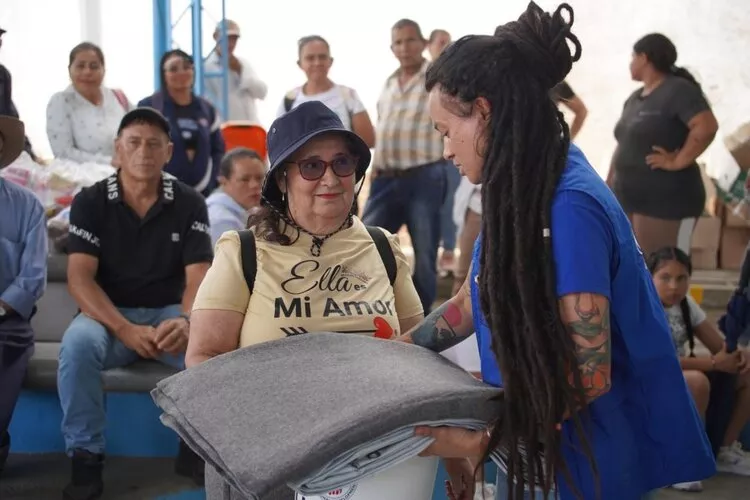
An IOM staff member hands over essential relief items to a woman affected by the earthquake in Quindío during a humanitarian assistance distribution.
An IOM staff member hands over essential relief items to a woman affected by the earthquake in Quindío during a humanitarian assistance distribution. Image: IOM/Carolina Castelblanco

Today, more than 2,700 people remain in temporary shelters, and many more earthquake-impacted households need support to repair their homes and livelihoods.

El Niño forecasts from Colombia’s national meteorological authority, IDEAM, will only worsen pressure on communities trying to recover from the earthquake. El Niño conditions could cause wildfires, water shortages and disruption to essential services.

Earthquake-affected communities also face public health risks. Dengue cases rose by more than 30 per cent in September in Chocó, Risaralda and Valle del Cauca, according to Colombia’s National Institute of Health.

‘Working with the Colombian Government and our partners, we can help families secure safe housing and rebuild livelihoods, but we need urgent funding while it can still make a difference,’ said Espinosa.


Related reads…

  • A tale of two quakes
  • At least 139 migrants dead after boat capsizes off coast of Djibouti
  • Colombia’s ‘plant hunter’ scientists revitalise country’s biodiversity
  • Thousands of people forced to flee Yemen to Djibouti as conflict escalates
  • At least 124 land and environmental defenders killed globally in 2025

To support affected communities, IOM has assisted more than 10,000 people across 51 municipalities, providing hygiene kits and water treatment units, deploying medical teams and supporting more than 450 rescuers and responders with mental health care.

A range of UN agencies have assisted in the aftermath of the disaster. The World Food Programme (WFP) delivered emergency food assistance, the UN sexual and reproductive health agency (UNFPA) deployed mobile teams in Chocó to support survivors of gender-based violence, with the UN’s Children Fund (UNICEF) provided water, sanitation and hygiene support to affected families.

The August 2026 earthquake struck at a depth of 103 kilometres (64 miles) in the Chocó province. Many deaths occurred in Cali, Colombia’s third most populous city. Tremors occurred in Venezuela, Ecuador and Panama, with an estimated 1.5 million people able to feel shaking close to magnitude seven as the quake struck.

More than 50 days after the earthquake, 778,282 people remained affected. Even before the disaster, Colombia was under severe strain as around 9.1 million people required humanitarian assistance due a range of factors from ongoing conflict to poverty.
Themes News Earthquakes

Protected by Copyscape

Primary Sidebar

SUBSCRIBE

GEOGRAPHICAL WEEKLY LOGO FREE - Sign up to get context, clarity and perspective in a noisy world, every Friday

Popular Now

On The Ground: The Aberfan Tribunal

On The Ground: The Aberfan Tribunal

Shompen band traversing a river on Great Nicobar Island.

UN urges India to suspend controversial mega-project on Great Nicobar Island

3d globe inside digital scanning frame.

AI or climate change – which poses the greater threat to humanity?

A priest beside health workers in protective equipment outside a metal-walled building in Mongbwalu

Why war is making the DRC’s Ebola outbreak harder to stop

Copernicus Marine Service visualisations show the impact of Super Typhoon Champi on the Philippine Sea on 21 October 2026. With winds reaching 296 km/h, the Category 5 storm was the strongest tropical cyclone recorded in 2026. The images show the anticlockwise movement of wind-generated waves (left) and significant wave heights reaching 10 metres near the storm’s centre (right).

Typhoon Champi hits Taiwan

Footer

  • Facebook
  • Instagram
  • LinkedIn
  • Reddit
  • TikTok
  • Twitter
  • YouTube

Geographical print magazine cover

Published in the UK since 1935, Geographical is the official magazine of the Royal Geographical Society (with IBG).

Informative, authoritative and educational, this site’s content covers a wide range of subject areas, including geography, culture, wildlife and exploration, illustrated with superb photography.

Click Here for SUBSCRIPTION details

Want to access Geographical on your tablet or smartphone? Press the Apple, Android or PC/Mac image below to download the app for your device

Footer Apple Footer Android Footer Mac-PC

More from Geographical

  • Subscriptions
  • Get our Newsletter
  • About Us
  • Contact Us
  • Advertise with us
  • Privacy policy
  • Terms & Conditions

Copyright © 2026 · Site by Syon Media