When the USA froze all foreign aid, Lesotho’s fragile HIV support network collapsed overnight. The consequences, as this story shows, were immediate – and devastating
By Tommy Trenchard and Lina Brand
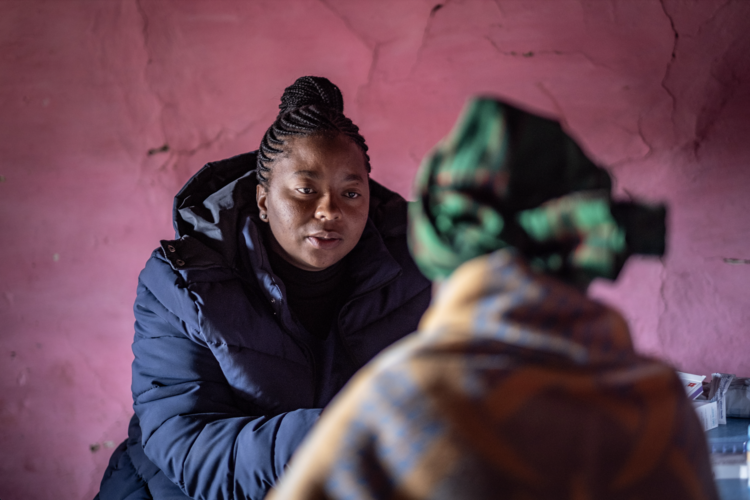
On a cold morning in June, Mateke Rabohlale set out into the hills of northern Lesotho, searching for one of her patients, who had gone missing. A gentle, softly spoken 36-year-old, Rabohlale worked as a community health worker in the mountainous southern African country, tending to hundreds of HIV- positive people in remote, rural villages. When some of them skipped their hospital appointments, she visited them at home – by car when possible, on foot when not.
On this winter day, Rabohlale was worried. The patient, a 47-year-old man, needed close support to ensure he took his daily anti-retroviral treatment. ‘It was so hard for him to adhere to his medication,’ she recalls four months later, speaking to Geographical outside her one-bedroom shack overlooking a green valley in a small village called Manamela. ‘He had told me: ‘If you stop coming, I will die.’ She hadn’t seen him since.
On 20 January 2025, US president Donald Trump signed an executive order freezing all US foreign aid. In Lesotho, the impact was instant. The tiny nation has one of the world’s highest HIV rates, with close to one in five adults HIV-positive. Its overburdened public health system depended heavily on foreign development funding, with only 12 per cent of the budget coming from government coffers.
TURBULENT TIMES…click below to read all the stories
• Trump 2.0
• USAID Cuts
• Courtroom Drama
• Scientists Reeling
Read our full coverage of the Year That Changed The World
The US pull-out cut deep. Almost all prevention and community-support programmes, which had been crucial in tackling the AIDS pandemic, were shuttered overnight.
Enjoying this article? Check out our related reads:
Rabohlale got the news while driving home from a day of visiting patients. The organisation that employed her as a ‘health retention supporter’, the Lesotho Network of AIDS Service Organisations (LENASO), was funded by the US-based Baylor College of Medicine. Her supervisor told her not to return to work the next day.

Until then, Rabohlale had taken great pride in her work. She believed it saved lives. ‘I felt ashamed,’ she remembers. ‘While we’re sitting at home, there are people who are dying.’
In the following months, LENASO’s programmes repeatedly started and stopped with the uncertainty of US funding, which has been caught up in court cases and government debates. Each budget cut brought layoffs. When staff first returned to work in late May and started contacting patients again, more than 400 across the country were registered as ‘lost to follow’, meaning they couldn’t be reached. That’s when Rabohlale set out to find her lost patient. On arriving in his village, a neighbour gave her the news – her patient had died.
‘If I was there, he would still be alive,’ she says in a quiet voice, wringing her hands. ‘I blame Trump.’
‘It’s chaos,’ says LENASO’s executive director, Mamello Mokoae, with a sigh as she sits in the organisation’s empty headquarters in Lesotho’s capital, Maseru. The charity had run a network of more than 300 community- support groups and dozens of health supporters across the country, supporting thousands of patients. In September, after months of back and forth, Mokoae received a final termination letter. When we visited, she was sorting through the last boxes of donated clothes, preparing to vacate the office.
Before the US cuts, Lesotho had got closer than ever to meeting the UN’s 95-95-95 HIV targets – 95 per cent of people living with HIV knowing their status, 95 per cent of those diagnosed on anti-retroviral therapy, and 95 per cent of those having a suppressed viral load.
The progress had been achieved over decades of building information, prevention and support networks reaching all the way to the most remote areas, and mobilising many community members themselves. Activists and officials now feared the lack of funding might undo the hard-won gains.
‘We are going back to square one,’ says Mokoae. A nursing student in the 1990s, when the HIV/AIDS pandemic first tore through her country, she is still haunted by memories from the frontlines of the crisis.
‘People were dying every minute,’ she says. ‘In the male ward, every night we would be taking out the corpses. People were getting buried every weekend, and even during the week. We had to raise a lot of orphans. My own relative was not able to get medication, so we just had to watch him die. It was terrible.’
While treatment and testing remain accessible, for the most part, to people living in more urban areas, Lesotho’s biggest challenge lies in its landscape. The entire country lies above 1,000 metres in altitude, earning it the nickname the ‘Kingdom in the Sky’ – and in the rugged highlands, where some 300,000 people lack road access to healthcare facilities, the cuts have been particularly devastating.
Keeping HIV patients on their medications in these isolated communities involved a fragile system of outreach missions, with health workers based at remote clinics travelling out to villages on horseback. The government’s Flying Doctor Service also ran a series of 12 clinics in areas inaccessible by road.

As the aid cuts kicked in and health workers were laid off, that system crumbled. The Flying Doctor Service now flies to only two of its 12 former clinics, and nurses at multiple rural health centres told Geographical they were now so short-staffed it had become virtually impossible to continue the outreach missions.
Instead, they are forced to focus their efforts in the clinics and hope patients will come to them. With villages often located several hours’ journey on horseback from the nearest clinic, many patients don’t manage.
‘A lot of people are defaulting on their medications because they live too far from the clinics,’ says Thandeka Potomane, a 30-year-old nurse based at the Ha Pafoli health centre, which lost staff, funding and its critical air supply route as a result of the cuts. ‘People are coming in too late, when the condition has already progressed. Then there’s nothing we can do. We’re not managing.’
Beyond the collapsing healthcare system, entire communities were left reeling as the cuts suspended lifelines of support in a country where nearly 60 per cent of the rural population lives on less than £3.18 a day. In Hillrock village, near Rabohlale’s home, a feeding scheme that provided breakfast and lunch daily to more than 250 children has been halted.

The programme was run by local women, with ingredients brought in by LENASO on a minimal budget.
‘For some children, it was their only source of food,’ says one of the cooks, 31-year-old Mamoea Mashupha. Her phone is filled with photos of children queuing to receive their daily meals. ‘Our kids were gaining weight, looking healthy. Now they’re deteriorating,’ she says, her voice breaking. ‘They keep asking: “When are you going to feed us?’

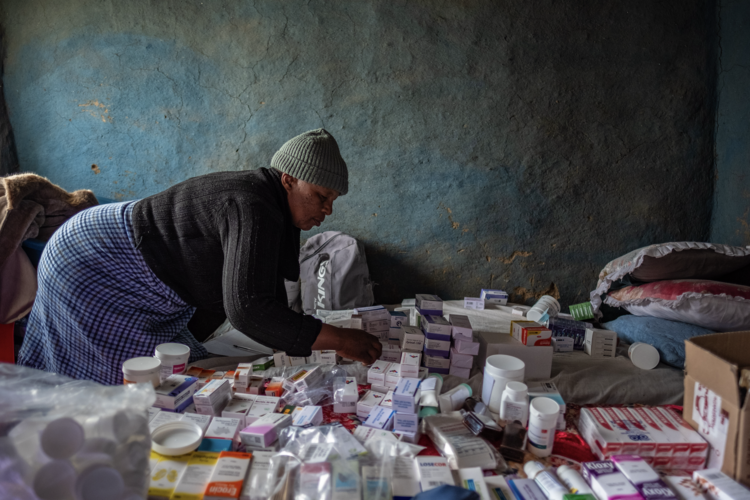
This health worker’s clinic used to be supplied by airlifts, but since the cuts, it has struggled to get supplies. Image: Tommy Trenchard
A few kilometres away, Malikila (a pseudonym) sits in the darkness of her rondavel, a traditional round hut with a thatched roof. The energetic 50-year-old wasn’t scared when, in 2018, she learnt she was HIV-positive. She knew the condition was no longer a death sentence. ‘I came to the clinic prepared. The most important thing was my life,’ she says.
The support group set up in her village was of great help in guiding her through adapting to the treatment. Operating with only about 700 maluti (£31) every few months, they ran information sessions and distributed condoms in the area, grew vegetable gardens to feed the members, and took turns travelling to the clinic to pick up each other’s medication. ‘It was life-saving,’ she says of the now-stopped projects.
‘Yes, giving aid was not an obligation for Americans,’ Malikila admits. ‘But we grew up thinking Lesotho and America were more than friends,’ she says. ‘We were brothers and sisters.’