Discover how these ‘green intruders’ are making their mark across urban landscapes in Britain
By
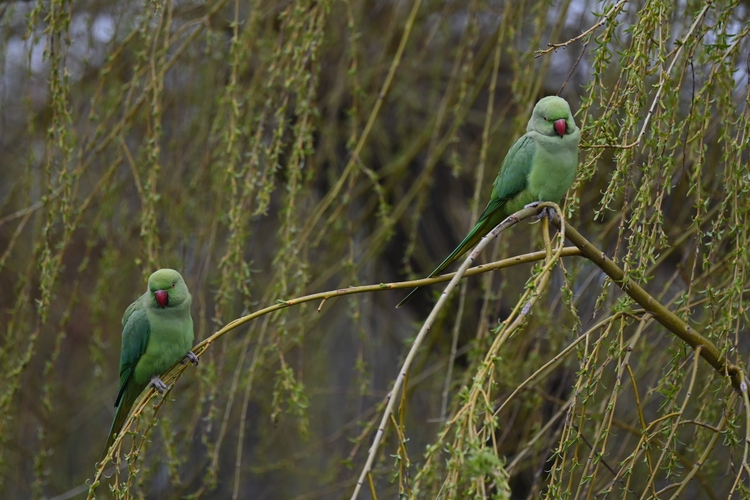
What does it mean for a species to belong somewhere? The last thing you expect to see flying across the grey sky of suburban London is a bird that looks like it belongs on a tropical postcard, and yet, it’s become an everyday sight for many of us in the UK. The neon-green wings and distinctive, unmissable trill of the parakeet are a curiosity no longer. They are residents – unapologetically loud and almost as omnipresent as pigeons.
The ring-necked parakeet (Psittacula krameri) is also known as the rose-ringed parakeet, thanks to the pink collar seen on adult males. Native to Africa and the Indian subcontinent, parakeets may look out of place in London skies, but they are anything but. Many of the UK’s native birds have struggled to cope with urban life, and biodiversity has suffered since the Industrial Revolution.
Enjoying this article? Check out our related reads…
However, parakeets have taken to urban life with enthusiasm, with their numbers growing from a few thousand in the 1990s to more than 12,000 breeding pairs today. Their success is no mystery: the urban heat island effect softens winter cold and parks, gardens, cemeteries and allotments provide abundant food and shelter. Also, the popularity of garden bird feeders supplies easy calories. Although most commonly associated with London, parakeets have been seen as far north as Glasgow and Aberdeen, and as far west as Devon, proving their true adaptability.
However, ring-necked parakeets are officially classed as an invasive species and many people are concerned about the pressure they put on native species. They breed earlier in the year, snapping up the best nesting spots before native birds such as woodpeckers and nuthatches, and even bats. Elsewhere in Europe, growing populations have prompted controversial culls. In the UK, the birds remain protected by the Wildlife & Countryside Act 1981, though their impact is periodically reassessed.
Still, the story is more complicated than the familiar assumption that ‘invasive’ automatically means ‘destructive’. Parakeets enlarge nesting holes, thanks to their powerful beaks, improving accommodation that other species can use later. Their presence is a reminder that not all change means collapse; urban ecosystems rarely behave neatly.
Perhaps because of their out-of-place appearance, UK parakeets have inspired an entire mythology. One enduring story claims Jimi Hendrix released a pair on Carnaby Street in 1968. Another insists they escaped from the set of The African Queen during filming in West London. These tales persist, not for their truth, but for their charm: colourful, eccentric and distinctly London.
The reality is less romantic and stretches back further, with historical records and genetic studies pointing to repeated escapes from aviaries – especially during the Victorian era of obsession with exotic pets and zoo animals. Gradually, enough birds escaped to create a self-sustaining population.
In an age so often marked by loss and extinction, parakeets tell a different story: that nature doesn’t always withdraw. Sometimes it adapts, settles in and becomes impossible to ignore.