
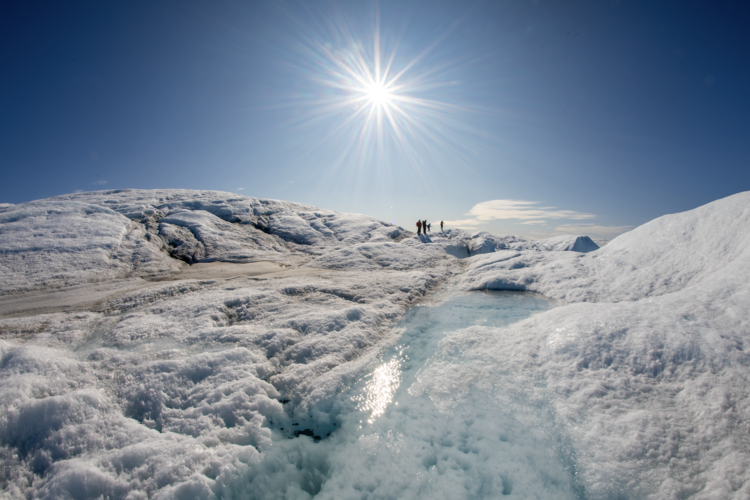
Journey across ice, tundra and fjord to see how the world’s largest island is changing – and what its future might mean for us all
Report and photographs by
It’s one o’clock in the morning and the sun, which at this time of year never quite sets, has scribbled long shadows onto the ice and cast bands of purple, orange and red across the sky. Carl bolts in an ice screw and pulls on the rope, testing that everything is secure. ‘You’re all good to go,’ he commands as I attach my harness and step back over the abyss.
With my crampons clawing at the plunging ice, I descend a short way down the slope before turning my head to peer into the mouth of the moulin. I don’t know whether to be shocked, awed or horrified by the sight of a river of frigid water spinning down the ice wall and into a void.
Enjoying this article? Check out our other country profiles…
Greenland, the world’s largest island, boggles the mind. Larger than Western Europe but with a human population of only 56,000, this is the world before people. For weeks on end in summer, the sun never drops below the horizon and, conversely, in the heart of winter, when temperatures can fall as low as –60°C, the only natural light comes from the moon, the stars and the spiralling green patterns of the aurora borealis.
But if there’s one thing that truly defines Greenland, it’s the ice. Around 80 per cent of this vast Arctic wilderness is frozen under an ice sheet – the largest outside Antarctica – that stretches across 1.7 million square kilometres, is more than three kilometres thick in places, and altogether contains around 2.9 million cubic kilometres of ice. Were all that ice ever to melt, worldwide sea levels would rise by around seven metres. And here’s the thing: the Greenland ice sheet is melting – and melting faster than most of us realise.
As I climb back up out of the moulin, Carl, my guide during this camping trip up onto the ice sheet, explains that moulins (the term comes from the French for ‘mill’) are sinkholes that drop from the surface right down to the bedrock far below. They are formed, he tells me, by meltwater percolating down through small gaps in the ice. Over time, the gaps expand to become gaping chasms leading to the icy underworld.
Terrifying and beautiful in equal measure, moulins also play a key role in glacial dynamics. The Greenland ice sheet isn’t one solid mass of unmoving ice. Instead, there’s a constant – and to human perspectives, almost imperceptible – movement of the ice as it gradually slides down from the centre of the ice sheet to the lower-lying coast.
Moulins are one of the keys to this slow-shifting landscape. When the water pouring into the moulin hits the bedrock below the ice, it acts as a lubricant, causing the ice to slide. The more water, the faster the ice flow. Today, thanks to the effect of climate change, there has been an increase in the number and size of moulins, which, scientists fear, could speed up how quickly the ice sheet is melting.
After I’ve felt the fear of dropping down into a moulin, Carl leads the way over the undulating ice to what he promises will be a sight I’ll never forget. At this time of year, with the sun beating down, the surface of the ice starts to melt and the water forms rivers in the ice. Diverting around some of these rivers, we eventually top a ridge and look down onto a wide, shallow lake fizzing in shades of electric blue. Carl hadn’t been exaggerating. But like the moulins, the ice rivers and lakes are an indication of the warming of the ice sheet.

In summer, it’s normal that meltwater lakes dot the ice sheet. Normally they only last a few weeks before the fleeting summer fades to a frozen memory and the water turns back to ice. But as the climate warms, the lakes – and the rivers that feed into them – are becoming more numerous, larger and longer-lasting.
Ice sheets and huge glaciers have been present in Greenland for at least 18 million years, but throughout this time, the size of the sheet has ebbed and flowed. Three million years ago, during the warm Pliocene period, the ice sheet vanished and only the highest summits on the island were permanently covered in ice. The current ice sheet formed when the Earth started cooling again some 2.5 million years ago. While we know that the extent of the ice has always fluctuated, what makes today’s retreat different from all others is the speed with which it’s happening – and that the whole process is being driven by human-caused climate change.
According to an Intergovernmental Panel on Climate Change report, the average surface air temperature across the Arctic has likely increased by more than double the global average over the past 20 years (other studies have concluded that temperatures are rising up to four times faster), and that the average temperature on the ice sheet is now the highest it has been in at least 1,000 years.
Naturally, this increasing warmth is melting the ice, and scientists say that the Greenland ice sheet has now shrunk for the 29th year in a row (up to 2025), and Greenland is losing ice faster than at any other time over the past 12,000 years.
According to the European Space Agency, the entire sheet thinned by an average of 1.2 metres between 2010 and 2023 (towards the edge of the ice sheet, the loss is greater, averaging 6.4 metres). To put this into blunter terms, a 2024 study revealed that the Greenland ice sheet is losing a staggering 30 million tonnes of ice every hour of every day – which equates to around 264 billion tonnes of ice loss per year.

Not all of Greenland is ice. In southwest Greenland, as well as parts of the southeast, there’s a small ribbon of tundra. At first glance, the tundra appears to be nothing more than a dull brown expanse of uniform moorland. But get down on your hands and knees and you’ll quickly discover that it’s a magical miniature forest of entwined plant stems and flowers that have fairytale names such as muskeg tea, bearberry and purple saxifrage.
Not everything living in the tundra is as small as the flowers though. Herds of reindeer graze on the lichens, Arctic foxes – white in winter, brown in summer – scurry around in search of a rodent lunch and marching straight out of the last Ice Age come groups of giant, shaggy-coated muskoxen. The tundra is also dotted with thousands of inky-black lakes and tarns that in summer attract waterbirds – and midges – by the million.
Leaving the surreal world of the ice sheet behind, I set out on a multi-day hike across the tundra with hiking guide Salik Grønvold. As we walk, he laments the changes he has seen in recent years. ‘When we were kids, we were lucky if it rained a couple of times during the summer. We loved playing football in the rain!’ he recalls with a smile. ‘Now, though, it rains much more than it used to. In 2023, it rained every day for almost a week. I’d never seen that kind of rain here before.’
Salik’s observations of increasing rainfall are backed up by science, with statistics showing that precipitation is falling as rain rather than snow further north than it used to, as well as later into the winter. It goes without saying that warmer temperatures, more rainfall and less snow are also having an impact on the plants and animals of the tundra.
In southern parts of Greenland, shrubs and even trees are now growing in places where before only tundra mosses sprouted, while in western Greenland, reindeer populations are decreasing as food supplies change and parasites and disease become more common. But perhaps the biggest worry is that tundra is a very efficient carbon sink, but as the permafrost melts, the carbon and methane stored within are released into the atmosphere, which leads to further global warming. For the first time, the tundra regions of Greenland are a carbon source rather than a sink.
As we drift among the icebergs of the Ilulissat Icefjord, Aputsiaq Gabrielsen, my boat driver, gestures ahead. ‘It’s amazing to think,’ he says, ‘that these icebergs started life thousands of years ago as just a single snowflake.’ As he speaks, he cuts the engine and we slowly drift to a halt in front of an iceberg larger than a city tower block.
‘The snowflake became compressed with other snowflakes and, over hundreds of years, turned to ice,’ he continues, his voice still resonating with wonder even though he’s probably told this story 100 times before. ‘It then took thousands of years for this ice to reach the lip of the ice sheet, where it broke off and formed these enormous icebergs. The bluer the iceberg, the older it is.’ Pausing to let the immensity of geology sink in, he adds, ‘Some of these icebergs could contain ice that was formed when our ancestors still lived in caves.’

From the ice sheet and the tundra, I had travelled down to the small coastal town of Ilulissat, where I boarded a boat with Gabrielsen and headed out to sea through a convoluted maze of icebergs. Icebergs can be seen floating in the waters of many parts of the Arctic and Antarctic, but nowhere in the Northern Hemisphere does icebergs quite like the Jakobshavn Glacier (more correctly known as Sermeq Kujalleq) at the head of the Ilulissat Icefjord. This, the world’s fastest-moving glacier, calves some 46 cubic kilometres of ice into the frigid waters of the Ilulissat Icefjord every year.
As we navigated around one particularly large iceberg, shards of smaller ice clanking against the hull of our little boat, Gabrielsen explained how a changing climate had dramatically increased the glacier’s rate of retreat over the past decade. ‘Ten years ago,’ he said, ‘the glacier moved around 20 metres a day. Today, scientists say that it’s closer to 40 metres a day.’

To put that in perspective, a study conducted by NASA revealed that between 1985 and 2022, the glacier lost 88 billion tonnes of ice, and over the course of the 20th century, Jakobshavn Glacier contributed four centimetres to global sea-level rise. This makes it the Arctic’s largest single contributor to rising sea levels – but worryingly, Jakobshavn is only one of hundreds of melting Greenlandic glaciers. Studies show that since 1985, Greenland has lost around 5,000 square kilometres of ice from coastal glacier retreat alone.
And this is where things really start to affect us all. It’s estimated that if the ice melt in Greenland continues at the same pace, by the end of this century, it will have caused global sea levels to rise anywhere between eight centimetres and 27 centimetres. That might not sound too drastic, but add in ice melt from Antarctica and elsewhere in the Arctic, and it could spell disaster for millions of people across the world living in coastal areas.
However, these frightening figures are only – if you’ll excuse the pun – the tip of the iceberg. Scientists are concerned that such significant quantities of meltwater cascading into the seas surrounding Greenland may be weakening the Gulf Stream, with studies showing that it’s now the weakest it has been in at least 1,600 years (data earlier than that simply doesn’t exist). The Gulf Stream carries warm ocean currents from the Caribbean towards Western Europe, keeping our climate surprisingly mild for the latitude. Were it ever to be significantly weakened or altered, the consequences for Europe – and the rest of the world – don’t bear thinking about.
As Gabrielsen turns the boat around and we begin heading back towards Ilulissat port, something momentous happens. For the first time during my stay in Greenland, the sun dips out of sight behind an iceberg and, for just a moment, it skims the western horizon. It’s a sign. Winter is around the corner. The cold will return. But for how long is anyone’s guess, because shortly after I left Greenland, researchers at Ohio State University announced that ice loss there is now so great that it has reached a tipping point – beyond which, no matter what we try to do to halt climate change, the ice sheet will continue to melt.
The author would like to thank Visit Greenland (visitgreenland.com) and Air Greenland (airgreenland.com) for organising this trip, as well as Salik Grønvold (sondyadventures.com) and Albatros Arctic Circle (albatros-arctic-circle.com) for the memorable hiking adventures.



