Discover more about this phenomenon and how they can help improve the understanding of coastal resilience to climate change
By
While the term ‘ghost forests’ sounds eerie and otherworldly, they are most certainly real and serve as a stark reminder of the complex, cascading effects climate change has on our ecosystems.
But how do ghost forests form? Why are they getting more prevalent, and what can they tell us about coastal resilience to climate change?
What are ghost forests?
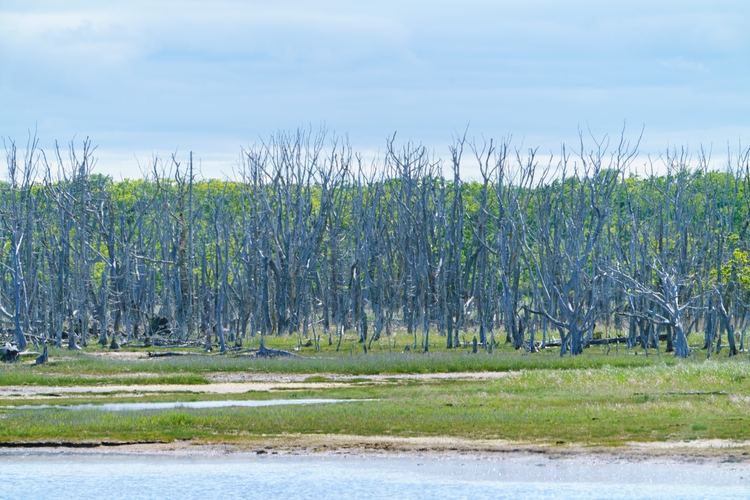
Ghost forests are groups of dead and dying trees that have drowned due to encroaching seawater. Across the course of a few decades, exposure to seawater can cause vast amounts of previously healthy forest cover to die.
Although they form in coastal areas worldwide, much of the research on ghost forests focuses on the mid-Atlantic coast of the USA. This is largely due to the physical geography, where the land is sinking, causing relative sea-level rise to accelerate. In addition, the shallow coastal plain is more liable to flooding, and a high concentration of human-made features, such as canals and ditches, has enabled saltwater to be carried inland during storms and high tides.
Since the late 19th century, more than 100,000 acres of forest have been lost along the coast of the USA, with thousands more at risk today. In the Alligator National Wildlife Refuge on the Albermarle-Pamlico Peninsula, which is an area of 152,000 acres untouched by logging or development, more than 10 per cent of the area’s tree cover became a ghost forest between 1985 and 2019.
Trees can stay standing long after their death. This creates a vivid picture of decaying trees in coastal areas.
Enjoying this article? Check out our related reads:
Why are they getting more prevalent?
Climate change is causing rising sea levels. Global average sea level has risen between eight and nine inches since 1880; in addition to this, an increase in the frequency and severity of floods has been recorded. Both lead to saltwater intrusion into coastal areas, which proves deadly to forests upon contact.
Climate change also increases the risk of droughts, which increases the prevalence of ghost forests. This is because of the shifting of the water table along the coastline. Due to freshwater scarcity, droughts create more space for saltwater to intrude farther inland through groundwater.
How can ghost forests impact coastal resilience to climate change?
Ghost forests have interesting effects on coastal resilience to climate change, and they can represent hidden shifts in how trees process carbon and nutrients underground.
The key to this understanding lies with the study of stemflow – the water that travels down branches and trunks. Stemflow can be useful for understanding the changes forest ecosystems undergo.
A research team from the University of Delaware has been investigating ghost forests along the mid-Atlantic coastline to better understand the environmental impacts they cause. They studied stemflow from healthy, dead, and stressed sweetgum trees, and their findings showed that significantly less stemflow reached the forest floor from dead trees.

‘Suddenly, you cut off water, nutrients and dissolved organic carbon to the forest floor. Not only is this changing the health of the trees, but it changes the health of the forest floor,’ said one of the supervisors of the study, Yu-Ping Chin.
These modifications in the carbon cycle are important because forest floors are crucial stores for carbon dioxide. When natural cycles are disrupted by ghost forests, more harmful impacts are bound to be felt.
Forests are vital sinks for carbon dioxide and often store much more carbon than the wetlands which succeed them. As forests become ‘ghost forests’, this loss of carbon sequestration shows how they are worsening climate change itself.
However, salt marshes, which often replace ghost forests over time, can provide numerous benefits, including flood protection and habitat. Interestingly, they can sometimes sequester a significant quantity of carbon dioxide, and in some cases like along coastal rivers in Southern Georgia, the amount of sequestered carbon can be higher in comparison with the former tidal forests.