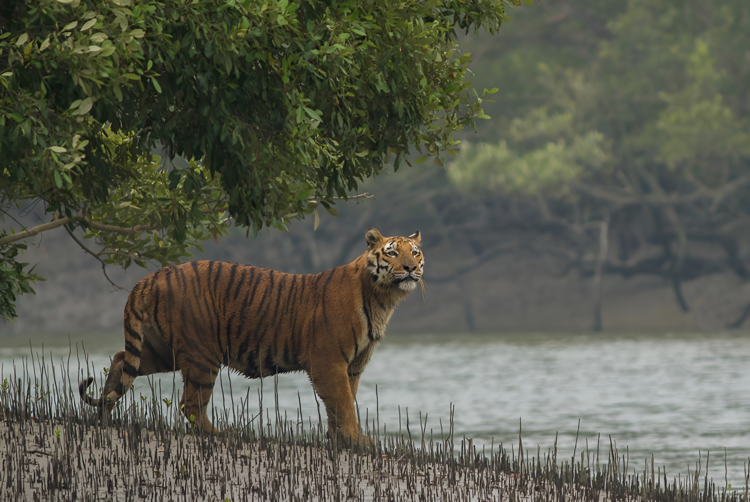
Rising seas are eating away at the Sundarbans – and pushing its tigers ever closer to human settlements
Photographs and words by
‘I could see my hand inside the mouth of the tiger!’ exclaims Abu Saleh. ‘I’d gone into the forest on my boat at low tide to fish. I was alone, but there was another boat nearby. I laid out my fish traps, anchored up by the riverbank and waited for the rising tide to bring the fish into my traps.’ Sitting on the wooden terrace of his blue tin house, Saleh looks out across waterlogged fields as he speaks.
The air has a tinge of salt to it. Locals say that every year, the water gets saltier, the flooding gets worse, the cyclones more violent and the tigers closer. ‘I had my back to the forest when the tiger pounced and dug its claws into my shoulders. I spun around and looked right into its eyes. I immediately hit it with my elbow, and it fell into the mud.’ Saleh’s voice rises a notch or two as he describes those harrowing few moments. ‘A second later, it attacked again, and that’s when it managed to get my hand into its mouth.’
Enjoying this article? Check out our related reads…
Covering 10,000 square kilometres of Bay of Bengal coastline along the India–Bangladesh border, the Sundarbans, the world’s largest mangrove forest, is a formidable place. Hundreds of river channels criss-cross a forest of tightly interlocking trees, and at low tide, millions of spiky roots jut up out of the mud like a perverse medieval torture instrument. Adding further to the fear factor are the huge crocodiles, giant snakes and a population of Bengal tigers with a chilling reputation for eating people.
‘I had a stick in my other hand and I started to hit the tiger as hard as I could. After clawing and biting me, the tiger finally let go and ran into the forest.’ Pausing, Saleh turns to look behind him towards the mangroves. Perhaps he was checking that the tiger wasn’t listening. ‘I don’t know why, but I chased after it. It attacked me again, and for 30 minutes we fought. As it bit and clawed, I hit it again and again with all my strength until it backed off. I never cried out. I just battled the tiger. But when it finally let me go, then I shouted for help.
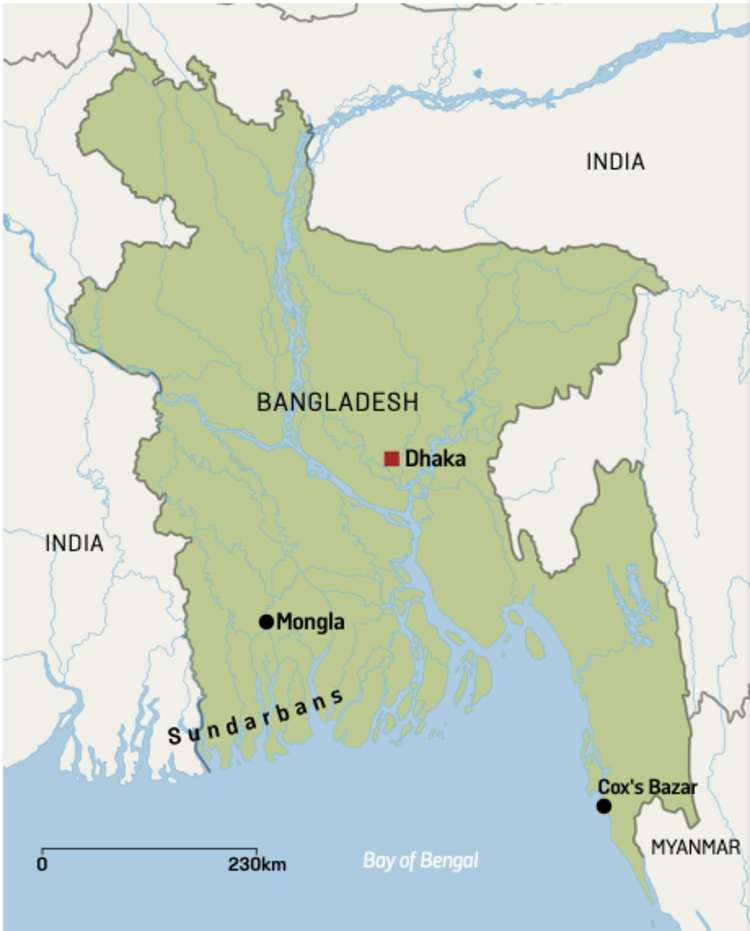
I was covered in blood – mine and the tiger’s. Another fisherman heard me and came to help.’
It’s not just tigers that call the Sundarbans home. Just over seven million people, many of whom are subsistence farmers and fishermen living below the poverty line, also depend on the mangrove forest for their livelihood. By heading into the forest to fish, gather firewood or even search for honey, people and tigers have long come into contact and conflict. Now, though, many locals say that as the waters rise and the Sundarbans drowns, the situation is getting worse. ‘I wasn’t the only one around here who was attacked by a tiger last year,’ Saleh told me. ‘Anukul, who was from a nearby village, was killed by a tiger, and over the last few years, there have been many attacks.’
There are thought to be somewhere between 400 and 450 tigers in the Sundarbans, which makes for one of the highest population densities of these big cats anywhere in the world. Showing that the reputation is well-founded, in 2023, a report was published claiming that between 2000 and 2022, about 300 people had been killed, and many more injured, by tigers in just the Bangladeshi half of the Sundarbans.
Jajanti Biswas’s husband was just one in this long line of fatal statistics. Dressed in a scorching red and blue sari, the 35-year-old keeps her head bowed as she tells me of the day a tiger changed her life forever. ‘My husband, Shapan, was a crab fisherman. At the time of the attack, we had been married for seven years and had two children together. One day, my husband went fishing for crabs. He was with four other people. They all fished separately but kept close to one another. The tiger came from behind. They always do. My husband shouted for help and the other people he was with came running, but it was all over very quickly. The tiger had killed him.’
There is less and less forest
Quite why the tigers of the Sundarbans have gained such a taste for humans isn’t totally understood. In the past, studies concluded that it was due to the high salinity in the water altering the tiger’s temperament. Today, that theory has been largely discarded, and it’s now thought that the low density of prey, combined with difficult terrain and a comparatively high number of people entering the forest, means that humans are an enticingly easy target for a hungry tiger.
And things might be about to get worse. ‘I grew up here, and over the past ten years I have seen the water level rise a lot,’ says Saleh. ‘There’s less land and less forest. It’s all vanishing under the water. I don’t know why. Maybe India has opened the dams upriver and is trying to flood Bangladesh?’ He adds as an afterthought, ‘We are also getting more powerful cyclones, which are destroying more of the forest.’
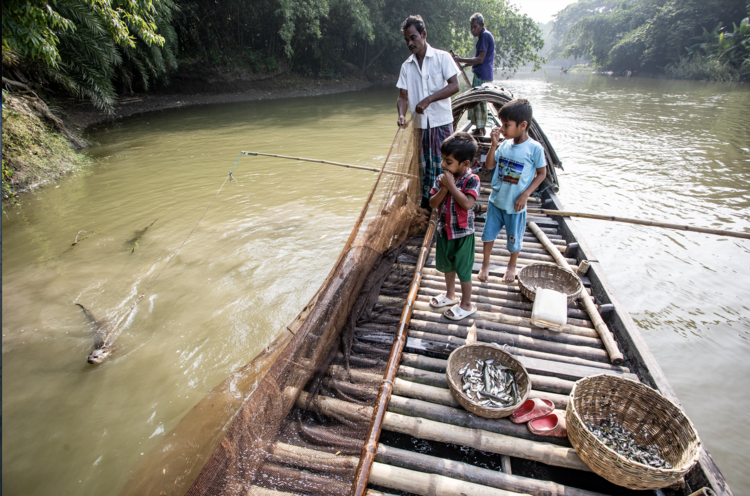
While Saleh might be mistaken about India trying to flood Bangladesh, he’s certainly right about the water levels rising and the cyclones becoming more powerful. Sea-level rises, resulting from human-caused climate change, as well as other man-made environmental crises, are fast eating away at the Sundarbans and pushing the tigers ever closer to human habitation, resulting in more conflict – often with deadly results.
A 2023 report by the World Meteorological Organization stated that since the 1990s, sea-level rises in the Bay of Bengal have been 30 per cent higher than the global average. At the same time, NASA Landsat satellite imagery has revealed that the sea level in the Sundarbans has risen by an average of three centimetres a year since the start of this century. With the Sundarbans having a mean elevation of less than one metre above sea level, those few centimetres matter.
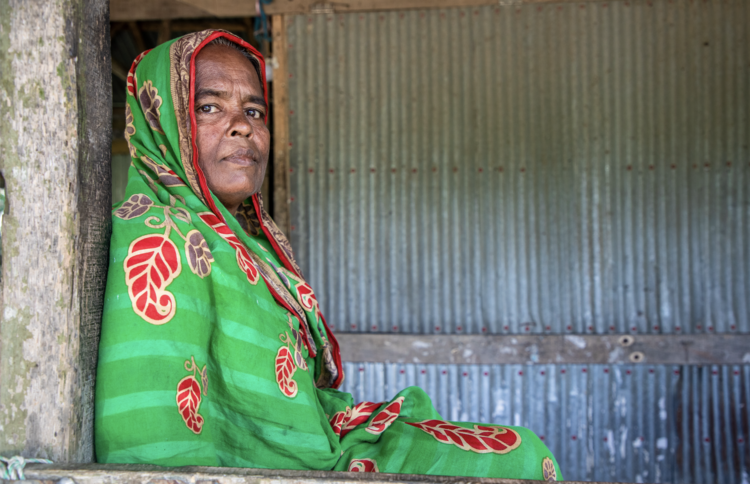
Parul Beer’s husband was killed in a tiger attack. She says that after the event, she got ‘no support from the community. People thought I had brought bad luck on my husband.’ She tells me that three months after she lost her husband, her son was killed in a car accident. With no other way of earning money, she now has to go into the forest herself to fish. Despite the hardships the tiger has brought her, she says: ‘The tiger is not my enemy, but losing a loved one to a tiger is hard’
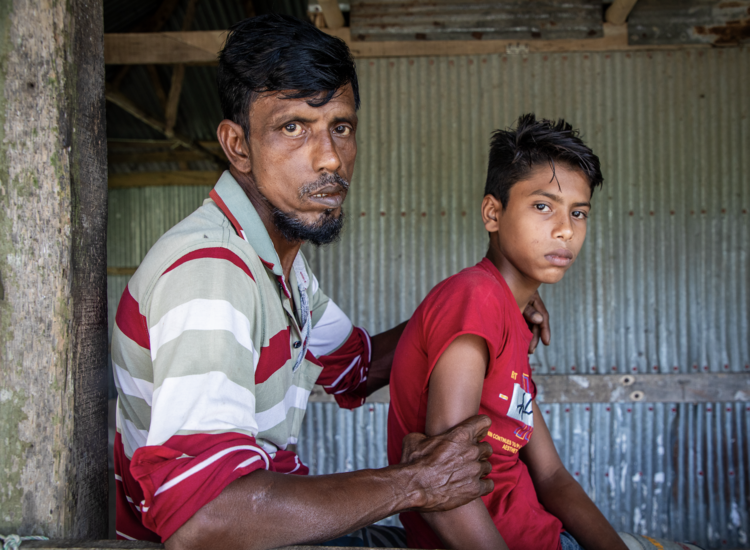
Nurezzaman Sana was attacked by a tiger in 2011 while out collecting wood. ‘It got its jaws around the back of my neck.’ He told me his wife doesn’t want him to work in the forest, but that financially he has no other option. His son, Mustakim Sana (pictured), says he worries about his father when he goes into the forest
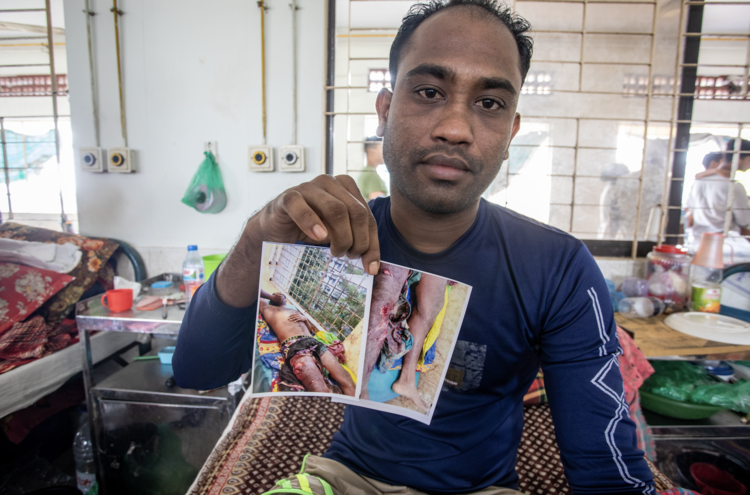
It’s not just tigers that are being forced into closer proximity to people as the waters rise. Saiful was attacked by a crocodile in a part of the Sundarbans where such large crocodiles had never been seen before. The huge reptile grabbed him by the leg and tried to pull him under while his friends held him by the arm and tried to pull him back onto the boat. He told me the ordeal lasted for half an hour. Here he holds some photos showing the extent of his injuries
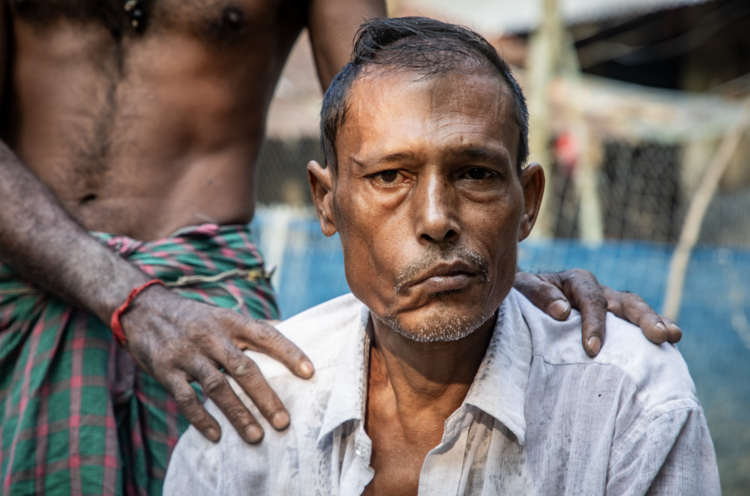
Shusanta was mauled by a tiger that later on the same day killed his mother. His brother (who has his hands on Shusanta’s shoulders in this picture) helped rescue Shusanta

Daben Mondal told me that he, like many people here, would pray to Bonobibi, the spirit of the forest, for protection against tiger attacks. But for him it wasn’t enough and he became another tiger victim. ‘I’ve never been back into the forest again’

Jajanti Biswas’s husband was killed by a tiger. ‘I wasn’t scared about this happening to him,’ she says. ‘It’s part of life here. But, I would never let my son go and work in the forest. It’s too dangerous’
The rising sea levels are also bringing salt. Soil salinity has increased dramatically in recent years. In the Bangladeshi Sundarbans, on average, soil salinity increased sixfold (and up to 15 times in some areas) in the 30 years between 1984 and 2014. Not only is this increased salinity rendering agricultural land useless, it’s also killing the forest itself. The sundari tree is the most common type of tree in the Sundarbans, but the number of these trees, which need low salinity levels to survive, has decreased by 76 per cent in 70 years.
Climate change isn’t just bringing rising levels of water and salt to this delicate ecosystem. It’s even making the weather angrier. At certain times of year, the Bay of Bengal is placid and still, but at other times (notably March to July and September to December) it can turn into a funnel for powerful tropical cyclones that bring storm surges and winds of up to 200km/h smashing into the coast. Mangrove forests are very adept at absorbing the anger of cyclones and their associated storm surges.
But, even so, there’s a limit to what a mangrove forest can handle. Studies have revealed that cyclones, which feed off warm waters, are growing in ferocity thanks to significant increases in sea-surface temperatures in the Bay of Bengal. Studies conducted in the Indian part of the Sundarbans have revealed that between 1980 and 2007, the increase in sea-surface temperatures was around eight times higher than the global average.
This has led to ever more destructive cyclones. Take Cyclone Amphan, the most powerful recorded cyclone ever to hit the Bay of Bengal, as an example. When it roared into the Sundarbans in May 2020, it’s estimated to have destroyed 28 per cent of the Indian Sundarbans region.
And the bad news doesn’t stop there. Shrinking glaciers in the Himalaya, as well as upriver dam construction, is leading to a reduction in the amount of river sediment flowing into the Sundarbans. This, in turn, is resulting in a loss of landmass, which in some coastal locations is as much as 40 metres a year.
Combine all of these factors together and so serious is the threat to the Sundarbans, which is a UNESCO World Heritage site and vital carbon sink, that a recent study predicted that by 2070, the Sundarbans would no longer contain any suitable tiger habitat. While there probably isn’t all that much that Bangladesh (which accounts for only 0.56 per cent of global carbon emissions) can do on its own to prevent global warming, state and private projects aiming to reduce conflict with tigers and slow the destruction of the forest are underway across the Sundarbans.
At the state level, in 2023, the Bangladeshi government announced an ambitious plan to install nylon-net fencing in areas where human habitation and the forest meet. The hope is that the fence will mean that tigers and humans will be less likely to come into contact. The authorities have reason to be confident that this will work because in the Indian part of the Sundarbans, such a technique is already in use, and it has led to a dramatic fall in the number of human–tiger encounters. In addition to the fence, 49 tiger response units have been established, whose job it is to monitor tigers and scare them back into the forest when they get too close to villages.
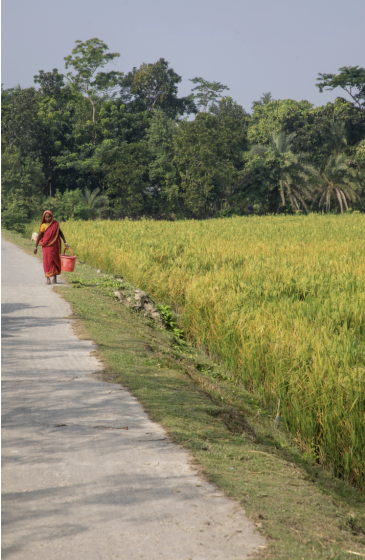
While installing fences is a great way of preventing tigers from entering villages and attacking people (although it does little to protect people when they venture into the forest to fish), it doesn’t solve the real problem of a rapidly vanishing forest.
‘It takes about two months for the mangrove saplings to be ready,’ Namita Mondol tells me as we walk around the riverside mangrove nursery she has set up with the help of BEDS (Bangladesh Environmental and Development Society), a local NGO that focuses on mangrove restoration. ‘After they’re ready, I sell the saplings back
to BEDS, who plant them in areas where the mangrove forest has been damaged. Before BEDS came along, everyone here just made money from fishing, which was dangerous because we had to go out into the forest. But today I make much more money from looking after the saplings and I’m so busy that there are now 20 of us – all women – looking after the trees.’
As Namita bends down to fuss over one of her saplings, Sheikh Faisal Ahmed, a field coordinator for BEDS, interjects: ‘So far, we have planted well over a million mangrove trees. We plant them in areas that have been degraded so that the forest can re-grow and help protect that land from cyclones and flood waters. It’s helping to mitigate some of the forest losses elsewhere.’
And BEDS isn’t alone in trying to replace lost forest. In the Indian Sundarbans, more than 16 million mangrove trees have already been planted by other NGOs, and 100 hectares of forest have been restored.
The rich countries should stop
It was the end of the afternoon. The heat of the day was receding and the light had taken on the orange hue of a tiger’s fur. A group of children played cricket in a dusty clearing and a flock of ducks quacked and splashed in a nearby pond. I was sitting with Shusanta and his brother Pinto in a garden full of fruit trees. A crowd of neighbours and friends had gathered around to listen as Shusanta described how he had been attacked by a tiger and, later the same day, his mother had been killed by the very same tiger. The tale ended with Shusanta repeating what so many others had already told me: ‘The tigers are coming closer because every year the water is rising. I think it’s because of silt building up in the canals and rivers.’

When I suggested that it might be more to do with man-made climate change leading to sea-level rises, I was met with blank looks from the assembled group. Of the 12 people who had been listening in on our conversation, none of them had ever heard of climate change – the very thing that was causing their world to drown and the cats to attack.
After considering what I had said for a few moments, Shusanta spoke up for the whole group. ‘We are from here. We live and breathe the oxygen of the Sundarbans. The Sundarbans is our mother and the house of the tiger. And so, I think the rich countries should stop destroying the Sundarbans with their climate change.’